




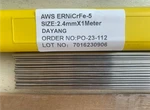
Stainless Steel Electrode
How to choose stainless steel welding rod?
Stainless steel electrodes are specialized consumables designed for arc welding processes, providing exceptional corrosion resistance, mechanical strength, and aesthetic weld appearance. Our product range includes multiple series tailored for different stainless steel grades and welding applications, ensuring high-quality welds in industries such as chemical processing, food manufacturing, medical equipment, and aerospace.


Product Series
1. Austenitic Stainless Steel Electrodes
E308L-16 Stainless Steel Electrode
Product Features: - Rutile coating for stable arc and easy slag removal - Low carbon content (≤0.03%) for excellent intergranular corrosion resistance - Suitable for welding 304, 304L stainless steel
Technical Parameters:
|
Diameter (mm) |
Welding Current (A) |
Tensile Strength (MPa) |
Impact Energy (J) |
|
2.5 |
60-80 |
≥550 |
≥60(-196°C) |
|
3.2 |
80-110 |
≥550 |
≥60(-196°C) |
|
4.0 |
110-160 |
≥550 |
≥60(-196°C) |
Typical Applications: - Food processing equipment - Medical devices - Architectural stainless steel structures - Chemical containers
E316L Stainless Steel Electrode
Product Features: - Molybdenum-alloyed for enhanced pitting resistance - Excellent weldability in all positions - Suitable for welding 316, 316L stainless steel
Technical Parameters:
|
Diameter (mm) |
Current Range (A) |
Hardness (HV) |
Corrosion Resistance |
|
3.2 |
80-110 |
≤220 |
Excellent in chloride environments |
|
4.0 |
110-150 |
≤220 |
Excellent in chloride environments |
Typical Applications: - Marine engineering - Chemical processing - Pharmaceutical equipment - Food and beverage industry
2. Duplex Stainless Steel Electrodes
E2209 Duplex Stainless Steel Electrode
Product Features: - 22% chromium, 9% nickel composition - Excellent resistance to stress corrosion cracking - Suitable for 2205, 2507 duplex stainless steels
Technical Parameters:
|
Diameter (mm) |
Welding Current (A) |
Tensile Strength (MPa) |
Impact Energy (J) |
|
3.2 |
90-120 |
≥690 |
≥47(-40°C) |
|
4.0 |
120-160 |
≥690 |
≥47(-40°C) |
Typical Applications: - Oil and gas industry - Desalination plants - Pulp and paper manufacturing - Chemical processing
Welding Process Guide
Pre-Welding Preparation
Surface Preparation:Thoroughly clean the workpiece surface from impurities such as oil stains and rust.Electrode Drying:
- Austenitic electrodes: 250-300°C for 1 hour
- Low hydrogen electrodes: 350-400°C for 1-2 hours
Joint Design: Use appropriate groove design based on material thickness:
- V-groove for 3-12mm thickness
- U-groove for thickness >12mm
Recommended Parameters
|
Material Thickness (mm) |
Electrode Diameter (mm) |
Current (A) |
Travel Speed (mm/min) |
|
1.5-3 |
2.5 |
60-80 |
150-200 |
|
3-8 |
3.2 |
80-110 |
120-200 |
|
8-16 |
4.0 |
110-160 |
100-180 |
FAQ
Q1: What is the difference between 304 and 316 stainless steel electrodes?
A1: 304 electrodes are general-purpose for 18-8 stainless steels, while 316 electrodes contain molybdenum for enhanced resistance to pitting corrosion in chloride environments.
Q2: How to select the correct electrode diameter?
A2: Choose based on material thickness: 2.5mm for ≤3mm material, 3.2mm for 3-8mm, and 4.0mm for >8mm thickness.
Q3: What causes porosity in stainless steel welding?
A3: Porosity is typically caused by:
1. Moisture in the electrode coating
2. Contaminated workpiece surface
3. Incorrect shielding gas flow rate
Q4: Can stainless steel electrodes weld carbon steel?
A4: While possible, it’s not recommended as it will compromise corrosion resistance. Use E309L electrodes specifically designed for dissimilar welding.
Q5: What is the correct drying procedure for stainless steel electrodes?
A5: Standard drying parameters:
- Rutile electrodes: 250-300°C for 1 hour
- Low hydrogen electrodes: 350-400°C for 1-2 hours
- Store dried electrodes at 80-100°C until use
Q6: How to prevent intergranular corrosion in stainless steel welds?
A6: Key measures include:
1. Use low-carbon electrodes (L-grade)
2. Control interpass temperature below 150°C
3. Post-weld heat treatment at 800-850°C
Q7: What is the effect of welding speed on stainless steel welding?
A7: Optimal speed: 150-250mm/min. Too fast causes insufficient penetration; too slow increases heat input and distortion.
Q8: Can stainless steel electrodes be used for aluminum welding?
A8: No, aluminum requires specialized aluminum electrodes due to different metallurgical requirements.
Q9: What is the significance of the “L” in E308L electrodes?
A9: “L” indicates low carbon content (≤0.03%), preventing carbide precipitation and improving corrosion resistance.
Q10: How to handle welding of stainless steel in cold weather?
A10: Preheat to 80-150°C when ambient temperature <0°C, maintain interpass temperature ≥100°C, and use low hydrogen electrodes.
Q11: What is the difference between AC and DC welding for stainless steel?
A11: DC+ (direct current electrode positive) provides better arc stability and penetration control compared to AC welding.
Q12: How to repair stainless steel weld defects?
A12: Defects must be completely removed, groove prepared, and repaired with matching electrodes following WPS requirements.
Q13: What is the service life of stainless steel electrodes?
A13: 2 years from production date when stored properly in sealed containers with ≤60% humidity.
Q14: Can stainless steel electrodes weld galvanized steel?
A14: Yes, but requires thorough cleaning of zinc coating and use of E309L electrodes designed for dissimilar welding.
Q15: What is the effect of electrode coating on arc stability?
A15: Rutile coatings provide best arc stability; cellulosic coatings offer deep penetration; low hydrogen coatings provide crack resistance.
Q16: How to identify electrode types by color coding?
A16: Common color codes:
- Green: Pure tungsten electrode
- Gray: Cerium-tungsten electrode
- Blue: Lanthanum-tungsten electrode
Q17: What is the maximum interpass temperature?
A17: Maintain interpass temperature ≤150°C for austenitic stainless steel to prevent carbide precipitation.
Q18: Can stainless steel electrodes be used for root pass welding?
A18: Yes, E308L-16 and E316L-16 are excellent choices for root pass with proper back purging.
Q19: How to prevent weld discoloration?
A19: Control heat input, use argon shielding, and implement post-weld passivation treatment.
Q20: What is the difference between AWS and GB standards for stainless steel electrodes?
A20: AWS focuses on mechanical properties while GB emphasizes manufacturing processes and safety requirements.
Q21: How to select electrodes for high-temperature applications?
A21: Choose nickel-based electrodes with high creep resistance, such as ENiCrFe-3 for elevated temperature service.
Q22: What causes weld spatter and how to reduce it?
A22: Spatter is caused by incorrect current or arc length. Solutions: adjust parameters and use anti-spatter compounds.
Q23: Can stainless steel electrodes weld in windy conditions?
A23: Wind speeds >8m/s require wind barriers or flux-cored electrodes with self-shielding capability.
Q24: What is the effect of electrode storage on performance?
A24: Moisture absorption causes unstable arc and porosity. Store in sealed containers with desiccants.
Q25: How to select electrodes for cryogenic applications?
A25: Choose electrodes with guaranteed impact toughness at service temperature, e.g., E308L for -196°C service.
Q26: What is the difference between ER308 and E308L electrodes?
A26: ER308 is solid wire for GMAW; E308L is covered electrode for SMAW process with lower carbon content.
Q27: How to prevent hydrogen-induced cracking?
A27: Key measures: use low hydrogen electrodes, proper preheating, and controlled cooling rate.
Q28: Can stainless steel electrodes weld in all positions?
A28: Yes, “1” in the fourth position of AWS classification (e.g., E308L-16) indicates all-position capability.
Q29: What is the effect of welding speed on bead appearance?
A29: Optimal speed: 150-250mm/min for good fusion and appearance without burn-through or overlap.
Q30: How to handle welding of thick stainless steel sections?
A30: Use multi-pass technique with interpass temperature control and low hydrogen electrodes for crack prevention.
Q31: What is the correct polarity for stainless steel welding?
A31: DC+ (direct current electrode positive) is recommended for best arc stability and penetration.
Q32: How to select electrodes for dissimilar metal welding?
A32: Use E309L electrodes for joining stainless steel to carbon steel.
Q33: What is the effect of electrode extension on arc stability?
A33: Optimal extension: 15-20mm for stainless steel electrodes to maintain arc stability.
Q34: Can stainless steel electrodes be used for surfacing welding?
A34: Yes, select electrodes with matching chemical composition and mechanical properties.
Q35: How to verify electrode quality upon receipt?
A35: Check for: intact packaging, clear labeling, and certification documents meeting AWS A5.4 standards.
Q36: What is the effect of moisture on stainless steel electrodes?
A36: Moisture causes porosity and hydrogen-induced cracking; store in moisture-proof containers.
Q37: How to select electrodes for high-strength applications?
A37: Choose E7018 or E8018 electrodes with minimum 70,000 psi tensile strength.
Q38: What is the difference between AWS A5.4 and ISO 14341 standards?
A38: AWS focuses on mechanical properties; ISO emphasizes manufacturing processes and safety requirements.
Q39: Can stainless steel electrodes weld in vacuum environments?
A39: Specialized vacuum welding electrodes are required, not standard stainless steel electrodes.
Q40: How to document welding procedure qualifications?
A40: Essential documents include WPS, PQR, and inspection records following ASME BPVC standards.