




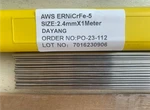
Flux Coated Brazing Alloys
How to choose the right flux coated brazing alloys?
Flux coated brazing alloys are high-performance brazing materials composed of a brazing filler metal core and a surface flux coating. The flux can remove oxides on the surface of base metals during brazing and prevent re-oxidation, ensuring the formation of firm and reliable brazed joints. They are widely used in high-demand industrial fields such as automotive manufacturing, electrical and electronic engineering, aerospace, and refrigeration equipment.
Product Categories and Models
According to different chemical compositions and application scenarios, flux coated brazing alloys can be divided into multiple types, such as silver-based, copper-based, nickel-based, aluminum-based, etc. Specific models include but are not limited to:
BAg-3 (flux coated)
Suitable for brazing of copper, copper alloys, and low-carbon steel, with excellent fluidity and wettability.
01
BCuP-6 (flux coated)
Used for brazing of copper and copper alloys, especially suitable for refrigeration pipeline connections and water tank brazing.
02
BNi-1 (flux coated)
Applicable to brazing of nickel-based alloys, stainless steel, and high-temperature alloys, with good high-temperature strength and oxidation resistance.
03
BAlSi-5 (flux coated)
Suitable for brazing of aluminum and aluminum alloys, with strong corrosion resistance in atmospheric environments.
04


Performance Characteristics
Oxide removal capability
The flux coating can effectively remove oxides on the surface of base metals, ensuring that the brazing filler metal fully wets and spreads on the base metal surface.
Brazed joint performance
The brazed joints formed by flux coated brazing alloys have high mechanical strength, good airtightness, and stable electrical conductivity (for electrical connection scenarios).
Process adaptability
Suitable for various brazing processes, including torch brazing, furnace brazing, induction brazing, etc., meeting different production needs.
Operational convenience
The integration of brazing filler metal and flux eliminates the need for separate flux application, simplifying the operation process and improving work efficiency.
Application Areas
Automotive Industry
Used for brazing of radiator cores, air conditioning condensers, and brake system components, ensuring efficient heat transfer and structural stability.
Electrical and Electronic Engineering
Applied to brazing of motor windings, transformer leads, and connector terminals, relying on stable electrical conductivity to ensure current transmission.
Aerospace
Used for brazing of precision parts such as aircraft hydraulic pipelines and sensor components, with brazed joints that can withstand high temperature and high pressure environments.
Refrigeration Equipment
Suitable for brazing of refrigeration pipelines and evaporators, ensuring good airtightness to prevent refrigerant leakage.
FAQ
Q1: What is flux coated brazing alloy?
A1: Flux coated brazing alloy is a brazing material with a brazing filler metal (such as silver-based, copper-based alloys) as the core and a flux coating on the surface. The flux plays a role in removing oxides and preventing re-oxidation during brazing, and it is widely used in brazing scenarios with high joint quality requirements.
Q2: What is the difference between flux coated brazing alloys and ordinary brazing filler metals?
A2: In terms of composition, flux coated brazing alloys have a surface flux coating, while ordinary brazing filler metals are single brazing materials without flux; in terms of operation, flux coated brazing alloys can be used directly without additional flux, while ordinary brazing filler metals require separate flux application; in terms of effect, flux coated brazing alloys ensure uniform flux distribution, reducing the risk of insufficient or excessive flux, and the brazing quality is more stable.
Q3: How to choose flux coated brazing alloys according to the use environment?
A3: In high-temperature environments, select nickel-based flux coated brazing alloys with high-temperature resistance; in humid or corrosive environments (such as coastal areas), prioritize copper-based or silver-based alloys with good corrosion resistance; for electrical connection scenarios, choose alloys with stable electrical conductivity, such as silver-based flux coated brazing alloys.
Q4: What brazing methods are suitable for flux coated brazing alloys?
A4: Common methods include torch brazing, furnace brazing, induction brazing, and resistance brazing. Torch brazing is suitable for small workpieces and on-site operations; furnace brazing is applicable to batch brazing of complex components; induction brazing is suitable for local heating of parts with high precision requirements.
Q5: What pretreatment is required for the base metal before brazing with flux coated brazing alloys?
A5: Thoroughly remove oil, rust, dust, and oxide films on the surface of the base metal. Mechanical methods (such as sandblasting, grinding) or chemical methods (such as pickling) can be used; for parts with high precision, alcohol or acetone can be used for degreasing to avoid affecting the wettability of the brazing filler metal.
Q6: What defects are prone to occur when brazing with flux coated brazing alloys?
A6: Common defects include incomplete wetting (brazing filler metal does not spread evenly), porosity (small holes in the joint), slag inclusions (residual flux or oxides), and cracks (caused by excessive stress). Incomplete wetting is mainly due to insufficient base metal cleaning or inappropriate brazing temperature; porosity is often caused by gas entrapment during brazing.
Q7: How to prevent incomplete wetting when brazing with flux coated brazing alloys?
A7: Ensure the base metal surface is thoroughly cleaned to remove all oxides and contaminants; control the brazing temperature within the recommended range (too low reduces fluidity, too high causes flux failure); design a reasonable brazing gap (generally 0.05-0.2mm) to facilitate the spread of the brazing filler metal.
Q8: How to choose the brazing temperature when using flux coated brazing alloys?
A8: The brazing temperature should be 30-50℃ higher than the melting point of the brazing filler metal core but lower than the melting point of the base metal. For example, BAg-3 (melting point 600-650℃) is usually brazed at 630-700℃; BNi-1 (melting point 1050-1100℃) is brazed at 1080-1150℃.
Q9: What are the storage conditions for flux coated brazing alloys?
A9: They should be stored in a dry and ventilated environment with a temperature of 15-30℃ and relative humidity not exceeding 60%; avoid contact with water, corrosive gases, and direct sunlight; keep the packaging sealed, and return unused alloys to a moisture-proof container in time.
Q10: Is post-brazing treatment required after brazing with flux coated brazing alloys?
A10: In most cases, yes. Residual flux on the joint surface may cause corrosion, so it should be cleaned with hot water, ultrasonic cleaning, or special cleaning agents; for high-precision parts, polishing can be performed to remove burrs; for high-temperature service parts, stress relief annealing may be required.
Q11: Can different types of flux coated brazing alloys be mixed?
A11: In principle, no. Different types have different melting points, flux compositions, and performance. Mixing may cause uneven melting, flux failure, and unqualified joints. Special cases require brazing process assessment to verify feasibility.
Q12: How to control the brazing gap when using flux coated brazing alloys?
A12: The gap should be determined according to the alloy type and base metal. For high-fluidity alloys (such as silver-based), a small gap (0.05-0.2mm) is suitable; for copper-based alloys with lower fluidity, the gap can be 0.1-0.3mm; use fixtures to fix the workpiece during brazing to prevent gap changes due to thermal deformation.
Q13: What causes flux failure when brazing with flux coated brazing alloys?
A13: Possible reasons include excessive storage humidity causing flux to absorb moisture and deteriorate; excessively high brazing temperature leading to flux volatilization or decomposition; or expired alloys, as flux loses activity over time.
Q14: How to test the performance of brazed joints formed by flux coated brazing alloys?
A14: Tensile and shear tests detect mechanical strength; airtightness tests (such as pressure tests, helium leak detection) check sealing performance; metallographic analysis observes internal structures (e.g., slag inclusions, porosity); for electrical brazing, conductivity tests are required.
Q15: How to select flux coated brazing alloys when brazing dissimilar metals?
A15: Consider the melting points of both base metals to ensure the brazing temperature is lower than both; select alloys whose brazing filler metal can wet both base metals; ensure flux compatibility with both to avoid harmful reactions. For example, brazing copper and stainless steel uses silver-based flux coated brazing alloys.
Q16: Can flux coated brazing alloys still be used after being damp?
A16: Slightly damp alloys can be used after drying at 80-100℃ for 1-2 hours, but flux activity may decrease; severely damp alloys (with caked or discolored flux) may cause pores or cracks and are recommended to be scrapped.
Q17: How to reduce brazing deformation when using flux coated brazing alloys?
A17: Use low-temperature brazing alloys to reduce thermal stress; adopt symmetrical brazing sequences for even heating; fix workpieces with fixtures during brazing; for thin-walled parts, use induction brazing with fast heating/cooling.
Q18: How to deal with slag inclusions in brazed joints when using flux coated brazing alloys?
A18: First, remove slag inclusions by mechanical methods (e.g., grinding); re-clean the brazing area; select new alloys and re-braze with appropriate temperature and heating speed; perform performance tests after re-brazing.
Q19: What is the effect of brazing time on joint quality when using flux coated brazing alloys?
A19: Too long a brazing time may cause excessive flux volatilization, reduced activity, and increased oxidation risk; too short a time may result in insufficient wetting and incomplete spreading of the brazing filler metal. The time should match the temperature and be controlled according to the alloy specification.
Q20: How to improve the airtightness of brazed joints when using flux coated brazing alloys?
A20: Select alloys with good fluidity to ensure full filling of the brazing gap; control brazing temperature and time to avoid pores; thoroughly clean the base metal to prevent contaminants affecting sealing; perform post-brazing airtightness tests and rework if necessary.
Q21: What should be paid attention to when brazing with flux coated brazing alloys in high-humidity environments?
A21: Preheat workpieces and alloys to remove moisture; strengthen ventilation to reduce environmental humidity; use moisture-resistant flux coated alloys; shorten alloy exposure time in air to avoid moisture absorption.
Q22: What is the difference between flux coated brazing alloys and flux-cored brazing wires in use?
A22: Flux coated brazing alloys have surface flux, suitable for small-diameter and precision brazing; flux-cored wires have internal flux, with higher flux content, suitable for large-area brazing. The former is convenient for manual operation; the latter is often used in automatic equipment.
Q23: How to handle uneven brazed joint formation when using flux coated brazing alloys?
A23: Check and adjust the heating method to ensure uniform heating of the brazing area; adjust the brazing angle to make the alloy flow evenly; replace worn fixtures that cause workpiece position deviation; select alloys with appropriate fluidity according to the joint shape.
Q24: What is the impact of base metal surface roughness on brazing with flux coated brazing alloys?
A24: Excessively rough surfaces may trap contaminants, affecting wetting; too smooth a surface may reduce the brazing filler metal's adhesion. The roughness should be moderate (generally Ra 1.6-6.3μm) to balance cleaning and adhesion.
Q25: How to choose flux coated brazing alloys for high-pressure pipeline brazing?
A25: Prioritize alloys with high mechanical strength (such as nickel-based or copper-phosphorus alloys); select those with good fluidity to ensure full gap filling; ensure compatibility with the pipeline material to resist medium corrosion; test joint pressure resistance after brazing.
Q26: What causes brazing filler metal to "run off" (excessive flow) when using flux coated brazing alloys?
A26: It may be due to too large a brazing gap, causing uncontrolled flow; too high a temperature increasing fluidity; or excessive heating in local areas, making the alloy flow to low-temperature zones.
Q27: How to evaluate the corrosion resistance of brazed joints formed by flux coated brazing alloys?
A27: Conduct salt spray tests to simulate atmospheric corrosion; perform immersion tests in corrosive media (e.g., acids, alkalis) to observe corrosion conditions; analyze surface corrosion morphology through metallography; compare with standard corrosion rates for evaluation.
Q28: What is the effect of flux coating thickness on brazing with flux coated brazing alloys?
A28: Too thick a coating may cause excessive residual flux and slag inclusions; too thin a coating may result in insufficient oxide removal and poor wetting. The thickness should be uniform and meet the alloy's factory specifications.
Q29: How to select flux coated brazing alloys for electrical component brazing?
A29: Choose alloys with high electrical conductivity (such as silver-based); ensure low contact resistance of joints; select low-temperature brazing alloys to avoid damaging component insulation; ensure joints have sufficient mechanical strength.
Q30: What is the reason for joint brittleness after brazing with flux coated brazing alloys?
A30: It may be due to over-high brazing temperature causing grain coarsening; excessive diffusion between the brazing filler metal and base metal; or flux residue reacting with the base metal. Post-brazing annealing can reduce brittleness.
Q31: How to control the heating rate when brazing with flux coated brazing alloys?
A31: The rate should be moderate: too fast may cause uneven temperature distribution and local overheating; too slow may lead to flux premature volatilization. Adjust according to the workpiece thickness—faster for thin workpieces, slower for thick ones.
Q32: What are the requirements for the cleanliness of the brazing environment when using flux coated brazing alloys?
A32: The environment should be free of dust, oil mist, and corrosive gases to avoid contamination of the brazing area; workbenches and fixtures should be kept clean; operators should wear clean gloves to prevent hand oil from soiling workpieces.
Q33: How to handle the situation where the brazed joint has insufficient strength when using flux coated brazing alloys?
A33: Check if the alloy type matches the base metal; re-braze with appropriate temperature/time to ensure sufficient wetting; if caused by pores or slag inclusions, remove defects and re-braze; perform strength tests after rework.
Q34: What is the impact of alloy storage time on brazing with flux coated brazing alloys?
A34: Long-term storage may cause flux to absorb moisture or lose activity, reducing oxide removal ability; the brazing filler metal may oxidize slightly, affecting fluidity. Alloys should be used within the shelf life, and stored in sealed packaging if unused for a long time.
Q35: How to choose flux coated brazing alloys for high-precision component brazing?
A35: Select alloys with low melting points to reduce thermal impact on components; choose those with good fluidity for precise gap filling; prioritize alloys with uniform flux coating to avoid residue affecting precision; match the alloy color with the component for appearance if needed.