




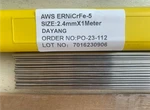

E7016 Mild Steel Welding Electrode
In the industrial welding sector, a welding electrode that combines high strength, crack resistance, and versatility is crucial for ensuring the stability and reliability of critical steel structures. As a representative of low-hydrogen potassium-coated carbon steel electrodes, the E7016 mild steel welding electrode is widely used in core fields such as shipbuilding, heavy machinery, and infrastructure due to its excellent comprehensive performance. This article provides a comprehensive analysis of this industrial-grade welding material from the perspectives of product characteristics, technical parameters, typical application cases, and operating specifications.
I. Core Performance: Comprehensive Advantages from Composition to Characteristics
The outstanding performance of the E7016 electrode stems from its scientific composition design and unique coating technology, which together form the product's core competitiveness.
(I) Chemical Composition of Deposited Metal: Precise Control to Ensure Welding Quality
The composition of the deposited metal directly determines the mechanical properties and defect resistance of the weld. The E7016 electrode strictly controls the content of key elements, with specific parameters and functions as follows:
Carbon (C): Content ≤ 0.12%. The low-carbon design effectively reduces the hardening tendency of the weld, fundamentally minimizing the risk of cold cracking, making it particularly suitable for welding scenarios requiring high low-temperature toughness.
Manganese (Mn): Content ≤ 1.60%. As a strengthening element, manganese significantly improves the strength and toughness of the weld while optimizing the droplet transfer and forming performance during welding, ensuring more stable welding operations.
Silicon (Si): Content ≤ 0.75%. It mainly plays a role in deoxidation, reducing oxide inclusions in the weld, improving the purity of the weld, and preventing the degradation of mechanical properties caused by inclusions.
Sulfur (S) and Phosphorus (P): Controlled below ≤ 0.035% and ≤ 0.040% respectively. Sulfur causes hot brittleness in the weld, while phosphorus tends to induce low-temperature brittleness. Strictly limiting these two harmful elements is key to ensuring the stable performance of the weld in different temperature environments.
(II) Core Product Characteristics: Balancing Practicality and Adaptability
The design of the E7016 electrode fully considers the complex needs of industrial welding, with outstanding performance in coating, versatility, and mechanical properties:
Low-hydrogen potassium coating design: The addition of potassium in the coating not only effectively reduces hydrogen absorption during welding but also significantly improves the crack resistance of the weld. Even under harsh working conditions such as low temperatures and high stress, it can ensure the integrity of the weld structure.
Strong versatility: It is compatible with both alternating current (AC) and direct current (DC) power sources, adapting to the equipment configurations of different factories. At the same time, it supports all-position welding (flat, vertical, horizontal, and overhead welding), eliminating the need for frequent electrode replacement and greatly improving construction efficiency.
Excellent mechanical properties: The weld metal has high tensile strength and good impact toughness, capable of withstanding a certain degree of impact load and working stress, fully meeting the welding requirements of important load-bearing structures such as bridges and pressure vessels.
II. Technical Parameters: Selection of Welding Parameters for Matching Scenarios
Different diameters of E7016 electrodes correspond to different current ranges and application scenarios. Properly matching parameters is a prerequisite for ensuring welding quality. The specific parameters are shown in the table below:
| Electrode Diameter (mm) | Applicable Current Range (A) | Matching Scenarios |
|---|---|---|
| 2.5 | 60~90 | Welding of thin steel plates and small-diameter pipes, requiring precise control of penetration depth to avoid burn-through |
| 3.2 | 90~130 | Flat/vertical welding of medium-thin workpieces and conventional steel structure welding, balancing efficiency and forming quality |
| 4.0 | 150~190 | Welding of thick-walled components and groove welding, requiring sufficient penetration depth to achieve weld fusion |
| 5.0 | 180~230 | Welding of heavy steel structures and multi-layer multi-pass welding of thick steel plates, meeting the requirements of high-strength load-bearing |
It should be noted that when using an AC power source, the arc stability is slightly inferior to that of a DC power source. It is recommended to appropriately adjust the current or prioritize the DC reverse polarity mode to improve arc concentration and reduce spatter.
III. Typical Application Cases: Focus on Practical Applications in Key Industrial Scenarios
With its excellent crack resistance, high strength, and all-position welding capability, the E7016 electrode plays a key role in practical projects across multiple core industrial fields. The following are detailed analyses of specific application cases:
(I) Shipbuilding: Welding of Hull Structures in Marine Environments
A coastal shipyard undertook the construction project of a 5,000-ton bulk carrier. The main hull was made of marine grade D mild steel (thickness: 8-25mm), which needs to withstand high humidity, salt spray corrosion in the marine environment, and vibration loads during navigation.
Welding requirements: The weld needs to have low hydrogen content (to prevent hydrogen-induced cracking caused by seawater penetration), good low-temperature toughness (to cope with the low-temperature marine environment in winter), and be capable of completing vertical and overhead welding operations on the hull deck and bulkheads.
E7016 application plan: E7016 electrodes with diameters of 3.2mm and 4.0mm were selected. Before welding, the electrodes were baked at 350°C for 1 hour, and the DC reverse polarity mode was used to control arc stability. For key stress-bearing parts of the hull (such as the connection between the keel and the deck), a multi-layer multi-pass welding process was adopted, with the thickness of each weld layer controlled at 3-4mm to effectively disperse welding stress.
Application effect: The qualification rate of the welds through non-destructive testing (UT/RT) reached 99.2%, with no defects such as cracks or pores. During the subsequent sea trial of the ship, the welds showed no deformation or leakage under low temperatures (-5°C) and continuous vibration, meeting the long-term reliability requirements for marine navigation.
(II) Heavy Machinery: High-strength Welding of Excavator Arms
A construction machinery factory produced 20-ton excavators. The core stress-bearing component, the "excavator arm," was made of Q345 low-carbon alloy steel plates (thickness: 16-30mm), which needs to withstand impact loads and torsional stress during excavation operations, requiring extremely high weld strength and fatigue resistance.
Welding requirements: The tensile strength of the weld needs to be ≥ 490MPa, and welding deformation must be avoided to prevent deviations in the opening and closing accuracy of the excavator arm. At the same time, the "connecting lug plate between the large arm and the small arm" of the excavator arm has a deep groove structure, requiring sufficient penetration to prevent stress concentration cracking.
E7016 application plan: E7016 electrodes with diameters of 4.0mm and 5.0mm were selected. A three-step process of "root welding + filling welding + cover welding" was adopted for thick plate grooves: small current (150-160A) was used for root welding to ensure penetration, medium current (170-180A) for filling welding to improve efficiency, and controlled current (160-170A) for cover welding to optimize forming. After welding, the welds were subjected to stress relief annealing at 200°C for 2 hours to reduce internal stress.
Application effect: The measured tensile strength of the welds reached 520MPa, far exceeding the design requirements. After 100,000 simulated excavation cycle tests, the excavator arm showed no fatigue cracks in the welds, and its service life was increased by 30% compared with traditional electrodes.
(III) Infrastructure: Welding of Load-bearing Beams for Highway Bridges
In a key provincial highway bridge project, the main beams were made of Q345qD low-carbon bridge steel (thickness: 20-40mm), which needed to span a 120-meter river channel. The main beams had to withstand dynamic loads from vehicle traffic and low temperatures (-10°C) in winter, requiring strict requirements on the low-temperature toughness and crack resistance of the welds.
Welding requirements: The impact energy of the welds at -40°C needs to be ≥ 34J, and the fillet welds between the web and flange of the main beam require horizontal welding operations. At the same time, it is necessary to cope with the humid environment in field construction (humidity often reaches 75%-85%).
E7016 application plan: E7016 electrodes with a diameter of 5.0mm were selected. Before welding, the welding area of the base metal was derusted by sandblasting (exposing the metallic luster), and the base metal was preheated to 100-150°C (to cope with the low-temperature environment). During field operations, temporary wind shelters were built (controlling wind speed < 2m/s), and the baked electrodes were stored in an 80°C heat preservation bucket for immediate use to avoid moisture absorption.
Application effect: The measured low-temperature impact energy of the welds reached 42J, meeting the low-temperature toughness requirement at -40°C. One year after the bridge was opened to traffic, regular inspections showed no cracking or deformation in the main beam welds, with stable load-bearing capacity, adapting to the traffic demand of 5,000 vehicles per day.
(IV) Pressure Vessels: Welding of Industrial Boiler Shells
A chemical enterprise built a new steam boiler, whose shell was made of 20g low-carbon boiler steel (thickness: 12-25mm), needing to withstand a working pressure of 1.6MPa and a high temperature of 300°C. Strict requirements were imposed on the weld tightness and hydrogen corrosion resistance (to prevent weld embrittlement caused by high-temperature hydrogen penetration).
Welding requirements: The welds need to meet the requirements of the Boiler Safety Technical Supervision Regulations without any penetrating defects. At the same time, the "cylindrical section circumferential weld" of the boiler shell is a circular weld, requiring uniform weld quality and sufficient penetration to prevent stress concentration cracking.
E7016 application plan: E7016 electrodes with diameters of 3.2mm and 4.0mm were selected. A "double-person symmetric welding" process was adopted to reduce the deformation of the cylindrical section. During welding, the arc length was strictly controlled (≤ electrode diameter) to avoid air intrusion and pore formation. After welding, 100% radiographic testing (RT) was performed on the welds, followed by a hydrostatic test (2.4MPa for 30 minutes).
Application effect: The qualification rate of the welds through RT testing was 100%, with no leakage in the hydrostatic test. After 18 months of boiler operation, the welds showed no hydrogen corrosion or deformation, meeting the long-term safe operation requirements under high temperature and high pressure.
IV. Operating Specifications: Quality Control from Preparation to Construction
Proper operating procedures are key to exerting the performance of the E7016 electrode. Every step, from electrode pre-treatment to welding environment control, must strictly follow the specifications:
Electrode baking and storage: Before welding, the electrodes must be baked at 350°C for 1 hour to remove moisture from the coating. Immediately after baking, they should be stored in a heat preservation bucket at 80~120°C for later use to prevent moisture absorption. Moistened electrodes need to be re-baked, but the number of re-baking times should not exceed 2, otherwise the performance of the coating will deteriorate.
Implementation of welding specifications: Adopt the short-arc welding method to shorten the arc length, reduce air intrusion, and avoid pore formation in the weld. Prioritize the narrow weld welding method to reduce welding deformation and stress concentration, which is especially suitable for high-precision structure welding.
Base metal cleaning: Before welding, thoroughly remove rust, oil, moisture, and other impurities from the welding area of the base metal until the metallic luster is exposed, preventing impurities from merging into the weld and causing performance defects.
Environment control: Avoid welding in an environment with humidity > 80% or wind speed > 2m/s. High humidity is prone to causing hydrogen-induced cracking, and strong wind will damage arc stability. When the ambient temperature is < 0°C, preheat the base metal to 100~200°C to reduce temperature difference stress.
V. Procurement and Cooperation: Choosing a Reliable Supplier
A professional supplier of E7016 mild steel welding electrodes should have a complete supply system and quality assurance. The following dimensions should be focused on during procurement:
Supply capacity: Capable of providing bulk wholesale services and supporting customized corporate needs (such as specific diameters and packaging specifications) to meet the procurement volume requirements of projects of different scales.
Quality certification: The products must comply with national or industry standards (e.g., GB/T 5117-2012 Non-alloy Steel and Fine-grain Steel Electrodes) and pass testing by authoritative institutions (e.g., SGS, CTI) to ensure that the composition and mechanical properties meet the standards.
Service support: Provide technical consultation (e.g., recommending electrode diameters and welding parameters based on project scenarios), offer reasonable discounts for bulk procurement customers, and ensure after-sales return and exchange services to solve procurement worries.
Whether it is marine-grade welding in shipbuilding or high-strength connection in heavy machinery, the E7016 mild steel welding electrode has become a reliable choice in the industrial welding field due to its stable performance and wide adaptability. Only by following standardized operating procedures and selecting formal suppliers can its advantages be fully exerted, ensuring the quality and safety of every weld.
Hot Tags: e7016 mild steel welding electrode, China, manufacturers, suppliers, factory, company, wholesale, discount, buy, low price, high quality, products
You Might Also Like


Send Inquiry