




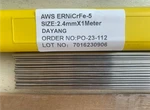
Surfacing Electrode
Wear-Resistant Surfacing Electrodes
Wear-Resistant Surfacing Electrodes are specialized welding consumables designed for surfacing—depositing a protective layer on metal surfaces to enhance wear resistance, corrosion resistance, or hardness. With a core of high-alloy materials (e.g., chromium, tungsten, nickel) and functional coatings (flux-cored or rutile), they form a dense, durable surfacing layer that bonds tightly to the base material. These electrodes are widely used in machinery, mining, and construction industries to extend the service life of worn parts like gears, rollers, and shovel teeth.


Product Categories and Models
Based on performance and application scenarios, common models include:
D212 (EDPCrMo-A4-03)
Chromium-molybdenum surfacing electrode, forming a layer with hardness 50–55 HRC. Suitable for low-impact wear parts (e.g., pump impellers, conveyor rollers).
D322 (EDRCrW-15)
Tungsten-chromium surfacing electrode, with high hardness (55–60 HRC) and wear resistance. Used for high-impact wear parts (e.g., crusher jaws, mining shovel teeth).
D507 (EDCrNi-C-15)
Nickel-chromium surfacing electrode, offering corrosion and high-temperature wear resistance (up to 600°C). Ideal for valve seats, furnace rollers, and chemical equipment.
Performance Characteristics
Wear Resistance
The surfacing layer contains hard phases (e.g., chromium carbides, tungsten carbides) that resist abrasive, adhesive, or impact wear—service life of parts can be extended by 2–5 times.
Bond Strength
The layer forms a metallurgical bond with the base material, avoiding peeling even under high stress (bond strength ≥300MPa).
Adjustable Hardness
Hardness ranges from 30 HRC (for machinable layers) to 65 HRC (for extreme wear), meeting different application needs.
Process Adaptability
Compatible with shielded metal arc welding (SMAW), suitable for flat, horizontal, and vertical downward surfacing.
Application Areas
Mining Machinery
Surfacing of crusher liners, drill bits, and conveyor belt rollers (using D322 for impact wear resistance).
01
Construction Equipment
Reinforcement of excavator buckets, bulldozer blades, and concrete mixer liners (using D212 for abrasive wear).
02
Industrial Machinery
Repair and reinforcement of gear teeth, bearing seats, and press molds (using D507 for corrosion and wear).
03
Energy & Chemicals
Surfacing of valve cores, pump shafts, and reactor inner walls (using D507 for high-temperature and corrosion resistance).
04
FAQ
Q1: What is a wear-resistant Surfacing Electrode?
A1: A wear-resistant Surfacing Electrode is a welding electrode designed to deposit a protective layer on metal surfaces, with a high-alloy core (chromium, tungsten, nickel) and flux coating. Its “wear-resistant” feature comes from hard alloy phases in the surfacing layer, which resist abrasion, impact, or corrosion. Unlike ordinary welding electrodes, it focuses on surface performance rather than joint strength, making it ideal for repairing or reinforcing worn parts.
Q2: How does a Surfacing Electrode differ from a regular welding electrode?
A2: In composition, Surfacing Electrodes have high alloy content (20–50% Cr/W/Ni) to form hard phases; regular electrodes have low alloys and focus on matching base material strength. In function, Surfacing Electrodes deposit a protective layer on the surface; regular electrodes join two pieces of metal. In performance, Surfacing Electrodes prioritize hardness and wear resistance; regular electrodes prioritize toughness and bond strength.
Q3: How to choose a Surfacing Electrode based on wear type?
A3: Match the electrode to the main wear mechanism:
• Abrasive wear (e.g., sand, gravel): D212 (chromium-molybdenum, 50–55 HRC) forms chromium carbides that resist cutting by hard particles.
• Impact wear (e.g., crushing rocks): D322 (tungsten-chromium, 55–60 HRC) with tough matrix and hard carbides to absorb impact.
• Corrosive wear (e.g., chemicals): D507 (nickel-chromium, 40–45 HRC) resists corrosion while maintaining wear resistance.
Q4: What pre-surfacing preparations are needed for Surfacing Electrodes?
A4: Key preparations include:
• Base material cleaning: Remove rust, oil, and scale with a wire brush or grinder (contaminants cause porosity or poor bonding).
• Preheating: For high-carbon steel or thick parts, preheat to 200–350°C to reduce stress and avoid cracking between the surfacing layer and base material.
• Groove design: For severely worn parts, machine a U-groove (depth = wear amount + 2mm) to ensure the surfacing layer fills evenly.
Q5: What welding parameters are suitable for Surfacing Electrodes?
A5: Parameters vary by electrode type and layer thickness:
• D212 (3.2mm): Current 90–120A, voltage 22–26V (for 2–3mm thick layers).
• D322 (4.0mm): Current 140–180A, voltage 24–28V (for 3–5mm thick layers).
• D507 (3.2mm): Current 80–110A, voltage 22–25V (for corrosion-resistant layers).
Use DC reverse polarity; control travel speed to ensure layer thickness uniformity (10–15 cm/min for 3.2mm electrodes).
Q6: What defects are common in Surfacing Electrode layers, and how to prevent them?
A6: Common defects include:
• Peeling: Caused by poor bonding (contaminants or insufficient preheating). Prevent by strict cleaning and preheating to 250°C.
• Cracks: Due to high stress (large layer thickness or rapid cooling). Prevent by surfacing in thin layers (≤3mm per pass) and slow cooling.
• Porosity: From moisture in the electrode or oil on the base material. Prevent by baking electrodes (350°C for 1 hour) and cleaning with acetone.
Q7: How to store Surfacing Electrodes to maintain performance?
A7: Store in a dry, sealed container at 10–30°C with relative humidity ≤60%—moisture damages the flux coating, causing porosity. Low-hydrogen surfacing electrodes (e.g., D507) must be baked at 350°C for 1–2 hours before use and stored in a 100–150°C holding oven after opening. Unopened electrodes have a 2-year shelf life; opened ones should be used within 4 hours.
Q8: Can Surfacing Electrodes be used on any base material?
A8: They work on most steels (carbon steel, low alloy steel) but require adjustments:
• Mild steel: Direct surfacing (preheat to 150°C for thick parts).
• High-carbon steel: Preheat to 300–350°C to avoid cracking.
• Cast iron: Use nickel-based surfacing electrodes (e.g., D507) and preheat to 400°C to reduce brittleness.
Avoid surfacing on aluminum or copper (different melting points prevent bonding).
Q9: What post-surfacing treatments are needed for Surfacing Electrode layers?
A9: For wear-resistant layers (D212/D322):
• Slow cooling (cover with heat-insulating cotton) to reduce stress.
• Grind to the required size (if machining is needed—note: high-hardness layers may require diamond tools).
For corrosion-resistant layers (D507):
• Pickle to remove oxides, then passivate to enhance corrosion resistance.
For high-stress parts:
• Stress relief annealing at 500–600°C to reduce cracking risks.
Q10: How to determine the thickness of the surfacing layer when using Surfacing Electrodes?
A10: The thickness depends on wear severity:
• Light wear (e.g., pump shafts): 2–3mm (one layer).
• Moderate wear (e.g., conveyor rollers): 3–5mm (two layers).
• Severe wear (e.g., crusher jaws): 5–10mm (multi-layer, with interpass cleaning).
Ensure the layer is 1–2mm thicker than the target size to allow for grinding.
Q11: How to test the performance of Surfacing Electrode layers?
A11: Key tests include:
• Hardness test: Use a Rockwell hardness tester (e.g., D212 should be 50–55 HRC).
• Bond strength test: Pull tests to ensure the layer does not peel (≥300MPa).
• Wear test: Abrasion tests (e.g., sandblasting) to compare wear rate with uncoated parts.
• Impact test: For impact wear parts (e.g., shovel teeth), ensure no cracking after 1000+ impacts.
Q12: What is the difference between D212, D322, and D507 Surfacing Electrodes?
A12: D212 (chromium-molybdenum) balances wear resistance and machinability (50–55 HRC), suitable for low-impact abrasive wear. D322 (tungsten-chromium) has higher hardness (55–60 HRC) and impact resistance, ideal for high-impact wear. D507 (nickel-chromium) prioritizes corrosion and high-temperature resistance (≤600°C), used in chemical or high-temperature equipment.
Q13: Can Surfacing Electrodes be used for multi-layer surfacing?
A13: Yes, multi-layer surfacing is common for thick layers (≥5mm). Key tips:
• Clean slag thoroughly between layers to avoid inclusions.
• Keep interpass temperature ≤300°C (for D212/D322) to prevent overheating.
• Stagger weld beads (like bricklaying) to avoid stress concentration.
• Use a 3.2mm electrode for the first layer (better bonding) and 4.0mm for subsequent layers.
Q14: How to handle peeling of the surfacing layer when using Surfacing Electrodes?
A14: Peeling is caused by poor bonding. Remove the peeling layer with a grinder, clean the surface, and re-surface:
• Preheat to 300°C (higher than initial preheat).
• Use a smaller electrode (2.5mm) for the first layer to ensure fusion.
• Weld with low current (10% lower than standard) to avoid base material dilution.
Q15: What safety precautions are specific to Surfacing Electrodes?
A15: Surfacing produces fumes rich in chromium, tungsten, or nickel (toxic if inhaled)—use local exhaust ventilation and a respirator with a P100 filter. High-hardness layers may produce sharp sparks—wear flame-resistant clothing and keep a fire extinguisher nearby. Grinding the surfacing layer generates dust—wear a dust mask and goggles.
Q16: How to choose between flux-cored and solid Surfacing Electrodes?
A16: Flux-cored Surfacing Electrodes have a hollow core with flux, offering higher deposition efficiency (good for large areas like rollers) and better alloy uniformity. They require no additional flux but may produce more slag.
Solid Surfacing Electrodes have a solid core and rely on coating flux, offering better control for thin layers (e.g., valve seats). They produce cleaner surfaces but have lower deposition rates.
Q17: Can Surfacing Electrodes be used for repair of worn parts?
A17: Yes, they are ideal for repair. For example:
• A worn gear tooth: Machine the worn area to a flat surface, preheat to 200°C, and surface with D212 to restore the tooth shape.
• A cracked shovel tooth: Grind out the crack, preheat to 300°C, and surface with D322 (impact-resistant) to extend service life.
Q18: How to prevent dilution of the surfacing layer by the base material?
A18: Dilution (mixing of base material with the surfacing layer) reduces hardness and wear resistance. Prevention:
• Use low current to minimize base material melting.
• Keep the arc short (arc length = ½ electrode diameter) to focus heat on the surfacing layer.
• Use a “skip welding” method (weld short segments, cool, repeat) to reduce heat input.
• For critical parts, deposit a thin “butter layer” first (with high-alloy electrode) to isolate the base material.
Q19: What is the impact of welding position on Surfacing Electrode performance?
A19: Flat and horizontal positions are optimal for uniform layer thickness and minimal dilution. Vertical downward surfacing is possible with small-diameter electrodes (2.5–3.2mm) and low current (80–100A). Overhead surfacing is not recommended—gravity causes molten metal to sag, leading to uneven layers and porosity.
Q20: How to evaluate the quality of a surfacing layer made with Surfacing Electrodes?
A20: Key criteria include:
• Visual: No cracks, peeling, or porosity; uniform thickness.
• Hardness: Within the specified range (e.g., 55–60 HRC for D322).
• Bonding: No gaps between the layer and base material (checked via ultrasonic testing).
• Wear test: Field trial (e.g., conveyor roller service life ≥6 months).
Q21: What is the maximum thickness of a surfacing layer with Surfacing Electrodes?
A21: With multi-layer surfacing, layers can reach 20mm thick. For thick layers:
• Use 4.0–5.0mm electrodes for efficiency.
• Preheat to 300°C and cool slowly between layers.
• Ensure each layer is ≤3mm to avoid cracking.
• Post-weld stress relieve to reduce residual stress.
Q22: How does alloy content affect Surfacing Electrode performance?
A22: Chromium forms hard carbides (enhancing abrasive wear resistance); higher Cr (≥15%) increases hardness. Tungsten adds impact resistance (tungsten carbides are harder than chromium carbides). Nickel improves corrosion resistance and toughness (prevents cracking in corrosive environments). Electrodes are formulated with specific alloys for their target wear type.
Q23: Can Surfacing Electrodes be used on cast iron parts?
A23: Yes, but use nickel-based surfacing electrodes (e.g., D507) to avoid cracking (nickel is compatible with cast iron). Preheat to 400–500°C (higher than for steel) to reduce thermal stress. Weld with low current (80–100A for 3.2mm electrodes) and cool slowly. This is common for repairing cast iron machine tool beds or pump housings.
Q24: How to handle moisture-absorbed Surfacing Electrodes?
A24: Low-hydrogen surfacing electrodes (e.g., D507) must be baked at 350°C for 1–2 hours if exposed to moisture. Flux-cored electrodes with moisture damage (caking or rust) should be discarded—moisture causes porosity, which weakens the layer’s wear resistance. Always store opened electrodes in a moisture-proof cabinet.
Q25: What post-surfacing machining is possible with Surfacing Electrodes?
A25: Machinability depends on hardness:
• Layers ≤40 HRC (e.g., some D507 layers) can be turned, milled, or drilled with high-speed steel tools.
• Layers 40–55 HRC (e.g., D212) require carbide tools.
• Layers ≥55 HRC (e.g., D322) are nearly unmachinable—grind to size with diamond wheels.
Q26: How to prevent cracks in Surfacing Electrodes layers?
A26: Cracks are caused by high stress, rapid cooling, or excessive thickness. Prevention:
• Surface in thin layers (≤3mm per pass).
• Preheat and slow cool (cover with heat-insulating cotton).
• Avoid sharp corners in the surfacing area (round edges to reduce stress).
• Choose electrodes with better toughness for high-impact parts (e.g., D322 over D212).
Q27: What is the shelf life of Surfacing Electrodes?
A27: Unopened electrodes have a 2-year shelf life in dry storage. Opened low-hydrogen surfacing electrodes (D507) must be used within 4 hours of baking. Flux-cored surfacing electrodes have a shorter shelf life (1.5 years unopened) due to flux sensitivity to moisture.
Q28: How to choose Surfacing Electrodes for high-temperature wear applications?
A28: Choose nickel-chromium electrodes (e.g., D507) with chromium ≥15% and nickel ≥10%—they resist oxidation and retain hardness at 500–600°C. Avoid tungsten-based electrodes (D322) for high temperatures, as tungsten oxides form above 600°C, reducing wear resistance.
Q29: How to ensure uniform thickness of the surfacing layer with Surfacing Electrodes?
A29: Use a guide (e.g., a metal bar) to control electrode distance from the surface. Mark the surface with parallel lines (5–10mm apart) to align weld beads. Overlap beads by 50% to avoid gaps. For large surfaces, use a welding fixture to maintain consistent travel speed and electrode angle.
Q30: Can Surfacing Electrodes be used to change the surface properties of a part?
A30: Yes. For example:
• A carbon steel pipe used in a corrosive environment can be surfaced with D507 to add corrosion resistance.
• A soft aluminum part (not directly weldable) can have a steel layer surfaced first, then welded to another steel part.
• A low-hardness gear can be surfaced with D212 to enhance tooth wear resistance while keeping the core tough.
Q31: What is the impact of preheating temperature on Surfacing Electrodes layers?
A31: Too low a preheat (≤100°C for high-carbon steel) causes cold cracks between the layer and base material. Too high a preheat (≥400°C for mild steel) increases dilution, reducing layer hardness. Follow guidelines: 150–200°C for mild steel, 300–350°C for high-carbon steel, 400–500°C for cast iron.
Q32: How to repair cracks in a surfacing layer made with Surfacing Electrodes?
A32: Grind out the crack to a V-shape (depth 2mm beyond the crack), clean, and re-surface:
• Preheat to 50°C higher than initial preheat.
• Use a 2.5mm electrode with low current (70–90A).
• Deposit a small bead to fill the crack, then build up the layer.
• Slow cool and grind smooth.
Q33: How to select Surfacing Electrodes for food-grade equipment?
A33: Choose nickel-chromium surfacing electrodes (e.g., D507) with low sulfur and phosphorus (≤0.01%). Ensure the layer is smooth (no pores to trap food) and passivate it with nitric acid to meet food safety standards (e.g., FDA, EU 10/2011). Avoid lead or cadmium-containing electrodes.
Q34: What is the difference between single-layer and multi-layer surfacing with Surfacing Electrodes?
A34: Single-layer surfacing (2–3mm) is quick, suitable for light wear or corrosion protection (e.g., valve stems). It has higher dilution (10–20%) but is cost-effective.
Multi-layer surfacing (≥5mm) reduces dilution (≤5% in the top layer) and improves wear resistance, suitable for severe wear (e.g., crusher liners). It requires more time but extends part life significantly.
Q35: How to dispose of waste Surfacing Electrodes and grinding dust?
A35: Discarded electrodes with chromium or nickel are considered hazardous waste—dispose of them through licensed waste management companies. Grinding dust must be collected in sealed containers (avoid inhalation) and sent to recycling facilities (alloy elements can be recovered). Never dispose of them in regular trash.