




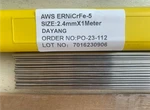
Copper Electrode
How to Select and Use High-Quality Copper Electrodes for Optimal Welding Results?
Copper Electrodes are specialized welding consumables designed for welding copper, copper alloys (e.g., brass, bronze), and dissimilar metals (e.g., copper to steel). With a copper or copper-based alloy core and tailored coatings (e.g., flux-cored, rutile), they deliver stable arcs, strong weld bonding, and excellent electrical/thermal conductivity in the weld. Ideal for scenarios requiring high conductivity and corrosion resistance, they are widely used in electrical engineering, refrigeration, and plumbing.


Product Categories and Models
Based on core composition and application, common models include:
ECu Pure Copper Electrode
Pure copper core (purity ≥99.9%) with a flux coating, suitable for welding pure copper (e.g., electrical busbars). Features high conductivity but requires precise heat control.
ECuSn Bronze Electrode
Copper-tin alloy core (tin 5–10%), with enhanced strength and wear resistance. Used for welding bronze parts (e.g., marine propellers, valve bodies).
ECuNi Copper-Nickel Electrode
Copper-nickel core (nickel 10–30%), resistant to seawater corrosion. Ideal for welding copper-nickel alloys in ship pipelines and desalination equipment.
Performance Characteristics
High Conductivity
Welds retain 80–90% of pure copper’s conductivity, critical for electrical components (e.g., motor windings).
Corrosion Resistance
Copper-nickel and bronze electrodes resist seawater, moisture, and mild acids, suitable for marine and plumbing applications.
Thermal Conductivity
Welds efficiently transfer heat, making them ideal for refrigeration equipment (e.g., copper refrigerant pipes).
Application Areas
Electrical Engineering
Welding of copper busbars, transformer windings, and motor terminals (requires high conductivity).
01
Plumbing & Refrigeration
Welding of copper pipes for water supply, air conditioning, and refrigerant lines (leak-tight and corrosion-resistant).
02
Marine Engineering
Welding of bronze propellers, copper-nickel ship pipelines (resists seawater corrosion).
03
Mechanical Manufacturing
Repair of brass gears, bronze bearings (restores wear resistance).
04
FAQ
Q1: What is a copper electrode?
A1: A copper electrode is a welding electrode with a copper or copper-based alloy core (copper content ≥60%) and a functional coating. It is engineered to match the properties of copper and copper alloys, ensuring welds have high conductivity, thermal transfer, and compatibility with the base material. For example, ECu pure copper electrodes are used to weld electrical busbars, as their welds retain excellent electrical conductivity.
Q2: How does a copper electrode differ from a copper alloy electrode?
A2: In composition, copper electrodes (e.g., ECu) have a pure copper core (≥99.9% copper) with minimal additives, while copper alloy electrodes (e.g., ECuSn, ECuNi) have copper mixed with alloy elements (tin, nickel, etc.). In performance, copper electrodes prioritize conductivity (critical for electrical parts), while copper alloy electrodes focus on strength or corrosion resistance (e.g., ECuNi for seawater resistance). Applications: copper electrodes for motor windings, copper alloy electrodes for marine pipes.
Q3: How to choose a copper electrode based on the base material?
A3: Match the electrode to the base material’s composition:
• Pure copper (e.g., electrical busbars): Use ECu pure copper electrodes to maintain conductivity.
• Brass (copper-zinc alloy): Choose ECuZn brass electrodes (zinc content matches brass) to avoid brittleness from zinc loss.
• Bronze (copper-tin alloy): ECuSn bronze electrodes ensure weld strength and wear resistance match the base material.
• Copper-nickel alloy: ECuNi electrodes (nickel content 10–30%) for seawater corrosion resistance.
Q4: What welding methods are suitable for copper electrodes?
A4: Tungsten inert gas welding (TIG) is preferred for precision (e.g., thin copper pipes) — it offers stable arc control and minimal spatter. Metal inert gas welding (MIG) works for thick copper parts (e.g., busbars) to improve efficiency. Shielded metal arc welding (SMAW) with flux-coated copper electrodes is used for on-site repairs (e.g., plumbing pipe fixes) due to portability.
Q5: Why is preheating important for copper electrodes, and how to do it?
A5: Copper has high thermal conductivity — heat from welding dissipates quickly, making it hard to achieve fusion. Preheating raises the base material temperature, reducing heat loss. For pure copper <3mm thick: preheat to 200–300°C. For thick copper (>5mm) or copper alloys: preheat to 300–500°C. Use a propane torch for even heating, and check temperature with an infrared thermometer to avoid overheating (which causes oxidation).
Q6: What defects are common when using copper electrodes, and how to prevent them?
A6: Common defects include lack of fusion (due to rapid heat loss) — prevent by preheating and using high current. Porosity (from hydrogen in moisture) — avoid by cleaning oil/moisture from the base material and using dry electrodes. Cracks (in copper-steel welds) — reduce by preheating and using a copper-nickel transition layer. For example, when welding a 6mm copper pipe, preheat to 400°C and use a 3.2mm electrode to ensure fusion.
Q7: How to handle the high thermal conductivity of copper when using copper electrodes?
A7: Copper’s high thermal conductivity causes heat to spread quickly, leading to insufficient fusion. Solutions: Preheat the base material (as noted in Q5); use higher current than for steel (e.g., 30% higher for the same diameter electrode); weld with a slow speed to allow heat to accumulate; use a “weaving” arc motion to concentrate heat in the weld area. For a 4mm copper plate, a current of 150–180A (vs. 120–150A for steel) ensures proper penetration.
Q8: What shielding gas is best for copper electrodes?
A8: For TIG/MIG welding, use high-purity argon (≥99.99%) — argon provides stable arc shielding and prevents copper oxidation. For thick copper, add 2–5% hydrogen to argon (improves heat input and reduces porosity). Avoid nitrogen-based gases (causes copper nitride formation, which makes welds brittle). For SMAW, the electrode’s flux coating provides shielding (no additional gas needed).
Q9: How to prevent oxidation of copper welds when using copper electrodes?
A9: Copper oxidizes easily at high temperatures, forming a black copper oxide layer that weakens welds. Prevention: Use a short arc (minimizes air contact); ensure shielding gas covers the weld until cooled to <300°C; pre-clean the base material to remove oxides (wire brush + acetone). If oxidation occurs, grind the oxide layer with sandpaper — for electrical parts, re-tin the surface to restore conductivity.
Q10: What is the impact of welding current on copper electrode performance?
A10: Too low a current fails to overcome copper’s high thermal conductivity, leading to incomplete fusion. Too high a current causes copper to melt excessively, leading to burn-through (especially for thin sheets) or grain coarsening (reducing strength). For a 3.2mm pure copper electrode, the optimal current is 120–150A — this balances heat input and fusion.
Q11: Can copper electrodes weld copper to steel?
A11: Yes, but it requires a transition approach. Copper and steel have different thermal expansion coefficients, so use a copper-nickel electrode (e.g., ECuNi) — nickel acts as a buffer. Preheat to 200–300°C to reduce stress; weld a thin layer first to bond copper to steel, then fill with the same electrode. Avoid excessive heat, as it causes iron to dilute the copper (reducing conductivity).
Q12: How to store copper electrodes to maintain performance?
A12: Store in a dry, ventilated area at 10–30°C with relative humidity ≤60% — moisture causes flux coating degradation. Pure copper electrodes are prone to tarnishing, so keep them in sealed plastic bags to avoid contact with sulfur-containing gases (e.g., from rubber). Unopened electrodes have a 1.5-year shelf life; opened ones should be used within 1 month.
Q13: What post-weld treatment is needed for copper electrode welds?
A13: For electrical parts, grind the weld to smooth the surface (reduces electrical resistance). For corrosion-resistant parts (e.g., marine pipes), pickle with a 10% sulfuric acid solution to remove oxides, then rinse with water. For load-bearing parts (e.g., bronze gears), stress relief annealing (200–300°C for 1 hour) reduces residual stress.
Q14: How to choose copper electrode diameter for different material thicknesses?
A14: Follow this guideline:
• 1–2mm thick copper: 2.0–2.5mm electrode (current 80–100A)
• 2–5mm thick copper: 3.2mm electrode (current 100–150A)
• 5mm+ thick copper: 4.0–5.0mm electrode (current 150–200A)
For example, welding a 4mm brass plate requires a 3.2mm ECuZn electrode to ensure full penetration.
Q15: What causes porosity in copper welds when using copper electrodes?
A15: Porosity is usually caused by:
• Moisture in the electrode coating or on the base material (vaporizes into gas).
• Inadequate shielding gas coverage (air enters the weld pool).
• Zinc evaporation in brass welding (zinc vapor forms bubbles).
Solutions: Bake moisture-absorbed electrodes at 150°C for 1 hour; clean the base material with acetone; ensure shielding gas flow rate is 15–20 L/min (for TIG).
Q16: How to handle copper electrode welds that are too brittle?
A16: Brittleness is often caused by alloy segregation (e.g., zinc loss in brass) or contamination (e.g., iron from steel). Solutions: Use a lower current to reduce melting (minimizes segregation); clean the weld area to remove foreign metals; for brass, use a brass electrode with matching zinc content to replenish lost zinc. For critical parts, re-weld with a new electrode.
Q17: What safety precautions are specific to copper electrodes?
A17: Brass welding may release zinc fumes (toxic if inhaled) — wear a respirator with a zinc fume filter. Copper dust can irritate the skin — wear gloves when handling electrodes. The flux coating may contain fluorides — avoid eye contact and wash hands after use.
Q18: How to test the conductivity of copper welds?
A18: For electrical parts, use a conductivity meter to measure the weld’s conductivity (should be ≥80% of pure copper, ~58 MS/m). For high-precision parts (e.g., motor terminals), perform a resistance test — the weld resistance should be ≤5% higher than the base material.
Q19: Can copper electrodes be used for aluminum-copper welding?
A19: Direct welding is not recommended — copper and aluminum form brittle intermetallic compounds (e.g., CuAl2) that cause cracks. If necessary, use a copper-clad aluminum transition piece: weld copper to the copper layer with a copper electrode, then weld aluminum to the aluminum layer with an aluminum electrode. This is only suitable for low-stress applications (e.g., decorative parts).
Q20: How to evaluate the quality of a copper electrode weld?
A20: Visual inspection: No cracks, pores, or burn-through. For electrical parts: Conductivity ≥80% of pure copper. For plumbing pipes: Pressure test (1.5x working pressure for 30 minutes, no leaks). For marine parts: Salt spray test (5% NaCl, 500 hours, no corrosion).
Q21: What is the difference between flux-cored and solid copper electrodes?
A21: Flux-cored copper electrodes have a hollow core filled with flux, which cleans the weld and prevents oxidation — ideal for dirty or rusty surfaces (e.g., on-site pipe repairs). They offer high deposition efficiency but may produce more slag. Solid copper electrodes have a solid core and rely on external shielding gas (e.g., TIG) — better for precision welding (e.g., electrical components) with cleaner welds.
Q22: How to choose between AC and DC current for copper electrodes?
A22: DC is preferred for better arc stability and deeper penetration — critical for thick copper parts. DC reverse polarity (electrode positive) works best for pure copper, as it concentrates heat in the base material. AC can be used for thin copper sheets (reduces burn-through risk) but may cause arc flicker — use a stabilizer if needed.
Q23: What is the maximum thickness copper electrodes can weld?
A23: With preheating and proper parameters, copper electrodes can weld up to 20mm thick copper. For thick plates, use multi-layer welding: root pass with 3.2mm electrode (current 120–150A), filling layers with 4.0mm electrode (current 150–180A). Preheat to 400–500°C and cool slowly between layers to avoid cracks.
Q24: How to prevent spatter when using copper electrodes?
A24: Spatter is caused by unstable arcs or high current. Solutions: Use DC current (more stable than AC); adjust current to the middle of the recommended range; keep the arc length at 1–2mm (avoids metal droplet ejection); use anti-spatter spray on the base material (easily removed post-weld).
Q25: What causes undercuts in copper welds, and how to prevent them?
A25: Undercuts (grooves at the weld edge) are caused by high current, fast welding speed, or steep electrode angles. Prevention: Reduce current by 10–15%; slow welding speed to allow molten copper to fill the edge; keep the electrode angle at 30–45° (not perpendicular). For thin sheets, use a 2.5mm electrode to minimize heat input.
Q26: How to handle moisture-absorbed copper electrodes?
A26: Slightly damp electrodes (stored in 60–70% humidity for <1 week) can be baked at 120–150°C for 1 hour to remove moisture. Severely damp electrodes (flux caking or visible moisture) should be discarded — moisture causes porosity, and baking cannot restore their performance.
Q27: What is the best way to clean copper before welding with copper electrodes?
A27: Step 1: Use a stainless steel wire brush to remove surface oxides and rust. Step 2: Wipe with acetone to remove oil, grease, or fingerprints (oils burn into gas, causing pores). Step 3: For thick copper, etch with a 10% sulfuric acid solution (30 seconds) to remove stubborn oxides, then rinse with water — this ensures good fusion.
Q28: Can copper electrodes be used for cold welding (no preheating)?
A28: Cold welding is not recommended for copper thicker than 2mm — copper’s high thermal conductivity prevents sufficient fusion without preheating. For thin sheets (<2mm), cold welding may work with high current (150–180A for 3.2mm electrode), but risks incomplete fusion. Preheating is always safer for reliable welds.
Q29: How to repair a cracked copper pipe with copper electrodes?
A29: First, drain the pipe and clean the crack with a wire brush + acetone. Grind a V-groove along the crack (depth = ½ pipe thickness). Preheat the area to 200–300°C. Weld the groove with a 2.5–3.2mm copper electrode, using low current (100–120A) to avoid burn-through. After welding, grind the weld smooth and pressure-test to confirm no leaks.
Q30: What is the impact of welding speed on copper electrode welds?
A30: Too fast a speed leaves insufficient time for heat to melt copper, leading to incomplete fusion. Too slow a speed causes excessive heat buildup, leading to warping (especially for thin pipes) or oxide formation. For a 3.2mm electrode, a speed of 8–12 cm/min is optimal — adjust based on thickness: slower for thick parts (to ensure penetration), faster for thin parts (to avoid warping).
Q31: How to prevent warping of copper sheets when using copper electrodes?
A31: Copper sheets warp easily due to uneven heating. Prevention: Use fixtures to clamp the sheet before welding; weld in a symmetrical pattern (e.g., alternate sides of the sheet); use intermittent welding (weld 2–3cm, cool, repeat) to avoid concentrated heat; choose a smaller electrode (2.5mm) for better heat control.
Q32: What is the shelf life of copper electrodes?
A32: Unopened copper electrodes have a 1.5–2-year shelf life in dry storage. Opened electrodes are prone to flux degradation and tarnishing — use within 1 month for best results. Flux-cored electrodes have a shorter shelf life (1 year unopened) due to flux sensitivity to moisture.
Q33: How to choose copper electrodes for high-pressure copper pipes?
A33: For high-pressure pipes (e.g., refrigerant lines), use ECuNi copper-nickel electrodes — nickel enhances strength and leak tightness. Ensure the electrode diameter matches the pipe thickness (3.2mm for 3–5mm pipes, 4.0mm for 5mm+). Post-weld, perform a stress relief anneal (300–400°C for 1 hour) to reduce residual stress.
Q34: Can copper electrodes weld brass to bronze?
A34: Yes, but use a copper-silver electrode (silver 10–15%) as an intermediate. Brass (copper-zinc) and bronze (copper-tin) have different alloy compositions, so silver helps compatibility. Preheat to 200°C; use low current (90–110A for 3.2mm electrode) to avoid alloy segregation. This is suitable for low-stress parts (e.g., decorative hardware).
Q35: How to handle copper electrode welds with poor conductivity?
A35: Poor conductivity is caused by oxidation, impurities, or improper electrode selection. Solutions: Grind off oxide layers and re-tin the weld (for electrical parts); ensure the electrode matches the base material (e.g., use ECu for pure copper, not brass); clean the weld area to remove iron or other contaminants. For critical parts, re-weld with a new pure copper electrode.