




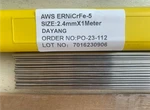
Nickel Electrode
High-Performance Nickel Electrodes
High-performance Nickel Electrodes are specialized welding consumables with a pure nickel or nickel-based alloy core, paired with functional coatings (e.g., low-hydrogen, rutile). They are engineered to deliver stable arcs, strong weld bonding, and exceptional compatibility with nickel, nickel alloys, and dissimilar metals. With advantages like high ductility, corrosion resistance, and low-temperature toughness, they are widely used in precision welding scenarios such as aerospace, medical devices, and cryogenic equipment.


Product Categories and Models
Based on core composition and application scenarios, common models include:
ENi-1 Pure Nickel Electrode
Pure nickel core with a titanium-calcium coating, ideal for welding pure nickel (99.9% nickel) and nickel-plated parts. Features excellent ductility, suitable for low-temperature environments (e.g., cryogenic storage tanks).
ENiCr-3 Nickel-Chromium Electrode
Nickel-chromium alloy core (nickel ≥70%, chromium 15–20%), with enhanced oxidation resistance. Used for welding nickel-chromium alloys in high-temperature equipment (e.g., furnace heating elements).
Performance Characteristics
High Purity
Core material purity ≥99.9% (for pure nickel electrodes), ensuring minimal impurities that could cause weld defects.
Low-Temperature Toughness
Maintains toughness at -196°C (liquid nitrogen temperature), making them suitable for cryogenic engineering.
Corrosion Resistance
Resists neutral salts, weak acids, and atmospheric corrosion, suitable for marine and chemical low-corrosion scenarios.
Application Areas
Aerospace
Welding of nickel alloy components in rocket fuel tanks (resists cryogenic temperatures).
Medical Devices
Welding of nickel-based alloy parts in surgical instruments (biocompatible and corrosion-resistant).
Cryogenic Engineering
Welding of liquid nitrogen/oxygen storage tanks (low-temperature toughness prevents brittle fracture).
FAQ
Q1: What is a high-performance Nickel Electrode?
A1: A high-performance Nickel Electrode is a welding electrode with a pure nickel or nickel-based alloy core (nickel content ≥90%) and a precision coating. It is designed to ensure stable arcs, strong welds, and compatibility with nickel materials, with key advantages like high ductility, low-temperature toughness, and corrosion resistance. For example, ENi-1 electrodes are widely used in cryogenic tank welding due to their ability to withstand -196°C without brittle fracture.
Q2: How does a Nickel Electrode differ from a Nickel Alloy Electrode?
A2: The core difference lies in nickel content: Nickel Electrodes have a higher nickel purity (≥90%, even up to 99.9% for pure nickel types), with minimal alloying elements; Nickel Alloy Electrodes contain 50–80% nickel, with more alloying elements (e.g., chromium, molybdenum) to enhance specific properties (e.g., high-temperature resistance). In application: Nickel Electrodes are for pure nickel or low-alloy nickel welding (e.g., nickel-plated steel); Nickel Alloy Electrodes are for nickel-chromium/molybdenum alloys (e.g., chemical reactors).
Q3: What scenarios are most suitable for Nickel Electrodes?
A3: They excel in three main scenarios:
• Low-temperature environments: Such as liquid nitrogen storage tanks (ENi-1 resists brittle fracture at -196°C).
• Pure nickel welding: For example, welding pure nickel sheets in battery manufacturing (ensures weld ductility matches the base material).
• Nickel-plated part repair: Used to weld cracks in nickel-plated steel (avoids damaging the plating layer outside the weld area).
Q4: Do Nickel Electrodes require special shielding gas?
A4: For shielded metal arc welding (SMAW), most Nickel Electrodes rely on their coating for protection (no additional shielding gas needed) — the coating releases protective gases during welding to isolate the molten pool from air. For TIG welding with nickel electrodes, high-purity argon (≥99.99%) is recommended to prevent oxidation, especially for high-precision parts like medical instruments.
Q5: What defects are prone to occur when using Nickel Electrodes, and how to prevent them?
A5: Common defects include porosity (from oil on the base material or moisture in the coating) and brittle welds(from overheating). Prevention: Clean the base material with acetone to remove oil; bake moisture-absorbed electrodes at 300°C for 1 hour; control current (e.g., 80–100A for 3.2mm electrodes) to avoid overheating and grain coarsening.
Q6: How to choose the right Nickel Electrode for low-temperature welding?
A6: Prioritize electrodes with verified low-temperature toughness, such as ENi-1 — its weld metal retains ductility at -196°C, avoiding brittle fracture. Avoid electrodes with high carbon content (carbon increases brittleness at low temperatures). Check the product specification for “cryogenic grade” or low-temperature impact test data (e.g., impact toughness ≥15J at -196°C).
Q7: Can Nickel Electrodes weld nickel to copper?
A7: Yes, but it requires a transitional approach. Nickel and copper have different thermal expansion coefficients, so use ENi-1 electrodes (nickel has better compatibility with copper than steel). Preheat to 150–200°C to reduce thermal stress; use low current (70–90A for 3.2mm electrodes) to avoid excessive intermetallic compound formation (which causes brittleness). After welding, cool slowly to prevent cracks.
Q8: What is the impact of welding current on Nickel Electrode performance?
A8: Too high a current causes the nickel core to overheat, leading to grain coarsening and reduced weld ductility — this is critical for low-temperature applications, as coarse grains increase brittleness. Too low a current results in insufficient fusion and slag inclusions. For a 3.2mm pure nickel electrode, the optimal current is 80–110A: this range ensures full fusion without overheating.
Q9: How to store Nickel Electrodes to maintain performance?
A9: Store in a dry, sealed container at 10–30°C with relative humidity ≤50% (moisture causes coating degradation). Pure nickel electrodes are sensitive to oxidation, so avoid contact with corrosive gases (e.g., chlorine). Unopened electrodes have a 2-year shelf life; opened ones should be used within 1 month and stored in a moisture-proof cabinet.
Q10: Do Nickel Electrodes require post-weld heat treatment?
A10: It depends on the application. For cryogenic parts (e.g., liquid nitrogen tanks), stress relief annealing (400–500°C for 1 hour) reduces residual stress, preventing cold cracks at low temperatures. For corrosion-resistant parts, no heat treatment is needed (overheating may reduce nickel’s natural passivity). For medical devices, a low-temperature temper (200–300°C) is used to smooth the weld surface without affecting biocompatibility.
Q11: How to prevent oxidation of Nickel Electrode welds?
A11: Oxidation (a gray/black film on the weld surface) reduces corrosion resistance and ductility. Prevention: Use a short arc (arc length = electrode diameter) to minimize air contact; avoid excessive current (reduces heat-induced oxidation); for TIG welding, ensure argon shielding covers the weld until it cools to <200°C. If oxidation occurs, gently grind the surface with 400-grit sandpaper to remove the oxide layer.
Q12: What is the difference between ENi-1 and ENiCr-3 Nickel Electrodes?
A12: ENi-1 is a pure nickel electrode (nickel ≥99.5%) with excellent ductility and low-temperature toughness, suitable for cryogenic welding and pure nickel parts. ENiCr-3 is a nickel-chromium electrode (nickel 70–75%, chromium 15–18%) with enhanced oxidation resistance, designed for high-temperature nickel-chromium alloy welding (e.g., furnace parts). Example: ENi-1 for liquid oxygen tanks, ENiCr-3 for furnace heating elements.
Q13: Can Nickel Electrodes be used for welding nickel-clad steel?
A13: Yes, but the cladding layer in the weld area must be preserved. Grind the cladding only where necessary (keep 2–3mm of cladding on both sides of the weld line). Use ENi-1 electrodes (matching the cladding’s nickel composition) and low current to avoid melting the steel substrate (which would dilute the weld with iron). Post-weld, check that the cladding remains continuous over the weld to maintain corrosion resistance.
Q14: How to choose Nickel Electrode diameter for different material thicknesses?
A14: Follow this guideline:
• 1–2mm thick materials: 2.0mm electrode (current 50–70A)
• 2–5mm thick materials: 2.5–3.2mm electrode (current 70–110A)
• 5mm+ thick materials: 4.0mm electrode (current 110–150A)
For example, welding a 3mm pure nickel sheet requires a 2.5mm electrode to balance fusion and heat input.
Q15: What causes weld brittleness when using Nickel Electrodes, and how to prevent it?
A15: Brittleness is usually caused by overheating (grain coarsening) or contamination (e.g., iron from steel mixing into the weld). Prevention: Use low current and fast welding speed to avoid overheating; clean the base material to remove iron-containing debris (e.g., rust from adjacent steel parts); for dissimilar metal welding (nickel to steel), limit the weld width to reduce iron dilution.
Q16: How to test the low-temperature performance of Nickel Electrode welds?
A16: For cryogenic applications, perform a Charpy impact test at the service temperature (e.g., -196°C for liquid nitrogen tanks) — the weld’s impact toughness should be ≥10J (to avoid brittle fracture). A bend test can also be done at low temperatures: the weld should bend 180° without cracking, indicating good ductility.
Q17: What safety precautions are specific to Nickel Electrodes?
A17: Nickel fumes are potentially toxic (long-term exposure may cause lung damage) — wear a respirator with a P100 filter when welding. The coating may contain fluorides, so avoid skin contact (wear chemical-resistant gloves). After welding, clean the workspace to remove nickel dust (use a HEPA vacuum).
Q18: How to handle moisture-absorbed Nickel Electrodes?
A18: Slightly damp electrodes (stored in 50–60% humidity for <1 week) can be baked at 250–300°C for 1 hour to remove moisture. Severely damp electrodes (coating caking or visible moisture) should be discarded — moisture causes porosity, and baking cannot restore their original performance.
Q19: Can Nickel Electrodes be used with AC current?
A19: Most Nickel Electrodes are DC-compatible (DC reverse polarity is preferred for stable arcs and uniform coating melting). AC current may cause arc instability and uneven fusion, especially for pure nickel electrodes. If AC must be used (e.g., no DC equipment), choose rutile-coated Nickel Electrodes (more AC-friendly) and increase current by 10% to compensate for arc loss.
Q20: How to ensure good slag removal for Nickel Electrode welds?
A20: Slag removal is easier with rutile-coated Nickel Electrodes (e.g., some ENi-1 models) than low-hydrogen types. Tips: Use a slight weaving motion during welding to help slag separate from the weld; avoid excessive current (prevents slag from fusing into the weld metal); clean slag between layers with a brass brush (softer than steel to avoid damaging the nickel surface).
Q21: What is the service life of Nickel Electrodes after opening?
A21: Opened Nickel Electrodes should be used within 1 month if stored in a moisture-proof cabinet (≤50% humidity). Beyond 1 month, the coating may absorb moisture or oxidize, leading to unstable arcs or porosity. For critical welds (e.g., medical devices), use newly opened electrodes to ensure consistency.
Q22: How to repair a cracked nickel part with Nickel Electrodes?
A22: First, grind the crack to a V-shape (depth 2–3mm beyond the visible crack) and clean with acetone. Preheat the area to 150°C (for thick parts) to reduce stress. Weld with the same Nickel Electrode (use 2.5mm diameter for precision), filling the V-groove in layers (each layer ≤2mm). After welding, grind the surface smooth and perform a liquid penetrant test to confirm no residual cracks.
Q23: What is the maximum temperature Nickel Electrode welds can withstand?
A23: Pure Nickel Electrode welds (e.g., ENi-1) can withstand up to 300°C continuously — beyond this, nickel may soften slightly. Nickel-chromium electrode welds (e.g., ENiCr-3) resist up to 600°C due to chromium’s oxidation resistance. For higher temperatures (600°C+), Nickel Alloy Electrodes (with more chromium/molybdenum) are better suited.
Q24: How to evaluate the quality of a Nickel Electrode weld?
A24: Visual inspection: No cracks, pores, or undercuts. For low-temperature parts: Pass a -196°C impact test (toughness ≥10J). For corrosion-resistant parts: Pass a 5% salt spray test (no rust after 500 hours). For medical devices: Weld surface roughness ≤Ra 1.6μm (to avoid bacterial adhesion) and biocompatibility certification (no toxic leaching).
Q25: Can Nickel Electrodes weld nickel to aluminum?
A25: Direct welding is not recommended — nickel and aluminum form brittle intermetallic compounds (e.g., NiAl3) at the joint. If necessary, use a transition layer: first weld a nickel-copper alloy (e.g., Monel) to nickel with a Nickel Electrode, then weld aluminum to the copper layer with an aluminum electrode. This reduces intermetallic formation but is only suitable for non-load-bearing parts.
Q26: How to prevent spatter when using Nickel Electrodes?
A26: Spatter is caused by unstable arcs or excessive current. Solutions: Use DC reverse polarity (more stable than AC); adjust current to the middle of the recommended range (e.g., 90A for a 3.2mm electrode); keep the arc length short (1–2mm) to avoid metal droplet ejection. For precision parts (e.g., medical instruments), use anti-spatter spray on the base material before welding (easily removed post-weld).
Q27: What is the difference between solid and flux-cored Nickel Electrodes?
A27: Solid Nickel Electrodes have a solid nickel core and external coating, suitable for precision welding (e.g., thin sheets) with good arc control. They require strict storage to avoid coating damage. Flux-cored Nickel Electrodes have a hollow nickel core filled with flux, offering higher deposition efficiency (good for thick parts) but slightly lower precision. They are more tolerant of dirty surfaces but may produce more slag.
Q28: How to choose between pure nickel and nickel-chromium Nickel Electrodes?
A28: Choose pure nickel (ENi-1) for:
• Low-temperature applications (≤300°C, e.g., cryogenic tanks)
• Pure nickel base materials (e.g., nickel sheets)
• Welds requiring high ductility (e.g., flexible connectors)
Choose nickel-chromium (ENiCr-3) for:
• Moderate high-temperature applications (300–600°C, e.g., furnace parts)
• Welds needing oxidation resistance (e.g., atmospheric exposure)
Q29: What is the effect of welding speed on Nickel Electrode welds?
A29: Too fast a speed leads to incomplete fusion (especially at the root of the weld); too slow a speed causes overheating (grain coarsening and brittleness). For a 3.2mm electrode, a speed of 10–15 cm/min is optimal — this ensures full fusion without excessive heat input. Adjust based on thickness: slower for thick parts (to ensure penetration), faster for thin parts (to avoid burn-through).
Q30: How to handle oxidation color on Nickel Electrode welds?
A30: Light oxidation (pale yellow) can be removed with a wire brush — it does not affect performance. Heavy oxidation (blue/black) indicates excessive heat or poor shielding; grind the surface with 240-grit sandpaper until the silvery nickel color is restored. For corrosion-critical parts, follow grinding with pickling (5% nitric acid solution) to passivate the surface.
Q31: Can Nickel Electrodes be used for underwater welding?
A31: No, standard Nickel Electrodes are not designed for underwater use. Water causes rapid cooling (leading to cracks) and disrupts arc shielding (causing porosity). Special underwater Nickel Electrodes (with waterproof coatings) exist but are rare and require specialized equipment (e.g., dry hyperbaric welding chambers). For underwater nickel part repair, remove the part and weld on land.
Q32: How to prevent intergranular corrosion in Nickel Electrode welds?
A32: Intergranular corrosion (corrosion along grain boundaries) is rare in pure nickel welds but may occur if contaminated with sulfur or phosphorus. Prevention: Use high-purity Nickel Electrodes (low sulfur/phosphorus ≤0.01%); clean the base material to remove sulfur-containing contaminants (e.g., lubricants); avoid overheating (prevents grain boundary segregation of impurities).
Q33: What is the best way to clean Nickel Electrodes before use?
A33: No pre-use cleaning is needed for new, unopened electrodes. For opened electrodes stored in a moisture-proof cabinet, wipe the surface with a dry cloth to remove dust. Do not use water or solvents — they may damage the coating or introduce moisture. If the coating is damaged (e.g., chipped), discard the electrode (damaged coating causes unstable arcs).
Q34: How to choose Nickel Electrodes for medical device welding?
A34: Prioritize biocompatible Nickel Electrodes (certified to ISO 10993) with low impurity content (no toxic elements like lead or cadmium). Choose small diameters (2.0–2.5mm) for precision welding (e.g., surgical instrument joints). Ensure the weld is smooth (no sharp edges) to avoid tissue irritation, and post-weld clean with ultrasonic cleaning to remove slag residues.
Q35: What is the impact of base material hardness on Nickel Electrode welding?
A35: Pure nickel base materials are soft (HV 80–100), so welding with Nickel Electrodes does not require preheating. If the nickel material is work-hardened (HV >150, e.g., cold-rolled nickel sheets), preheat to 150–200°C to reduce residual stress — work-hardened nickel is more prone to cracking during welding due to high internal stress.