




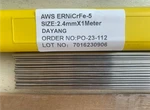

E7016 Mild Steel Welding Electrode Rod
1. Core Q&A About the Product: What & Why E7016?
1.1 What Makes E7016 Unique?
Low-Hydrogen Potassium Coating Design: The coating contains potassium, which controls the hydrogen content in deposited metal to below 10ml/100g, significantly reducing the risk of hydrogen-induced cracking. It also enhances arc stability, compatible with both Alternating Current (AC) and Direct Current (DC) power sources, suitable for field scenarios where dedicated DC equipment is not always available.
All-Position Welding Capability: Supports flat, horizontal, vertical, and overhead welding. No frequent electrode replacement is needed, making it suitable for welding complex angles in ship hulls and heavy machinery.
Excellent Mechanical Properties: The deposited metal has a tensile strength of ≥490MPa and an impact toughness of ≥34J at -40℃. Harmful elements are strictly controlled, with sulfur (S) ≤0.035% and phosphorus (P) ≤0.040%, enabling it to withstand extreme loads and temperature changes.
1.2 Why Choose E7016?
Cost Reduction & Efficiency Improvement: Reduces weld defect rates. A South Korean shipyard saw its NDT (Non-Destructive Testing) pass rate increase from 91% to 99.5% after using E7016, saving USD 200,000 in rework costs per ship. Compared with high-end low-hydrogen electrodes, it costs 30% less, helping a German crane manufacturer save USD 150,000 annually.
Wide Compatibility: Works with multiple grades of mild steel such as Q235 and Q345, reducing inventory types. A Chinese infrastructure enterprise cut its electrode inventory from 5 types to 1, lowering management and training costs.
Strong Compliance: Meets international standards like AWS A5.1 and GB/T 5117, and complies with strict industry regulations for IMO (International Maritime Organization) ship hulls and ASME (American Society of Mechanical Engineers) boilers/pressure vessels, helping enterprises secure international orders.
2. Basic Product Parameters
| Item | Specification Standard |
|---|---|
| Product Type | Low-Hydrogen Potassium Mild Steel Welding Electrode |
| Hydrogen Content in Deposited Metal | ≤10ml/100g |
| Tensile Strength | ≥490MPa |
| Impact Toughness at -40℃ | ≥34J |
| Harmful Element Content | Sulfur ≤0.035%, Phosphorus ≤0.040% |
| Applicable Power Source | Alternating Current (AC)/Direct Current (DC) |
| Welding Positions | All Positions (Flat/Horizontal/Vertical/Overhead) |
| Optional Electrode Diameters | 2.0mm, 2.5mm, 3.2mm, 4.0mm, 5.0mm |
3. Application Scenarios & Cases
3.1 Shipbuilding
Application Parts: Cargo hold bulkheads of container ships, keel connection points of ship hulls
Customer Case: A South Korean shipyard building 12,000-ton container ships used E7016 electrodes with diameters of 3.2mm and 4.0mm to solve the problem of weld cracks in thick plates, shortening the construction cycle of a single ship by 2 weeks.
3.2 Heavy Machinery
Application Parts: Crane booms, connecting lug plates of excavator arms
Customer Case: A German manufacturer of 20-ton excavators adopted E7016 electrodes with diameters of 4.0mm and 5.0mm, combined with a multi-layer multi-pass welding process, increasing the fatigue life of excavator arms by 25%.
3.3 Infrastructure
Application Parts: Main beams and steel columns of highway bridges
Customer Case: In a highway bridge project in northern China, E7016 electrodes with a diameter of 5.0mm were used. Welding was conducted after preheating the base metal to 100-150℃ in an environment of -10℃, and the low-temperature impact energy of the welds reached 42J, meeting the traffic operation requirements.
3.4 Pressure Vessels
Application Parts: Shells of industrial boilers, circumferential welds of cylinder sections
Customer Case: For a 1.6MPa steam boiler of a chemical enterprise, E7016 electrodes with diameters of 3.2mm and 4.0mm were used. Double-person symmetric welding and 100% RT (Radiographic Testing) were conducted, and the boiler operated without leakage for 18 months.
4. Usage & Operation Specifications
4.1 Electrode Pre-Treatment
Baking: Bake the electrodes at 350℃ for 1 hour before welding to remove moisture from the coating.
Storage: After baking, store the electrodes in an insulated bucket at 80-120℃ and take them as needed. Moistened electrodes can be re-baked, but no more than 2 times, to avoid deterioration of the coating performance.
4.2 Welding Parameter Matching
| Electrode Diameter (mm) | Applicable Current (A) | Matching Scenarios |
|---|---|---|
| 2.0 | 50-80 | Precision Welding of Thin Steel Parts |
| 2.5 | 60-90 | Welding of Small-Diameter Pipes and Thin Steel Plates |
| 3.2 | 90-130 | Flat/Vertical Welding of Medium-Thin Workpieces |
| 4.0 | 150-190 | Groove Filling Welding of Thick-Walled Components |
| 5.0 | 180-230 | Multi-Layer Multi-Pass Welding of Heavy Steel Structures |
4.3 Environmental & Base Metal Requirements
Environment: Avoid welding in environments with humidity >80% or wind speed >2m/s. When the temperature is <0℃, preheat the base metal to 100-200℃.
Base Metal: Before welding, derust the base metal by sandblasting until the metallic luster is exposed, and remove oil stains and moisture to prevent impurities from affecting weld quality.
5. Procurement & After-Sales Service
5.1 Supply Specifications
Packaging: 2.5kg/box, 20kg/carton (customizable packaging available)
Bulk Customization: Supports customization of diameter and packaging according to project needs, and provides bulk wholesale discounts.
5.2 Quality Assurance
Certification: The product has passed authoritative testing by SGS and CTI, complying with AWS A5.1 and GB/T 5117 standards.
After-Sales Service: Provides welding technical consultation, such as parameter matching and process optimization. Bulk procurement customers enjoy return and exchange guarantees.
Hot Tags: e7016 mild steel welding electrode rod, China, manufacturers, suppliers, factory, company, wholesale, discount, buy, low price, high quality, products
You Might Also Like


Send Inquiry