




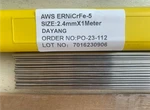
CO₂ Gas Shielded Welding Wire
How to select and use CO₂ gas shielded welding wire for optimal results?
CO₂ gas shielded welding wire is a dedicated welding material matched with CO₂ gas shielded welding process. It is mainly composed of low-carbon steel or low-alloy steel as the base, with added deoxidizing elements (such as manganese, silicon, titanium) and alloying elements to improve welding performance. It has the advantages of high welding efficiency, good forming quality, and strong adaptability to thick and thin plates, making it widely used in general machinery manufacturing, construction steel structure, automobile welding, and hardware processing industries.
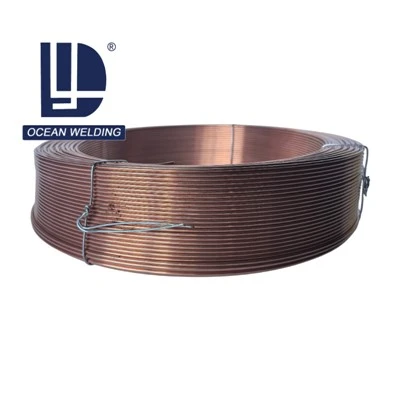


Product Categories and Models
According to the strength level and application scenarios, CO₂ gas shielded welding wires can be divided into multiple types, such as solid core and flux-cored. Specific models include but are not limited to:
ER50-6: A widely used solid core welding wire with a tensile strength of ≥500MPa, suitable for welding low-carbon steel and 500MPa grade low-alloy high-strength steel.
E71T-8: A flux-cored welding wire with good crack resistance, applicable to welding of low-alloy steel structural parts, and suitable for all-position welding.
ER49-1: A cost-effective solid core welding wire, suitable for welding ordinary carbon steel (such as Q235) in general structural parts.
E81T1-Ni1: A low-temperature impact resistant flux-cored welding wire, suitable for welding of low-temperature pressure vessels and engineering machinery that require -40℃ impact performance.
Performance Characteristics
Welding efficiency
It can realize continuous wire feeding and high-current welding, with a deposition rate 2-3 times that of manual arc welding, which significantly shortens the welding cycle.
Mechanical properties
The welded joint has balanced strength and toughness. Different models can meet the requirements of tensile strength, yield strength, and impact toughness in different scenarios.
Process adaptability
It is suitable for various welding positions (flat, horizontal, vertical, overhead) and can weld workpieces of different thicknesses (from 1mm thin plates to 50mm thick plates after groove processing).
Cost performance
CO₂ gas is low in price, and the welding wire has a high utilization rate (no electrode head loss), which reduces the overall welding cost compared with other processes.
Application Areas
Construction steel structure
Used for welding of steel beams, columns, and connecting plates in buildings and bridges, ensuring the structural stability of large-scale projects.
01
Automobile manufacturing
Applied to welding of automobile frames, door frames, and chassis components, with high efficiency to meet the needs of mass production.
02
General machinery
Welding of machine tool beds, brackets, and transmission parts, balancing welding quality and production cost.
03
Hardware processing
Used for welding of metal furniture, steel pipes, and daily hardware products, with simple operation and easy to master.
04
Industry Selection Cases
Case 1: Construction Steel Structure – Welding of Q355B Steel Beam Connections
• Application scenario: Welding of H-shaped steel beams and flange plates in a stadium steel structure (requires tensile strength ≥490MPa and good weld formation).
• Selection: ER50-6 solid core CO₂ gas shielded welding wire.
• Reason: Its strength matches Q355B steel (tensile strength 490-630MPa), and the silicon-manganese deoxidizing system can effectively prevent pore in CO₂ shielding atmosphere; the wire has good fluidity, ensuring full penetration of the beam connection welds and reducing the risk of cold cracks.
Case 2: Automobile Manufacturing – Welding of Car Frame (High-Speed Production Line)
• Application scenario: Automatic welding of automobile frame longitudinal beams (low-carbon steel, thickness 3-8mm) with a production rhythm of 60 pieces/hour.
• Selection: E71T-8 flux-cored CO₂ gas shielded welding wire.
• Reason: Flux-cored wire has higher deposition efficiency than solid core wire, matching the high-speed production line; it has good all-position welding performance, adapting to the complex welding positions of the frame; the flux core can compensate for the slight pollution of the base metal, reducing the requirement for pre-welding cleaning and improving efficiency.
Case 3: Low-Temperature Pressure Vessel – Welding of LPG Tank
• Application scenario: Welding of 16MnDR low-temperature steel LPG tank (requires -40℃ impact energy ≥27J to avoid brittle fracture at low temperature).
• Selection: E81T1-Ni1 flux-cored CO₂ gas shielded welding wire.
• Reason: The nickel element in the wire improves the low-temperature toughness of the weld, meeting the -40℃ impact requirement; the flux core contains strong deoxidizing elements, which can reduce the oxygen content in the weld and avoid the formation of brittle oxides; it is compatible with CO₂ shielding, ensuring stable arc during welding of thick-walled tanks.
Case 4: General Hardware – Welding of Steel Pipe Railing
• Application scenario: Manual welding of Q235 steel pipe railings (thickness 2-4mm) in a residential community (requires simple operation and low cost).
• Selection: ER49-1 solid core CO₂ gas shielded welding wire.
• Reason: It has low cost and is suitable for small batch hardware processing; the welding process is simple, and ordinary welders can master it quickly; the strength matches Q235 steel, and the weld is smooth and beautiful, meeting the appearance requirements of railings.
FAQ
Q1: What is CO₂ gas shielded welding wire?
A1: CO₂ gas shielded welding wire is a welding material used in conjunction with CO₂ gas shielded welding. It is divided into solid core and flux-cored. The solid core wire relies on CO₂ gas to isolate air and deoxidizing elements (manganese, silicon) to prevent oxidation; the flux-cored wire has a flux core inside, which can assist deoxidation and slag removal. It is mainly used for welding carbon steel and low-alloy steel.
Q2: What is the difference between solid core and flux-cored CO₂ gas shielded welding wire?
A2: In structure, solid core wire is a solid metal wire, while flux-cored wire is a hollow wire with flux inside. In performance, solid core wire has high welding efficiency and low spatter, suitable for precision welding; flux-cored wire has strong deoxidation and slag removal ability, suitable for welding rusty or dirty base metals. In application, solid core wire is used for clean workpieces and indoor welding; flux-cored wire is used for outdoor, thick plates or workpieces with poor surface conditions.
Q3: How to choose CO₂ gas shielded welding wire according to the base metal strength?
A3: For ordinary carbon steel (such as Q235, tensile strength 375-500MPa), choose ER49-1 (tensile strength ≥490MPa); for low-alloy high-strength steel (such as Q355, tensile strength 490-630MPa), select ER50-6 (≥500MPa); for high-strength steel (such as Q460, tensile strength ≥460MPa), use ER55-G (≥550MPa) to ensure the joint strength is not lower than the base metal.
Q4: What factors affect the spatter of CO₂ gas shielded welding wire during welding?
A4: The matching of welding parameters is the key: too high current or voltage will increase spatter; the wire feeding speed is unstable, causing arc fluctuation and spatter; the purity of CO₂ gas is insufficient (such as water content >0.05%), which will cause arc instability; the distance between the contact tip and the workpiece is too large (exceeding 15mm) will also increase spatter.
Q5: What pretreatment is required for the base metal before welding with CO₂ gas shielded welding wire?
A5: Remove oil, rust, and paint on the surface of the base metal—mechanical methods (wire brush, grinder) can be used for rust removal, and organic solvents (acetone, gasoline) can be used for degreasing; for thick plates (thickness >10mm), preheat to 80-150℃ if necessary to prevent cold cracks; for flux-cored wire, the cleaning requirement can be appropriately reduced, but severe rust and oil stains must still be removed.
Q6: What defects are prone to occur when using CO₂ gas shielded welding wire?
A6: Common defects include spatter (affecting appearance and increasing cleaning workload), pore (caused by moisture, oil stains, or insufficient gas protection), cold cracks (mostly in low-alloy steel thick plates, caused by high hydrogen content and large restraint intensity), and incomplete fusion (due to low heat input or fast welding speed).
Q7: How to reduce spatter when welding with CO₂ gas shielded welding wire?
A7: Adjust the current and voltage to the optimal matching range (the arc is stable, and the molten pool is quiet); use a welding wire with a smooth surface to ensure stable wire feeding; select high-purity CO₂ gas (purity ≥99.5%) and control the gas flow (15-25L/min for solid core wire); install a spatter inhibitor (anti-spatter spray) on the workpiece surface in advance.
Q8: What is the appropriate CO₂ gas flow rate when using CO₂ gas shielded welding wire?
A8: For solid core wire: when welding thin plates (thickness <3mm), the flow rate is 10-15L/min; for medium and thick plates (3-10mm), it is 15-20L/min; for outdoor or windy environments, increase by 5-10L/min. For flux-cored wire: the flow rate is generally 20-25L/min, because the flux core reaction requires better gas protection.
Q9: What are the storage conditions for CO₂ gas shielded welding wire?
A9: Store in a dry and ventilated warehouse with a relative humidity not exceeding 60% and a temperature of 10-30℃; the packaging must be sealed to prevent moisture (moisture will cause pore and hydrogen-induced cracks); flux-cored wire should be used within 6 months after opening, and unused wire should be sealed and stored in a moisture-proof cabinet.
Q10: Is post-weld heat treatment required after welding with CO₂ gas shielded welding wire?
A10: For ordinary carbon steel structural parts, post-weld heat treatment is not required; for low-alloy steel thick plates (thickness>20mm) or workpieces with high restraint intensity, stress relief annealing at 550-650℃ can be performed to reduce residual stress and prevent cold cracks; for pressure vessels, heat treatment must be carried out according to design specifications.
Q11: Can CO₂ gas shielded welding wire be used for welding stainless steel?
A11: Not recommended. CO₂ is an oxidizing gas, which will cause chromium oxidation in stainless steel, reducing corrosion resistance; stainless steel welding requires inert gas (argon) or argon-carbon dioxide mixed gas, and special stainless steel welding wire should be used instead of ordinary CO₂ gas shielded welding wire.
Q12: How to choose the wire diameter of CO₂ gas shielded welding wire?
A12: For thin plates (thickness 1-3mm), choose 0.8-1.0mm diameter wire; for medium plates (3-10mm), use 1.2-1.6mm wire; for thick plates (≥10mm), select 1.6-2.0mm wire. The wire diameter should also match the welding machine's current range—small-diameter wire is suitable for low current, and large-diameter wire requires high current.
Q13: What is the reason for wire jamming when using CO₂ gas shielded welding wire?
A13: The wire feed wheel pressure is too high, causing the wire to deform; the wire feed hose is bent, blocked by debris, or the inner wall is worn; the welding wire diameter is uneven or there are burrs on the surface; the contact tip aperture is too small, which does not match the wire diameter.
Q14: How to test the mechanical properties of CO₂ gas shielded welding wire welds?
A14: Tensile test: measure the tensile strength, yield strength, and elongation of the joint; impact test: detect the toughness of the weld (especially for low-temperature and high-strength steel); bending test: check the plasticity of the joint (bend 180° without cracks indicates good performance); hardness test: evaluate the hardness distribution of the weld and heat-affected zone.
Q15: How to handle 气孔 in CO₂ gas shielded welding wire welds?
A15: First, use a grinder to remove the 气孔 and the surrounding 5mm range of the weld; clean the repair area with acetone to remove oil and debris; adjust the welding parameters (increase gas flow, reduce current appropriately) and re-weld with low hydrogen type welding wire if necessary; after repair, check with penetration testing to ensure no residual 气孔.
Q16: What should be paid attention to when welding in windy environments with CO₂ gas shielded welding wire?
A16: Use a wind shield to block the wind (wind speed >2m/s will destroy the gas protection); increase the CO₂ gas flow rate by 30-50% to compensate for the gas blown away by the wind; choose flux-cored wire, which has stronger anti-wind ability than solid core wire; avoid welding in open areas with strong winds, or choose indoor welding.
Q17: Can CO₂ gas shielded welding wire be used after being damp?
A17: Slightly damp solid core wire can be used after drying at 150-200℃ for 1-2 hours; severely damp wire (with obvious rust or white spots) may cause a large number of 气孔 and must be scrapped. Flux-cored wire is more sensitive to moisture—slightly damp wire needs to be dried at 250-300℃ for 2-3 hours, and severely damp wire is recommended to be scrapped.
Q18: How to prevent cold cracks when welding low-alloy steel with CO₂ gas shielded welding wire?
A18: Use low-hydrogen type welding wire (such as ER50-6 with hydrogen content <5ml/100g); strictly clean the base metal to remove oil, rust, and moisture (sources of hydrogen); preheat the base metal to 80-150℃ (the thicker the plate, the higher the preheating temperature); perform post-weld heat treatment in time to eliminate hydrogen.
Q19: What is the impact of CO₂ gas moisture content on welding with CO₂ gas shielded welding wire?
A19: High moisture content will cause hydrogen to enter the molten pool, leading to hydrogen-induced cracks; it will also cause arc instability, increase spatter, and make the weld surface rough; in severe cases, white smoke will appear during welding, and the weld will have dense 气孔. Therefore, the moisture content of CO₂ gas should be controlled below 0.05%.
Q20: How to choose between solid core and flux-cored CO₂ gas shielded welding wire?
A20: Choose solid core wire for clean workpieces, high appearance requirements, and indoor welding (such as automobile body welding); select flux-cored wire for workpieces with rust, oil stains, or outdoor welding (such as construction site steel structure); flux-cored wire is preferred for all-position welding of thick plates, while solid core wire is more cost-effective for flat welding of thin plates.
Q21: What is the difference between CO₂ gas shielded welding wire and submerged arc welding wire?
A21: In process, CO₂ gas shielded welding uses gas protection, while submerged arc welding uses flux protection; in efficiency, submerged arc welding is suitable for thick plate flat welding with high deposition rate, and CO₂ gas shielded welding is suitable for all-position welding with flexible operation; in application, CO₂ gas shielded welding wire is used for medium and thin plates and small structural parts, and submerged arc welding wire is used for large-scale equipment (such as pressure vessels, ship hulls).
Q22: How to control the welding speed when using CO₂ gas shielded welding wire?
A22: The welding speed should be matched with current and wire feeding speed: too fast will cause incomplete fusion and shallow penetration; too slow will lead to excessive heat input, large deformation, and coarse grains. For thin plates (1-3mm), the speed is 150-300mm/min; for medium plates (3-10mm), it is 100-200mm/min; for thick plates with grooves, it is 80-150mm/min.
Q23: What is the reason for uneven weld width when using CO₂ gas shielded welding wire?
A23: The welding speed is unstable (fast and slow); the wire feeding speed fluctuates, causing current changes; the welding gun moves unevenly (such as shaking); the groove is asymmetric, leading to uneven distribution of molten metal.
Q24: How to improve the corrosion resistance of CO₂ gas shielded welding wire welds?
A24: Remove the oxide layer and spatter on the weld surface (mechanical grinding or pickling); paint the weld surface (such as anti-rust paint, galvanizing) to form a protective layer; for workpieces in humid environments, choose a welding wire with trace alloy elements (such as copper-plated wire, which has better corrosion resistance than ordinary wire).
Q25: What should be paid attention to when using CO₂ gas shielded welding wire for all-position welding?
A25: Choose a flux-cored welding wire with good flowability (such as E71T-8) or a solid core wire with special processing; use small-diameter wire (0.8-1.2mm) and low current to control the molten pool; adopt short-circuit transition mode to avoid molten metal sagging; maintain a stable welding gun angle (vertical or slightly inclined to the workpiece).
Q26: How to handle the situation where the weld has slag inclusions when using flux-cored CO₂ gas shielded welding wire?
A26: First, check whether the flux core is evenly distributed (uneven flux core will cause local slag inclusions); increase the welding current appropriately to ensure the slag floats up; clean the slag between welding passes (especially for multi-layer welding); adjust the welding gun angle to avoid slag being trapped in the weld.
Q27: What is the service life of CO₂ gas shielded welding wire?
A27: Unopened welding wire can be stored for 2 years under standard storage conditions; opened solid core wire should be used within 1 year, and flux-cored wire should be used within 6 months (flux core is easy to absorb moisture); if the surface is oxidized (rusty) or the flux core is damped (hardened), the service life is terminated, and it should be scrapped.
Q28: How to choose welding parameters for CO₂ gas shielded welding wire when welding thick plates?
A28: Use large-diameter wire (1.6-2.0mm) and high current (250-400A) to ensure penetration; adopt multi-layer multi-pass welding, and clean the slag between layers; preheat the base metal to 100-150℃ to reduce cold crack risk; use a U-shaped or X-shaped groove to increase the fusion area.
Q29: What is the impact of the distance between the contact tip and the workpiece (stick-out) on welding?
A29: Too long a stick-out (>15mm) will cause unstable arc, increased spatter, and reduced penetration; too short (<5mm) will cause the contact tip to be heated and worn, and the weld may be blocked by the tip. The appropriate stick-out is 10-15mm, which can ensure stable current transmission and gas protection.
Q30: How to prevent incomplete fusion when welding with CO₂ gas shielded welding wire?
A30: Ensure the groove is clean and free of oxides, rust, and oil stains; adjust the heat input (increase current or reduce welding speed) to ensure the base metal edge melts; maintain a proper welding gun angle (10-15° forward inclination) to direct the arc to the fusion zone; for thick plates, use a bevel to increase the fusion area.
Q31: What is the difference between copper-plated and non-copper-plated CO₂ gas shielded welding wire?
A31: Copper-plated wire has a layer of copper on the surface, which improves electrical conductivity and reduces wire feeding resistance, suitable for high-speed wire feeding occasions (such as automobile production lines); non-copper-plated wire is cheaper, but has higher requirements for wire feeding equipment. Copper-plated wire has better corrosion resistance in storage, but the copper layer may fall off if the plating is poor, causing blockage.
Q32: How to test the quality of CO₂ gas shielded welding wire before use?
A32: Check the surface: no rust, oil stains, or burrs, and the copper plating (if any) is uniform; check the diameter: use a caliper to measure, and the tolerance should be within ±0.02mm; for flux-cored wire, bend the wire to check if the flux core is continuous and free of powder leakage; perform a trial welding to observe arc stability, spatter, and weld formation.
Q33: What is the impact of ambient humidity on CO₂ gas shielded welding?
A33: High humidity (>70%) will cause the welding wire and base metal to absorb moisture, increasing the risk of 气孔 and hydrogen-induced cracks; it will also reduce the effectiveness of CO₂ gas protection (moisture in the air reacts with the gas). In high humidity environments, dehumidify the workplace, preheat the base metal, and use low-hydrogen welding wire.
Q34: How to choose CO₂ gas shielded welding wire for low-temperature environment welding?
A34: Select welding wire with low-temperature impact toughness (such as E81T1-Ni1, -40℃ impact energy ≥27J); choose flux-cored wire with better crack resistance than solid core wire; the welding wire should have low hydrogen content (<5ml/100g) to prevent cold cracks; preheat the welding wire and base metal to room temperature (>15℃) before use.
Q35: How to reduce welding deformation when using CO₂ gas shielded welding wire?
A35: Adopt symmetrical welding sequence (weld from both sides of the workpiece alternately) to balance stress; use intermittent welding instead of continuous welding to reduce heat accumulation; pre-set reverse deformation (calculate the deformation direction in advance and bend the workpiece oppositely); use fixtures with strong rigidity to clamp the workpiece during welding; cool the weld with a heat sink (such as a copper block) after welding.