




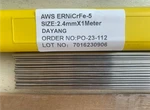
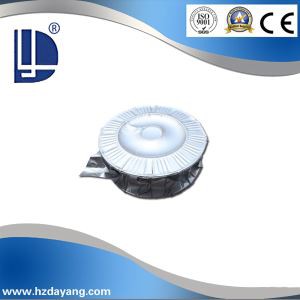
Flux Cored Welding Wire

Flux-Cored Stainless Steel Welding Wire is a metal wire filled with flux, used for gas shielded welding (such as FCAW) or self-shielded welding.
Compared with solid wire, flux-cored wire has higher deposition efficiency and is suitable for high-speed welding and thick plate welding.


Product categories and models
High welding efficiency: The deposition speed of flux-cored welding wire is much higher High efficiency and energy saving: Flux-cored welding wire has high deposition efficiency and fast welding speed, saving a lot of time and cost.
Easy operation: The welding conditions can be set flexibly, suitable for semi-automatic or fully automatic welding, the welding process is stable, and the weld quality is good.
Environmental performance: Flux-cored welding wire has less spatter, which reduces pollution during welding and is environmentally friendly.
Excellent comprehensive performance: The weld after welding has good mechanical properties, corrosion resistance and crack resistance, which is suitable for welding needs in complex environments.
ER308L: Suitable for MAG welding, with good corrosion resistance and crack resistance, commonly used in ships, construction, machinery and other fields.
ER316L: Suitable for marine engineering and chemical equipment, with excellent salt spray corrosion resistance.
Performance characteristics
High welding efficiency
The deposition speed of flux-cored welding wire is much higher than that of manual welding rods, and the deposition efficiency can reach about 90%, which is 2-4 times higher than that of traditional welding rods.
Excellent welding performance
The arc stabilizer added to the flux-cored welding wire can stabilize the arc, make the weld beautiful, have less spatter, and have good slag removal, which is suitable for all-position welding.
Excellent corrosion resistance
Flux-cored welding wire usually contains a variety of chemical elements, such as molybdenum, niobium, tantalum, etc. These elements can improve the high-temperature creep resistance, intergranular corrosion resistance and mechanical properties of the weld.
Wide range of applications
Flux-cored welding wire is not only suitable for stainless steel welding, but also for welding other metal materials such as nickel alloys and carbon steel.
Application areas

01
Petrochemical industry
Such as pipeline welding, storage tank welding, etc., flux-cored welding wire has good corrosion resistance and crack resistance, and is suitable for high temperature and high pressure environment.

02
Construction industry
Used for welding of building structures, such as bridges, towers, etc., with beautiful welds and high strength.

03
Machinery manufacturing
Suitable for welding of mechanical equipment, ships, vehicles, etc., with high welding efficiency and stable weld quality.

04
Nuclear power and aerospace
In these special fields, flux-cored welding wire is widely used in the welding of key components due to its excellent corrosion resistance and crack resistance.
FAQ
Q1: What is stainless steel flux-cored welding wire?
A1: Stainless steel flux-cored welding wire is a welding wire made by drawing a certain amount of powder into a thin steel strip. During welding, the steel strip and powder work together to protect the molten pool and fill the weld. It is suitable for welding stainless steel materials.
Q2: Compared with solid stainless steel welding wire, what are the advantages of flux-cored welding wire?
A2: Flux-cored welding wire has higher deposition efficiency and faster welding speed; good arc stability and less spatter; strong adaptability to welding in various positions; and can improve the performance and crack resistance of weld metal by adjusting the powder composition.
Q3: What welding methods are suitable for stainless steel flux-cored welding wire?
A3: It is mainly suitable for gas shielded welding (such as CO₂ gas shielded welding, mixed gas shielded welding) and self-shielded welding. Different welding methods correspond to different types of flux-cored welding wire.
Q4: How to choose a suitable flux-cored welding wire according to the stainless steel base material?
A4: The chemical composition of the base material (such as chromium, nickel, and molybdenum content), mechanical property requirements, and the use environment of the welding joint need to be considered. For example, for 304 stainless steel base material, ER308L flux-cored wire can be selected.
Q5: How to choose the gas protection type of flux-cored wire?
A5: Pure CO₂ gas is generally used for ordinary stainless steel welding; when welding stainless steel with higher requirements, Ar+CO₂ or Ar+O₂ mixed gas can be used to improve weld formation and reduce pores.
Q6: What are the diameter specifications of stainless steel flux-cored wire?
A6: Common diameter specifications include 0.8mm, 1.0mm, 1.2mm, 1.4mm, 1.6mm, etc. Small diameter wires are suitable for thin plates or all-position welding, and large diameters are used for thick plate welding.
Q7: How do welding current and voltage match flux-cored wire?
A7: The welding current is mainly determined by the diameter of the welding wire and the thickness of the plate. The voltage needs to match the current. Generally, too high a voltage will lead to an increase in the weld width and a decrease in the excess height. If the voltage is too low, the weld depth will be insufficient and the weld will be narrow and high. The specific parameters need to be adjusted through trial welding.
Q8: What defects are easy to occur when welding stainless steel flux-cored wire?
A8: Common defects include pores, cracks (including hot cracks and cold cracks), unfusion, slag inclusions, etc. Porosity is mostly caused by poor gas protection or dampness of the flux core. Cracks are related to welding process, parent material composition and weld stress.
Q9: How to prevent the generation of welding pores?
A9: Ensure good gas protection and appropriate gas flow (generally 15-25L/min); dry the welding wire as required before use (usually 150-200℃ for 1-2 hours); clean the welding part of oil, rust and other impurities.
Q10: Can the flux-cored wire still be used after it is damp?
A10: Slightly damp flux-cored wire can be used after drying according to regulations; severely damp welding wire may cause increased porosity and unstable arc during welding, and is not recommended to be used to avoid affecting the welding quality.
Q11: What are the storage conditions for stainless steel flux-cored wire?
A11: It should be stored in a dry and well-ventilated environment, with room temperature maintained at 10-30℃ and relative humidity not exceeding 60%; the welding wire packaging should be sealed to avoid moisture and rust.
Q12: What are the requirements for the welding gun angle when welding stainless steel flux-cored wire?
A12: The angle between the welding gun and the workpiece is generally 70-85° during flat welding; the positions of vertical welding and overhead welding need to be adjusted according to the specific situation to ensure that the molten pool is stable and the weld is well formed. The angle between the welding gun and the weld is usually kept at 60-80°.
Q13: How to adjust the wire feeding speed of flux-cored wire?
A13: The wire feeding speed needs to match the welding current and voltage, and is generally adjusted by the wire feeding system of the welding equipment. If the wire feeding speed is too fast, the welding wire will not be fully melted. If it is too slow, the deposition efficiency will be low. The appropriate parameters need to be determined according to the welding process test.
Q14: How to post-process the weld after welding with stainless steel flux-cored wire?
A14: Weld cleaning (removing welding slag and spatter), grinding (making the weld surface smooth), pickling and passivation (improving corrosion resistance) and other treatments can be performed according to requirements. The specific treatment method depends on the use requirements of the welding joint.
Q15: What effect does the powder composition of flux-cored wire have on welding quality?
A15: The powder contains arc stabilizers, deoxidizers, alloying agents and other ingredients. Arc stabilizers can improve arc stability; deoxidizers can reduce the oxygen content in the weld; alloying agents can adjust the chemical composition and properties of the weld metal, directly affecting the strength and corrosion resistance of the weld.
Q16: Are there special requirements for stainless steel flux-cored wires in different welding positions?
A16: Yes, all-position welding requires the welding wire to have good operability and arc stability, and the solidification speed of the molten pool is moderate; for flat welding positions, welding wires with higher deposition efficiency can be selected, and the operability requirements are relatively low.
Q17: How to judge the quality of stainless steel flux-cored welding wire?
A17: It can be judged by observing the appearance of the welding wire (the surface should be smooth, rust-free, and the powder filling should be uniform), conducting welding tests (checking arc stability, spatter size, weld formation, and defects), and detecting the mechanical properties and chemical composition of the weld metal.
Q18: Can stainless steel flux-cored welding wire be used for welding dissimilar stainless steel materials?
A18: Yes, but it is necessary to select welding wires with a composition between the two or that can meet higher performance requirements based on the chemical composition and performance requirements of the two parent materials, and formulate appropriate welding processes.
Q19: What is the reason for the wire breakage phenomenon of flux-cored welding wire during welding?
A19: Possible reasons include excessive or insufficient pressure on the wire feed wheel, blockage of the wire feed hose, wire quality problems (such as uneven powder filling leading to local strength reduction), inappropriate welding parameters (excessive current causes the wire to overheat and become brittle), etc.
Q20: What is the difference between the deposited metal and weld metal of flux-cored wire?
A20: The deposited metal refers to the weld metal formed by the complete melting of the filler metal; the weld metal includes the filler metal and the partially melted parent material, and the two may differ in chemical composition and performance.
Q21: How to reduce welding deformation when using stainless steel flux-cored wire for welding?
A21: Reasonable welding sequence (such as symmetrical welding, segmented de-welding), control of welding heat input (using smaller welding current and faster welding speed), rigid fixation of the workpiece and other methods can be used to reduce deformation.
Q22: What is the shelf life of flux-cored wire?
A22: Under the condition of meeting the storage conditions, the shelf life of stainless steel flux-cored welding wire is generally 1-2 years, but the quality of the welding wire still needs to be checked before actual use. If problems such as moisture and rust are found, it needs to be used with caution.
Q23: When welding stainless steel flux-cored welding wire, is preheating and post-heating required?
A23: For stainless steel with large thickness, high carbon content or welded in low temperature environment, preheating may be required (generally preheating temperature 50-150℃); post-heating is mainly used to prevent cold cracks, which needs to be determined according to specific material and process requirements.
Q24: What is the difference between flux-cored welding wire and welding rod when welding stainless steel?
A24: Flux-cored welding wire has high welding efficiency and can be welded continuously; the arc is stable and the weld is well formed; it is suitable for automated welding. Welding rods have good flexibility and are suitable for small batch and complex structure welding, but the deposition efficiency is low and the welding rods are frequently replaced.
Q25: How to choose the shielding gas flow rate of stainless steel flux-cored welding wire?
A25: The gas flow rate needs to be adjusted according to the welding position, welding current and environmental conditions. Generally, the flow rate is 15-20L/min for flat welding, and it is appropriately increased to 20-25L/min for vertical welding and overhead welding to ensure a good gas protection effect.
Q26: How to ensure the corrosion resistance of the weld after welding with stainless steel flux-cored wire?
A26: In addition to selecting welding wire with suitable composition, it is also necessary to control the welding heat input to avoid overheating and deterioration of the weld structure; pickling and passivation treatment is performed after welding to remove surface oxide scale and impurities and improve corrosion resistance.
Q27: Will the powder leakage of flux-cored wire affect the welding quality?
A27: Powder leakage will cause uneven powder composition, affecting the protection effect and performance of the weld, such as pores, decreased mechanical properties, etc. Therefore, welding wire with powder leakage should be used with caution or scrapped.
Q28: When welding stainless steel flux-cored wire, how to choose the power polarity?
A28: When using gas shielded welding, DC reverse connection (welding wire connected to positive electrode) is usually used to obtain a stable arc, less spatter and good penetration; self-shielded welding generally uses DC positive connection.
Q29: How to clean the welding gun after stainless steel flux-cored wire welding?
A29: After welding, the spatter in the welding gun nozzle should be cleaned in time. You can use a special nozzle cleaning tool or soak it in anti-splash agent; regularly check and replace the conductive nozzle to ensure smooth wire feeding and good conductivity.
Q30: What should be paid attention to when welding stainless steel flux-cored wire in a low temperature environment?
A30: When welding in a low temperature environment, the base material needs to be preheated to prevent cold cracks; improve the gas protection effect to prevent poor protection caused by low-temperature liquefaction of the gas; appropriately reduce the welding speed to ensure that the weld is fully fused.
This annotation form is clearer and more intuitive. If you think there are places that need to be supplemented or modified, or if you have other new needs, please tell me at any time.