




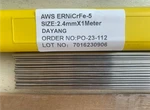
Copper Alloy Electrode
High-Strength Copper Alloy Electrodes
High-strength Copper Alloy Electrodes are specialized welding consumables designed for welding copper alloys (such as brass, bronze, copper-nickel, and copper-silver alloys). With a core made of copper alloy (copper content ≥60%, blended with elements like zinc, tin, nickel, or silver) and a functional coating (e.g., flux-cored, low-hydrogen), they address the low weldability of copper alloys caused by high thermal conductivity and alloy segregation. These electrodes ensure stable arcs, strong weld bonding, and consistent performance matching the base material, making them essential in marine engineering, mechanical manufacturing, and electrical equipment.


Product Categories and Models
Based on alloy composition and application scenarios, common models include:
ECuZn Brass Electrodes
Copper-zinc alloy core (zinc content 20–30%), designed for welding brass (copper-zinc alloys). Features good fluidity and machinability, suitable for brass valves, pipe fittings, and decorative parts.
ECuSn Bronze Electrodes
Copper-tin alloy core (tin content 5–10%), with high strength and wear resistance. Used for welding bronze (copper-tin alloys) such as marine propellers, bearing bushes, and gear hubs.
ECuNi Copper-Nickel Electrodes
Copper-nickel alloy core (nickel content 10–30%), offering excellent seawater corrosion resistance. Ideal for welding copper-nickel alloys in ship pipelines, desalination equipment, and offshore platforms.
ECuAg Copper-Silver Electrodes
Copper-silver alloy core (silver content 5–15%), with high electrical conductivity and low melting point. Suitable for welding copper-silver alloys in high-precision electrical components (e.g., connectors, switches).
Performance Characteristics
Alloy Compatibility
The core composition is tailored to match specific copper alloys, avoiding brittle intermetallic compounds and ensuring weld strength is close to the base material.
Corrosion Resistance
Copper-nickel and copper-silver electrodes resist seawater, moisture, and mild acids, making them suitable for harsh environments.
Mechanical Properties
Welds have high tensile strength (≥300MPa for bronze electrodes) and good ductility, meeting the load-bearing requirements of mechanical parts.
Process Adaptability
Compatible with shielded metal arc welding (SMAW), TIG, and MIG, adapting to different thicknesses and welding positions.
Application Areas
Marine Engineering
Welding of copper-nickel ship pipelines, bronze propellers, and brass marine hardware (resists seawater corrosion).
01
Mechanical Manufacturing
Repair and manufacturing of bronze bearings, brass gears, and copper alloy molds (restores wear resistance and strength).
02
Electrical Engineering
Welding of copper-silver alloy connectors, brass terminal blocks, and copper alloy motor components (ensures electrical conductivity).
03
Plumbing & Decorative Arts
Welding of brass pipe fittings, copper alloy faucets, and decorative copper alloy parts (ensures leak tightness and aesthetics).
04
FAQ
Q1: What is a high-strength Copper Alloy Electrode?
A1: A high-strength Copper Alloy Electrode is a welding electrode with a copper alloy core (blended with zinc, tin, nickel, or silver) and a functional coating, designed to weld copper alloys. Its “high-strength” feature comes from the core’s alloy elements (e.g., tin enhances hardness, nickel improves toughness), ensuring welds have tensile strength ≥300MPa—suitable for load-bearing copper alloy parts like bronze gears or ship pipelines.
Q2: How does a Copper Alloy Electrode differ from a pure Copper Electrode?
A2: In composition, Copper Alloy Electrodes contain alloy elements (zinc, tin, etc.) to match copper alloys, while pure Copper Electrodes are nearly 100% copper. In performance, Copper Alloy Electrodes prioritize strength and corrosion resistance (e.g., ECuNi resists seawater), while pure Copper Electrodes focus on conductivity (for electrical busbars). Applications: Copper Alloy Electrodes for marine bronze parts; pure Copper Electrodes for motor windings.
Q3: How to choose a Copper Alloy Electrode based on the copper alloy type?
A3: Match the electrode to the base alloy’s key elements:
• Brass (copper-zinc): Use ECuZn (zinc content 20–30%) to replenish zinc lost during welding (prevents brittleness).
• Bronze (copper-tin): Choose ECuSn (tin 5–10%) to ensure weld wear resistance matches the base material (e.g., for bearing bushes).
• Copper-nickel alloy: ECuNi (nickel 10–30%) for seawater corrosion resistance (critical for ship pipelines).
• Copper-silver alloy: ECuAg (silver 5–15%) to maintain high conductivity (for electrical connectors).
Q4: Why is preheating more important for Copper Alloy Electrodes than pure Copper Electrodes?
A4: Copper alloys (e.g., bronze, brass) have higher melting points and lower thermal conductivity than pure copper, but they are more prone to cold cracks due to alloy segregation. Preheating (200–400°C) reduces thermal stress, slows cooling, and allows alloy elements to distribute evenly in the weld pool. For example, welding thick bronze parts without preheating may cause tin segregation (localized brittleness), while preheating prevents this.
Q5: What defects are common in Copper Alloy Electrode welds, and how to prevent them?
A5: Common defects include:
• Zinc evaporation (in brass welding): Causes porosity. Prevent by using ECuZn with matching zinc content and low current (reduces evaporation).
• Tin segregation (in bronze welding): Causes brittle spots. Prevent by preheating to 300°C and using slow cooling.
• Cracks in copper-nickel welds: Caused by thermal stress. Prevent by preheating and post-weld stress relief (250°C for 1 hour).
Q6: Can Copper Alloy Electrodes weld copper alloys to steel?
A6: Yes, but use a copper-nickel electrode (ECuNi) as a transition. Nickel in the electrode improves compatibility with both copper alloys and steel. Preheat to 200–300°C to reduce stress; weld with low current (100–120A for 3.2mm electrode) to avoid excessive dilution of alloy elements. After welding, cool slowly to prevent cracks at the joint.
Q7: How to choose welding current for Copper Alloy Electrodes?
A7: Current depends on electrode diameter and alloy type:
• 2.5mm electrode: 80–100A (suitable for thin brass/bronze sheets ≤3mm).
• 3.2mm electrode: 100–140A (for 3–6mm thick copper-nickel or bronze parts).
• 4.0mm electrode: 140–180A (for thick bronze/copper-nickel parts ≥6mm).
Brass requires lower current than bronze (to reduce zinc evaporation); copper-nickel needs slightly higher current (due to higher melting point).
Q8: What shielding gas is suitable for Copper Alloy Electrodes in TIG/MIG welding?
A8: Use high-purity argon (≥99.99%) for most copper alloys—it prevents oxidation and stabilizes the arc. For brass, add 2–5% hydrogen to argon (reduces zinc oxide formation and porosity). For copper-nickel, argon + 5–10% helium improves penetration (critical for thick parts). Avoid nitrogen-based gases (causes brittle nitrides).
Q9: How to store Copper Alloy Electrodes to maintain performance?
A9: Store in a dry, sealed container at 10–30°C with relative humidity ≤60%—moisture damages the flux coating (causes porosity). Brass electrodes are sensitive to sulfur (causes zinc sulfide formation), so avoid storage near rubber or sulfur-containing materials. Unopened electrodes have a 2-year shelf life; opened ones should be used within 1 month (store in a moisture-proof cabinet).
Q10: What post-weld treatment is needed for Copper Alloy Electrode welds?
A10: For load-bearing parts (e.g., bronze gears): Stress relief annealing at 250–300°C for 1 hour to reduce residual stress.
For corrosion-resistant parts (e.g., copper-nickel pipes): Pickle with 5% nitric acid to remove oxides, then rinse with water (restores corrosion resistance).
For machined parts (e.g., brass fittings): Grind or file the weld to smooth the surface (improves machinability).
Q11: How to prevent oxidation in Copper Alloy Electrode welds?
A11: Oxidation (a black/green film) weakens welds and reduces corrosion resistance. Prevention:
• Use a short arc (arc length = electrode diameter) to minimize air contact.
• Ensure shielding gas covers the weld until cooled to <300°C.
• Clean the base material with a wire brush + acetone to remove pre-weld oxides.
If oxidation occurs, gently grind the surface with 240-grit sandpaper.
Q12: What is the difference between ECuSn and ECuNi Copper Alloy Electrodes?
A12: ECuSn (copper-tin) is designed for bronze welding—tin enhances wear resistance and strength, making it ideal for high-friction parts like bearing bushes. ECuNi (copper-nickel) prioritizes corrosion resistance (especially to seawater), suitable for marine pipelines and offshore equipment. Example: Use ECuSn for bronze propeller shafts; ECuNi for ship cooling water pipes.
Q13: Can Copper Alloy Electrodes be used for welding copper alloy castings?
A13: Yes, but castings often have porosity or impurities, so pre-weld inspection is critical. Grind off surface defects (e.g., sand inclusions) before welding. Use ECuSn or ECuNi (high crack resistance) and preheat to 300–400°C (reduces stress from casting residual stress). Weld with low current and multi-layer passes to avoid excessive heat input.
Q14: How to choose electrode diameter for different copper alloy thicknesses?
A14: Follow this guideline:
• 1–3mm thick: 2.5mm electrode (current 80–100A).
• 3–6mm thick: 3.2mm electrode (current 100–140A).
• 6–10mm thick: 4.0mm electrode (current 140–180A).
• ≥10mm thick: 5.0mm electrode + multi-layer welding (current 180–220A for the first layer).
Example: A 5mm thick brass pipe requires a 3.2mm ECuZn electrode.
Q15: What causes spatter in Copper Alloy Electrode welds, and how to prevent it?
A15: Spatter is caused by unstable arcs (common in AC welding) or excessive current. Prevention:
• Use DC reverse polarity (more stable than AC) for smoother arcs.
• Adjust current to the lower end of the recommended range (e.g., 100A instead of 140A for 3.2mm brass electrodes).
• Keep the electrode angle at 30–45° to avoid metal droplet ejection.
Q16: How to handle moisture-absorbed Copper Alloy Electrodes?
A16: Slightly damp electrodes (stored in 60–70% humidity for <1 week) can be baked at 150–200°C for 1 hour to remove moisture. Severely damp electrodes (flux caking or visible moisture) should be discarded—moisture causes porosity, and baking cannot restore the flux’s ability to prevent oxidation.
Q17: What safety precautions are specific to Copper Alloy Electrodes?
A17: Brass welding releases zinc fumes (toxic if inhaled)—wear a respirator with a zinc fume filter and ensure ventilation. Copper alloy dust can irritate the skin—use gloves. Flux coatings may contain fluorides—avoid eye contact and wash hands after use.
Q18: How to test the quality of Copper Alloy Electrode welds?
A18: For mechanical parts: Tensile strength test (should match the base alloy, e.g., ≥350MPa for bronze).
For corrosion-resistant parts: Salt spray test (5% NaCl, 500 hours—no red rust or pitting).
For leak-tight parts (e.g., pipes): Pressure test (1.5x working pressure for 30 minutes—no leaks).
Q19: Can different types of Copper Alloy Electrodes be mixed in welding?
A19: No, mixing is not recommended. For example, ECuZn (brass) and ECuSn (bronze) have different alloy elements—mixing causes uneven composition, leading to brittle welds or corrosion. Stick to one electrode type per weld; if switching is necessary, test the joint for strength and corrosion resistance first.
Q20: How to prevent warping of thin copper alloy sheets when using Copper Alloy Electrodes?
A20: Thin sheets (≤3mm) warp easily due to uneven heating. Prevention:
• Use fixtures to clamp the sheet before welding.
• Weld in a staggered pattern (e.g., weld 2cm on one side, then 2cm on the opposite side) to balance stress.
• Use a 2.5mm electrode and low current (80–100A) to minimize heat input.
Q21: What is the impact of welding speed on Copper Alloy Electrode welds?
A21: Too fast a speed causes incomplete fusion (especially in bronze, which has high melting point). Too slow a speed leads to overheating, causing zinc evaporation (in brass) or grain coarsening (in copper-nickel). For 3.2mm electrodes, a speed of 10–15 cm/min is optimal—faster for brass (reduces zinc loss), slower for bronze (ensures fusion).
Q22: How to repair a cracked copper alloy part with Copper Alloy Electrodes?
A22: Grind the crack to a V-shape (depth 2–3mm beyond the visible crack) and clean with acetone. Preheat the area to 200–300°C (higher for thick parts). Weld with the matching electrode (e.g., ECuSn for bronze), filling the V-groove in thin layers (each layer ≤2mm). After welding, grind smooth and perform a penetration test to confirm no residual cracks.
Q23: What is the shelf life of Copper Alloy Electrodes?
A23: Unopened electrodes have a 2-year shelf life in dry storage (≤60% humidity). Opened electrodes are prone to flux degradation and alloy oxidation—use within 1 month. Flux-cored Copper Alloy Electrodes have a shorter shelf life (1.5 years unopened) due to flux sensitivity to moisture.
Q24: How to choose between flux-cored and solid Copper Alloy Electrodes?
A24: Flux-cored electrodes have a hollow core with flux, which cleans the weld and provides shielding—ideal for on-site repairs or dirty surfaces (e.g., rusty brass pipes). They offer high deposition efficiency but may produce more slag.
Solid electrodes require external shielding gas (argon) but produce cleaner, more precise welds—suitable for high-quality parts like copper-nickel ship pipelines or electrical components.
Q25: Can Copper Alloy Electrodes weld copper alloys to aluminum?
A25: Direct welding is not recommended—copper and aluminum form brittle intermetallic compounds. If necessary, use a copper-aluminum transition piece: weld the copper alloy to the copper layer with a Copper Alloy Electrode, then weld aluminum to the aluminum layer with an aluminum electrode. This is only suitable for low-stress applications (e.g., decorative parts).
Q26: How to prevent undercuts in Copper Alloy Electrode welds?
A26: Undercuts (grooves at the weld edge) are caused by high current, steep electrode angles, or fast welding. Prevention:
• Reduce current by 10–15% (e.g., from 140A to 120A for 3.2mm electrodes).
• Keep the electrode angle at 30–45° (not perpendicular to the workpiece).
• Slow welding speed to allow molten metal to fill the edge.
Q27: What is the best way to clean copper alloys before welding with Copper Alloy Electrodes?
A27: Step 1: Use a stainless steel wire brush to remove oxides, rust, or casting residues.
Step 2: Wipe with acetone to remove oil, grease, or fingerprints (oils cause porosity).
Step 3: For copper-nickel or bronze, etch with a 5% sulfuric acid solution (1 minute) to remove stubborn oxides, then rinse with water.
Cleanliness ensures good fusion and reduces defects.
Q28: How does temperature affect Copper Alloy Electrode performance in welding?
A28: Low ambient temperatures (≤5°C) increase heat loss, making fusion harder—preheat the base material to 300°C instead of 200°C. High temperatures (≥35°C) accelerate zinc evaporation in brass—use lower current and faster welding speed to minimize heat exposure.
Q29: What is the maximum thickness Copper Alloy Electrodes can weld?
A29: With preheating and multi-layer welding, they can weld up to 25mm thick copper alloys. For thick parts:
• Use a 5.0mm electrode for the root pass (current 180–220A).
• Fill with 4.0mm electrodes, keeping interpass temperature ≤300°C.
• Preheat to 300–400°C and cool slowly between layers to avoid cracks.
Q30: How to evaluate the corrosion resistance of Copper Alloy Electrode welds?
A30: For marine parts, perform a seawater immersion test (30 days in natural seawater—no pitting or corrosion). For industrial parts, use a 10% salt solution spray test (500 hours—no red rust). For chemical applications, test in the service medium (e.g., 5% sulfuric acid for 100 hours—no weight loss >0.1g/cm²).
Q31: Can Copper Alloy Electrodes be used for overlay welding (surfacing)?
A31: Yes, they are ideal for surfacing copper alloy parts to restore dimensions or enhance wear resistance. Use ECuSn for bronze surfacing (wear resistance) or ECuNi for corrosion-resistant surfacing. Weld in thin layers (each ≤2mm) with low current to avoid diluting the base material.
Q32: How to handle weld porosity in Copper Alloy Electrode welds?
A32: Porosity is caused by moisture, zinc evaporation, or poor shielding. Solutions:
• Bake electrodes to remove moisture; clean the base material to remove oil/water.
• For brass, reduce current and increase welding speed to reduce zinc loss.
• For TIG/MIG, check shielding gas flow (15–20 L/min) and ensure no leaks in the gas line.
Q33: What is the impact of electrode coating type on Copper Alloy Electrode performance?
A33: Flux coatings (common in SMAW) provide shielding and remove impurities—good for dirty surfaces but may leave slag.
Low-hydrogen coatings reduce hydrogen-induced cracks—suitable for thick copper-nickel parts or high-stress welds.
Rutile coatings offer stable arcs and easy slag removal—ideal for thin sheets or beginners.
Q34: How to choose Copper Alloy Electrodes for high-temperature applications?
A34: Choose copper-nickel electrodes (ECuNi) with 20–30% nickel—nickel enhances high-temperature stability (resists oxidation up to 500°C). Avoid brass electrodes (zinc evaporates above 350°C) or bronze with low tin (prone to softening). For temperatures >500°C, use copper-silver electrodes (ECuAg) with 10–15% silver (improves heat resistance).
Q35: How to ensure consistent weld color with Copper Alloy Electrodes?
A35: Weld color indicates shielding quality:
• Silvery/bright gold: Good shielding (minimal oxidation).
• Dull yellow/blue: Mild oxidation (acceptable for non-critical parts).
• Black/green: Severe oxidation (requires re-welding).
To maintain color: Use proper shielding gas flow, avoid excessive current, and cool the weld in a shielded environment (e.g., cover with argon until cool).