




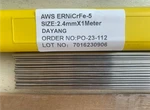
Submerged Arc Welding Wire
Efficient Submerged ARC Welding Wire
Efficient submerged arc welding wire is a high-deposition welding material designed for thick-plate welding, paired with granular flux for submerged arc welding. It is mainly made of low-carbon steel or low-alloy steel, with added deoxidizing elements (manganese, silicon, titanium) and alloying elements (chromium, molybdenum) to match base metal performance. The wire melts under the protection of molten flux, avoiding air contact, and features high welding efficiency, deep penetration, and stable joint quality. It is widely used in heavy machinery, shipbuilding, pressure vessel manufacturing, and steel structure engineering.
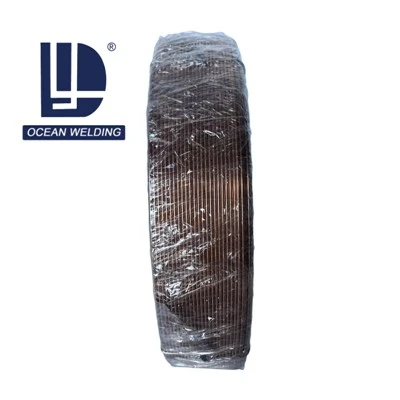
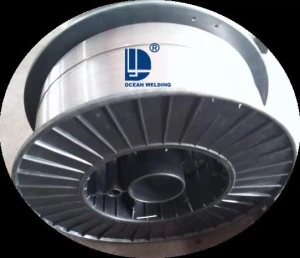


Product Categories and Models
Classified by strength level and alloy composition, common models include:
H08A
A low-carbon steel welding wire with low alloy content, suitable for welding mild steel (Q235) and general structural parts. Cost-effective and widely used.
H08MnA
A manganese-containing low-alloy wire, with tensile strength ≥420MPa. Suitable for welding 300MPa-grade low-alloy steel (Q345) in bridges and machinery.
H10Mn2
A high-manganese wire with better toughness, suitable for welding medium-thick plates (10-30mm) of low-alloy steel, such as ship hulls.
H08CrMoA
A chromium-molybdenum alloy wire, resistant to high temperature and pressure. Used for welding high-pressure pipelines and boiler steel (15CrMo).
Performance Characteristics
High deposition efficiency
Continuous wire feeding enables a deposition rate of 15-50kg/h, 5-10 times that of manual arc welding, significantly reducing welding time for thick plates.
Deep penetration
Large current welding (300-1000A) ensures penetration depth of 5-20mm, suitable for one-time welding of thick plates (≥8mm).
Stable quality
Flux isolation of air reduces spatter and pores; the weld has uniform composition and low impurity content (sulfur, phosphorus ≤0.03%).
Mechanical matching
Welded joints match the base metal’s strength and toughness. For example, H08MnA matches Q345’s tensile strength (≥470MPa).
Application Areas
Shipbuilding
Welding of hull plates, deck structures, and bulkheads (requires high strength and seawater corrosion resistance).
01
Pressure vessels
Welding of oil storage tanks, chemical reactors, and boiler drums (requires pressure resistance and tightness).
02
Heavy machinery
Welding of excavator arms, crane booms, and machine tool beds (requires high joint strength).
03
Steel structures
Welding of large bridges, stadium steel beams, and factory buildings (requires efficiency and structural stability).
04
Industry Selection Cases
Case 1: Ship Hull Welding (AH36 Ship Plate)
• Requirement: Tensile strength ≥490MPa, -20℃ impact energy ≥34J, and high efficiency (welding 12mm thick plates).
• Selection: H10Mn2 submerged arc welding wire + SJ101 flux.
• Reason: Manganese in the wire improves low-temperature toughness, meeting -20℃ impact requirements; high deposition efficiency reduces hull welding cycles; flux removes impurities, ensuring weld density (resists seawater corrosion).
Case 2: Pressure Vessel Welding (16MnR Steel)
• Requirement: Pressure resistance ≥6MPa, no internal defects (detected by X-ray), and uniform weld structure.
• Selection: H08MnA submerged arc welding wire + SJ301 flux.
• Reason: The wire’s strength matches 16MnR; flux’s deoxidation and desulfurization reduce pores and cracks; submerged arc’s stable arc ensures uniform penetration (critical for pressure resistance).
Case 3: Bridge Steel Beam Welding (Q355ND Low-Alloy Steel)
• Requirement: Tensile strength ≥510MPa, fatigue resistance (2 million load cycles), and fast construction.
• Selection: H08Mn2MoA submerged arc welding wire + SJ102 flux.
• Reason: Molybdenum enhances fatigue resistance; high current welding (600-800A) completes 20mm thick beam welding in 2 passes; flux forms a smooth weld surface, reducing stress concentration.
FAQ
Q1: What makes submerged arc welding wire "efficient"?
A1: It enables continuous high-current welding (300-1000A) with a deposition rate of 15-50kg/h, far exceeding manual welding. It also requires less post-weld cleaning (no spatter), saving time.
Q2: How to match submerged arc welding wire with flux?
A2: Match based on base metal and performance: For mild steel (Q235), use H08A + SJ101 (rutile flux). For low-alloy steel (Q355), use H08MnA + SJ301 (basic flux). For high-temperature steel (15CrMo), use H08CrMoA + SJ601 (alloy flux).
Q3: Can submerged arc welding wire be used for thin plates (<6mm)?
A3: Not recommended. Its high heat input (large current) easily causes burn-through or deformation. Thin plates are better welded with CO₂ gas-shielded wires. Submerged arc wire is ideal for ≥8mm thick plates.
Q4: What causes "slag inclusion" in submerged arc welds?
A4: Slag inclusion is caused by: 1) fast welding speed (slag can’t float); 2) insufficient flux (incomplete coverage); 3) flux caking (poor fluidity). Prevent it by: slowing speed; ensuring flux thickness (20-40mm); using dry flux.
Q5: How to choose wire diameter for submerged arc welding?
A5: 3.2mm for 8-12mm plates; 4.0mm for 12-25mm plates; 5.0mm for >25mm plates. Larger diameters require higher current but improve efficiency—match to the welding machine’s capacity.
Q6: What’s the optimal flux particle size for submerged arc welding wire?
A6: 8-60 mesh (coarse particles for large current, fine for small current). Too fine: poor gas permeability (porosity). Too coarse: uneven coverage (slag inclusion). Use flux as specified by the wire manufacturer.
Q7: How to prevent "porosity" in submerged arc welds?
A7: Porosity comes from: 1) damp flux (bakes at 300℃ for 2h); 2) oil/rust on base metal (clean with grinder); 3) insufficient flux coverage (increase flux amount). Ensure flux is dry and base metal is clean.
Q8: What’s the impact of welding speed on submerged arc weld quality?
A8: Too fast: shallow penetration, slag inclusion. Too slow: overheating (grain coarsening), deformation. For 12mm plates with 4.0mm wire: 30-40cm/min (matches 600-700A current).
Q9: Can submerged arc welding wire weld dissimilar metals (e.g., Q235 and Q355)?
A9: Yes. Use H08MnA (matches Q355’s strength) + SJ301 flux. Control heat input to 25-35kJ/cm (avoid overheating Q235). Preheat Q355 to 100℃ if thickness >16mm.
Q10: How to store submerged arc welding wire and flux?
A10: Wire: dry, ventilated (humidity ≤60%), sealed (shelf life 2 years). Flux: airtight container, dry (bake damp flux at 300℃ for 2h); unused flux after welding can be reused (sieve to remove slag).
Q11: What causes "undercut" in submerged arc welds?
A11: Undercut is due to: 1) high voltage (arc blows to edges); 2) fast speed (insufficient filler); 3) large wire extension. Fix by: reducing voltage; slowing speed; keeping extension at 25-35mm.
Q12: How to handle "incomplete penetration" in thick plate welding?
A12: Incomplete penetration is caused by low current or fast speed. Fix by: increasing current (100A per 2mm thickness); slowing speed; using X-groove (for >20mm plates) to improve access.
Q13: What’s the difference between solid and flux-cored submerged arc welding wire?
A13: Solid wire requires external flux (better for high-quality welds like pressure vessels). Flux-cored wire has internal flux (no external flux needed), suitable for outdoor welding but with lower purity.
Q14: How to test submerged arc weld quality?
A14: X-ray/ultrasonic testing (internal defects); tensile/bending tests (strength/plasticity); impact test (toughness for low-temperature steel); metallographic analysis (grain size, inclusions).
Q15: What’s the maximum thickness that submerged arc welding wire can weld in one pass?
A15: Up to 20mm with a U-groove. For >20mm plates: multi-pass welding (clean slag between passes); use 5.0mm wire + 800-1000A current for the first pass (deep penetration).
Q16: How to prevent weld deformation when using submerged arc welding wire?
A16: Use symmetrical welding (weld from both sides); adopt skip welding (reduce heat accumulation); clamp with strong fixtures; pre-set reverse deformation (1-2° for 12mm plates).
Q17: Can submerged arc welding wire be used for vertical or overhead welding?
A17: No. It relies on gravity for molten metal/slag separation, only suitable for flat or horizontal fillet welding. Vertical/overhead welding requires flux-cored or gas-shielded wires.
Q18: What’s the impact of wire extension (distance from contact tip to workpiece) on welding?
A18: Too long (>40mm): unstable arc, spatter. Too short (<20mm): flux burns, contact tip wear. Optimal extension: 25-35mm (ensures stable current and flux protection).
Q19: How to choose submerged arc welding wire for high-temperature environments (>300℃)?
A19: Choose chromium-molybdenum wires like H08CrMoA. Chromium improves oxidation resistance; molybdenum enhances high-temperature strength. Match with SJ601 flux (contains Cr/Mo).
Q20: What causes "hot cracks" in submerged arc welds?
A20: Hot cracks are caused by: 1) high sulfur/phosphorus (choose low-impurity wire: S/P ≤0.03%); 2) excessive heat input (reduce current/speed); 3) high restraint (use preheating).
Q21: How to adjust parameters when welding in low-temperature environments (<0℃)?
A21: Preheat base metal to 100-150℃ (prevents cold cracks); increase current by 5-10% (compensate for heat loss); slow cooling (cover with insulation blankets).
Q22: What’s the service life of opened submerged arc welding wire?
A22: Use within 6 months if stored in dry conditions (≤60% humidity). Oxidized wire (dark surface) causes unstable arc—discard if rust or oil is visible.
Q23: How to reuse flux for submerged arc welding?
A23: Collect unused flux after welding, sieve to remove slag and debris, mix with 30% new flux, and bake at 300℃ for 1h. Reused flux can’t exceed 3 cycles (avoids impurity accumulation).
Q24: What’s the difference between H08A and H08MnA submerged arc welding wires?
A24: H08A (low carbon, no manganese) is for mild steel (Q235) with lower strength (≥410MPa). H08MnA (manganese 1.0-1.5%) is for low-alloy steel (Q355) with higher strength (≥470MPa) and toughness.
Q25: How to prevent "flux entrapment" in multi-pass welding?
A25: Flux entrapment occurs when slag isn’t cleaned between passes. Prevent it by: using a chisel to remove slag; ensuring each pass melts 1-2mm of the previous layer; tilting the wire to push slag ahead.
Q26: Can submerged arc welding wire weld galvanized steel?
A26: Yes, but remove galvanized layer 50mm from the groove (zinc evaporates, causing porosity). Use H08MnA + SJ301 flux; increase flux amount (blocks zinc fumes); ventilate well.
Q27: What’s the impact of welding current on weld penetration?
A27: Current is the main factor: 300A = 5mm penetration; 600A = 10mm; 900A = 15mm. Increase current for deeper penetration, but match with wire diameter (5.0mm wire max 1000A).
Q28: How to choose submerged arc welding wire for fatigue-resistant parts?
A28: Choose wires with low impurities (S/P ≤0.025%) and fine grains (add titanium/niobium), e.g., H08Mn2MoTiA. Match with basic flux (SJ301) to reduce inclusions (sources of fatigue cracks).
Q29: What’s the optimal flux thickness for submerged arc welding?
A29: 20-40mm. Too thin: insufficient protection (porosity). Too thick: slow cooling (grain coarsening). Adjust based on current: 20mm for 300-500A; 30-40mm for 600-1000A.
Q30: How to handle "weld reinforcement" (excess height)?
A30: Reinforcement should be ≤3mm (reduces fatigue strength). Control by: matching wire feed to speed; using a trailing roller to flatten; grinding to specified height if needed.
Q31: What causes "contact tip wear" and how to avoid it?
A31: Wear is caused by high current, unstable wire feeding, or poor tip quality. Avoid it by: using copper-chromium tips (high-temperature resistance); replacing tips every 8h of use; ensuring smooth wire feeding.
Q32: Can submerged arc welding wire be used for repair welding?
A32: Yes, it’s efficient for large defects. For cracks: grind a U-groove, preheat to 150℃, weld with H08MnA + SJ301; for pores: remove defective area, re-weld with low current (avoids burn-through).
Q33: What’s the cost advantage of submerged arc welding wire?
A33: Lower labor cost (1 welder operates 1-2 machines); high material utilization (95% vs. 60% for manual electrodes); fast speed reduces project time—saves 30-50% total cost for thick-plate projects.
Q34: How to test flux moisture content before use?
A34: Take 100g flux, bake at 300℃ for 2h, weigh again. Weight loss >0.1% means damp (needs baking). Damp flux causes porosity—never use without baking.
Q35: What’s the impact of wire straightness on submerged arc welding?
A35: Bent wire causes unstable feeding and arc deviation, leading to uneven welds. Ensure wire straightness (tolerance ≤1mm/m); use a wire straightener if needed; store wire on proper reels (avoid kinks).