






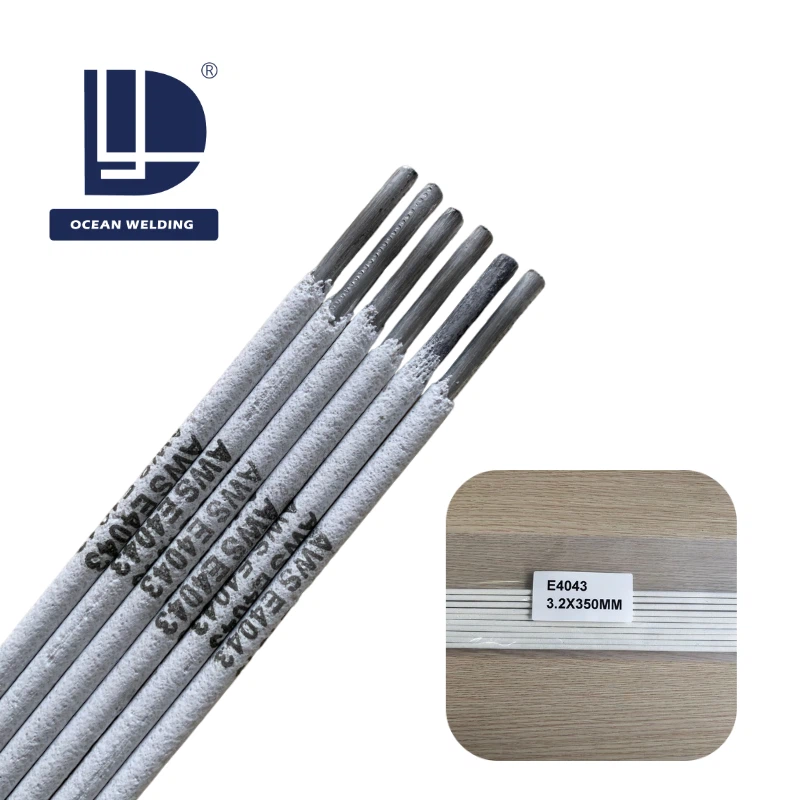
4043 Welding Rod
Model: E4043 welding rod
Brand: Ocean Welding
Product Overview
As a highly acclaimed product in the welding field, the E4043 welding rod provides reliable protection for various welding operations with its excellent performance and stable quality. Whether it is a small maintenance project or a large industrial manufacturing project, the welding rod can demonstrate excellent applicability.
Product Features
Excellent welding process performance
The electrode has good arc stability, easy arc ignition, and a soft and stable arc during welding. It can effectively reduce welding spatter, make the weld beautiful and smooth, greatly reduce the intensity of subsequent grinding and other processing work, and improve work efficiency.
Wide adaptability to parent materials
Especially suitable for welding of various aluminum alloy materials such as 6061 and 6063, it can achieve good fusion with the parent material, ensure that the weld joint has excellent mechanical properties and corrosion resistance, and meet the stringent requirements of different projects for welding quality.
Excellent crack resistance
During the welding process, the E4043 electrode can effectively inhibit the generation of weld cracks. Even under complex welding conditions, such as welding of thick workpieces and welding of different materials, it can ensure the integrity and reliability of the weld joint, reduce the risk of welding rod defects, and improve the overall safety of the welded structure.

Technical Parameters
Coating type and welding current
| Item | Details |
|---|---|
| Coating type | Titanium oxide type |
| Welding current type | AC or DC positive connection |
Welding rod diameter specification
| Welding rod diameter (mm) | Applicable scenarios |
|---|---|
|
2.5 |
Suitable for welding relatively fine and thin materials, such as welding of small aluminum alloy crafts |
|
3.2 |
General specifications, widely used in welding operations of ordinary thickness aluminum alloy materials |
|
4.0 |
For welding of thick aluminum alloy workpieces, it can provide higher deposition efficiency |
Chemical composition
|
Si |
Fe |
Cu |
Mn |
Mg |
Zn |
Ti |
Al |
|
4.5 - 6.0 |
≤0.8 |
≤0.3 |
≤0.15 |
≤0.05 |
≤0.2 |
≤0.2 |
Bal |
Mechanical properties
| Tensile strength (MPa) | Elongation (%) |
|---|---|
|
≥180 |
≥10 |
Application Areas

Shipbuilding
It performs well in the welding of aluminum alloy structures of ships, can withstand seawater corrosion and complex stress environments, and ensures the durability of ship structures.

Architectural decoration
Commonly used in the welding and installation of aluminum alloy doors and windows, curtain walls and other architectural decoration materials to create a beautiful and solid building appearance.

Automobile manufacturing industry
Suitable for welding of automobile aluminum alloy engine cylinder blocks, wheel hubs and other parts, improving the quality and performance of automobile parts and promoting the development of lightweight automobiles.

Aerospace field
used for welding repair and manufacturing of aluminum alloy parts to ensure the high strength and reliability of aviation structural parts and ensure flight safety.
Usage Guidelines
- Preparation before welding: Ensure that the surface of the parent material is clean and free of impurities such as oil, rust, and scale. Grinding can be performed if necessary. The welding rod should be dried as required before use. The drying temperature is generally 150-200℃ and kept warm for 1-2 hours to ensure the welding quality.
- Welding operation: Select the E4043 welding rod current reasonably according to the thickness of the parent material, welding position and electrode diameter. When welding, maintain an appropriate welding speed and angle. The general welding angle is 70°-80° to ensure good fusion and forming of the weld.
- Post-welding treatment: After welding, clean the slag and spatter on the weld surface in time, conduct an appearance inspection of the weld, and if necessary, perform non-destructive testing to ensure that the welding quality meets the standard requirements.
Brand advantage

As a professional welding materials manufacturer, we have advanced production equipment and a strict quality control system.
From raw material procurement to product delivery, every link is carefully controlled.
Over the years, we have won the trust and support of our customers with our high-quality products and perfect after-sales service.
Choosing welding rod means choosing professionalism, reliability and efficiency.
FAQ
Q: What does the welding rod stand for?
A: In the electrode type, 'E' denotes the electrode; '40' denotes a minimum tensile strength of 40,000 psi (approximately 276 MPa) for the molten metal; '4' denotes that the electrode is suitable for all-position welding, including flat, cross, vertical and backside welding; and '3' denotes that the flux casing type is calcium titanium. '4' indicates that the electrode is suitable for all-position welding, including flat, horizontal, vertical, and backside welding; "3" indicates that the flux casing type is calcium titanium, and can be used with either an AC or DC forward or reverse power source.
Q: How can I tell if a weld is of acceptable quality?
A: Appearance inspection can be done to see whether the surface of the weld is smooth and uniform, with or without defects such as porosity, slag entrapment, cracks, biting edges, etc.; and whether the size of the weld meets the design requirements. Non-destructive testing methods, such as ray testing, ultrasonic testing, etc., can also be used to check whether there are defects inside the weld. For important weldments, mechanical property tests, such as tensile tests, bending tests, etc., are also required to check whether the strength and toughness of the weld and other properties meet the requirements.
Q: What is the shelf life of E4043 welding rod?
A: Under normal storage conditions, the shelf life of unopened E4043 welding electrodes is generally 1 - 2 years. However, poor storage conditions, such as moisture, rain, etc., will shorten the shelf life and affect the performance.
How to order
| TYPE: | E4043 | E4043 | E4043 |
|---|---|---|---|
| Material: | Stainless Steel Electrodes | Stainless Steel Electrodes | Stainless Steel Electrodes |
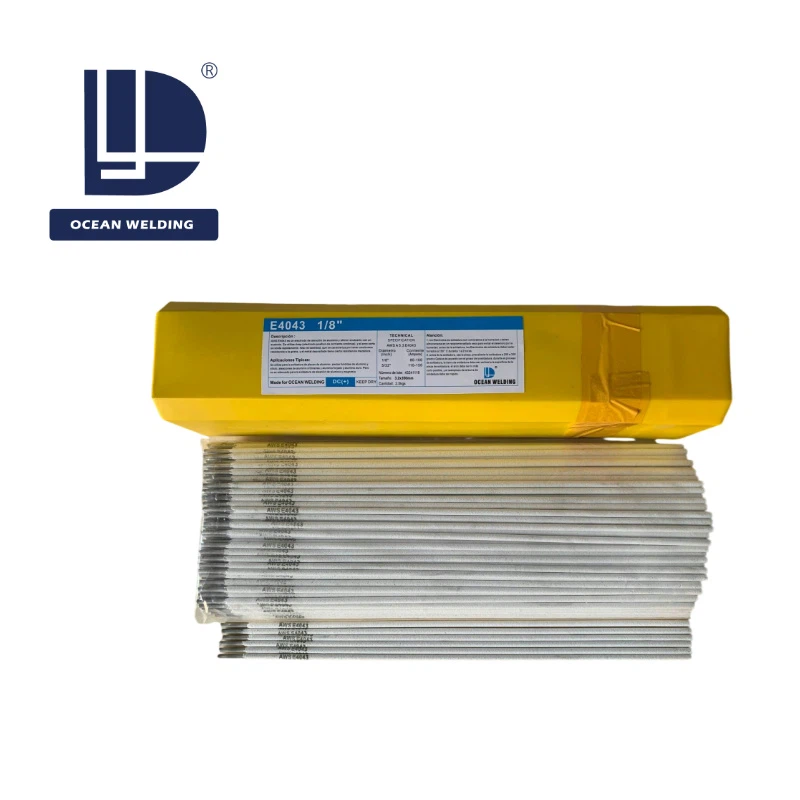
| Size : | Diameter:2.0 mm, 2.5 mm, 3.2 mm, 4.0 mm, etc. | Diameter:2.0 mm, 2.5 mm, 3.2 mm, 4.0 mm, etc. | Diameter: 2.0 mm, 2.5 mm, 3.2 mm, 4.0 mm, etc. |
| Length: 300 mm, 350 mm, 400 mm, etc. | Length: 300 mm, 350 mm, 400 mm, etc. | Length:300 mm, 350 mm, 400 mm, etc. | |
| Torelance: | (-0.04/-0.01)mm | (-0.04/-0.01)mm | (-0.04/-0.01)mm |
| Packing: |
2kg,5kg/inner box |
20kg/Carton | 1000kg/Pallet |
| M.O.Q: | 1ton | 1ton | 1ton |
Hot Tags: 4043 welding rod, China, manufacturers, suppliers, factory, company, wholesale, discount, buy, low price, high quality, products
Previous
Stainless Steel Welding RodNext
Arc Welding RodsYou Might Also Like


Send Inquiry