




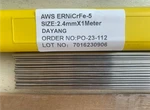


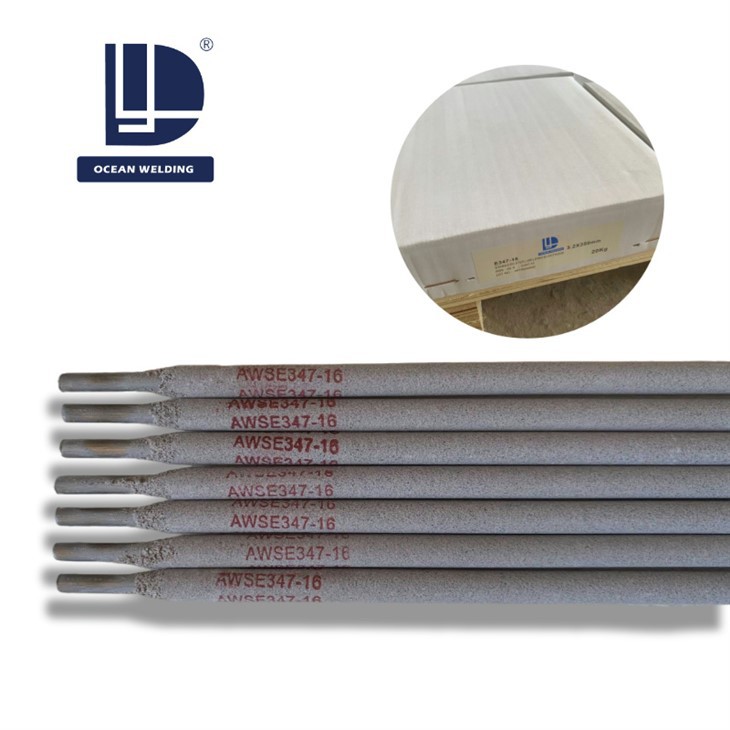

Arc Welding Rods
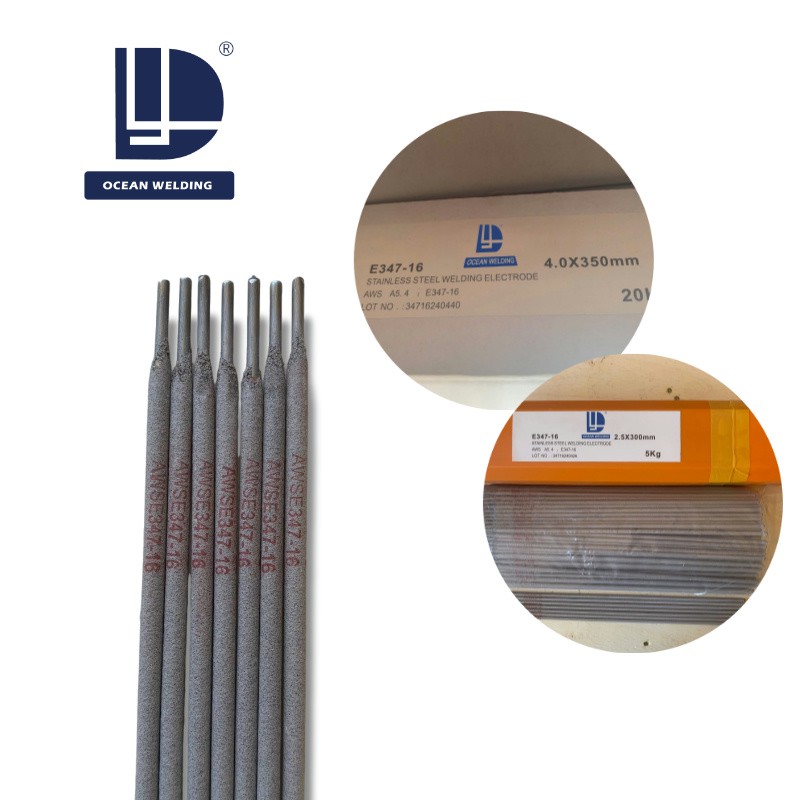
Model: E347-16
Composition characteristics: It is a stainless steel welding rod with a titanium calcium coating and niobium stabilizing elements. The main component is low 19Cr-11Ni-Nb (Ti).
Hangzhou Lin'an oCEAN Welding Co., Ltd.
"Produce first-class products, create first-class brands, and provide first-class services"
Production capacity
Owns a hydraulic equipment production line with an annual production capacity of 5,000 tons of welding rods.
Technical strength
Possessing strong technical strength and a 5-10-person R&D team.
Quality control
Implements a strict internal quality control system to ensure that product quality meets high standards.
Excellent quality, achieving the peak of welding
In the boundless world of welding materials, E347-16 arc welding rods of Hangzhou Lin'an Dayang Welding Co., Ltd. is like a dazzling star, exuding unique charm. Over the years, Dayang Welding has been working hard in the industry. With its profound technical accumulation and professional spirit, we can bring you this outstanding welding artifact.
Product Features
Perfect fusion of ingredients and technology:
The E347-16 welding rods adopts a carefully formulated chemical composition, with chromium-nickel stainless steel containing niobium as the main body. Under the advanced production process, each electrode is strictly controlled. The titanium calcium coating not only ensures the high stability of the arc during welding, but also makes spatter very small, making your welding operation as smooth as flowing water.
Excellent corrosion resistance:
Due to the addition of niobium, the key element, the weld has super strong resistance to intergranular corrosion. Whether facing a humid working environment or contacting various corrosive media, the joints welded with E347-16 welding rods can remain stable for a long time, effectively extending the service life of the equipment and saving you maintenance costs.
Excellent mechanical properties:
The weld metal has good strength, toughness and plasticity. When subjected to various stresses and impacts, it can show excellent performance and ensure the stability of the welded structure. Whether it is large-scale engineering construction or precision equipment manufacturing, E347-16 welding rods can do it and provide solid protection for your project.
Widely applicable

- In the field of petrochemicals, pipelines, containers and other equipment are always facing the test of high temperature, high pressure and highly corrosive media. E347-16 welding rods have become the best choice for this industry with their excellent corrosion resistance and high temperature performance. Whether it is the welding of complex pipelines in refineries or the connection of key components of chemical plants, it can ensure the long-term stable operation of equipment under harsh working conditions.
- Boilers, heat exchangers and other equipment in the power industry have extremely high requirements for welding quality. The welds welded by E347-16 welding rods not only meet the strength standards, but also have excellent corrosion resistance. In the welding of stainless steel pipelines in nuclear power plants, its high-quality welding effect is even more escort for the safe operation of nuclear power plants.
- For the food and pharmaceutical industries, the hygiene and corrosion resistance of equipment are crucial. The stainless steel parts welded by E347-16 welding rods have a smooth surface, are not easy to breed bacteria, and can effectively resist the erosion of food and pharmaceutical ingredients, which fully meets the strict hygiene standards of the industry. From food storage tanks to pharmaceutical reactors, it can create a safe and reliable production environment for you.
- In the field of architectural decoration, stainless steel is often used to create decorative parts such as railings, handrails, curtain walls, etc. The welds welded by E347-16 welding rods are beautiful and elegant, complementing the overall style of the building. At the same time, its excellent corrosion resistance can ensure that the decorative parts remain bright and new after being exposed to the atmosphere for a long time, adding lasting charm to the building.


why choose us
- Professional brand, trustworthy: Hangzhou Lin'an OCEAN WELDING Co., Ltd. has focused on the research and development and production of welding materials for many years, and has accumulated rich experience and profound technical background. We always adhere to customer demand-oriented, quality-centered, and are committed to providing high-quality welding solutions to customers around the world.
- Strict quality control: From raw material procurement to production and processing, to finished product inspection, every link follows strict quality standards. We have a professional quality inspection team and advanced testing equipment to ensure that each E347-16 arc welding rods meets high quality requirements, allowing you to use it without worry.
- Intimate service support: We not only provide high-quality products, but also have a professional technical service team. No matter what problems you encounter during the welding process, we can provide you with solutions and technical guidance in a timely manner. From pre-sales consultation to after-sales guarantee, Ocean Welding is always with you.
How to use
Welding preparation
1.Drying of Arc Welding Rods
- E347-16 welding rod should be dried before use, generally placed in a 250 - 300 ℃ drying box baking 1 - 2 hours to remove the water in the flux skin of the welding rod, to prevent the weld from producing porosity and other defects.
- After drying the welding rod should be placed in the 100 - 150 ℃ insulation cylinder, with use, to avoid re-moisture.
2.Cleaning of welded parts
- Thoroughly remove impurities such as oil, rust, oxidised skin and moisture from the part to be welded and within 20-30mm on both sides of the weldment. Sandpaper grinding, wire brush cleaning, acetone or alcohol cleaning and other methods can be used.
- For the oxide film on the surface of the weldment, it can also be removed by pickling or machining to ensure that the weld area reveals a metallic luster.
3.Selection of welding equipment
- Usually choose the DC reverse connection (the weldment is connected to the negative pole, the electrode is connected to the positive pole) of the welding power supply to ensure stable arc combustion, reduce spattering, and improve the quality of welding.
- According to the thickness, shape and welding position of the weldment, select the appropriate power of the welding equipment.
4.Determine the welding parameters
- Welding rod diameter: according to the thickness of the weldment to choose the appropriate diameter of the welding rod. General thickness of the weldment in 3 - 4mm, can choose 3.2mm diameter of the electrode; thickness in 5 - 8mm, can choose 4.0mm diameter of the electrode.
- Welding current: the size of the welding current should be based on the diameter of the electrode, welding position and thickness of the weldment and other factors to determine. For example, the diameter of 3.2mm electrode, flat welding welding current can be selected 90 - 120A; vertical welding, horizontal welding, back welding, the current should be smaller than flat welding 10% - 20%.
Welding operations
1.Arc initiation
- Direct hit method: the end of the welding rod and the surface of the weldment vertical collision, and then quickly lift the rod 2 - 4mm, generating an arc. This method is suitable for welding in various positions, but it is difficult to operate and requires quick and accurate movements.
- Scratch method: the end of the welding rod like a match in the surface of the weldment gently scratch, when the arc ignited, quickly lift the welding rod 2 - 4mm, to maintain a stable arc burning. This method is easy to start the arc, but may leave scratches on the surface of the weldment, is not suitable for higher surface quality requirements of the weldment.
2.Rod transport
- Straight line method: the electrode moves in a straight line along the welding direction, suitable for butt welding of thin plates, the first pass of multi-layer welding and multi-layer multi-pass welding.
- Sawtooth method: The end of the electrode swings in a sawtooth shape and stops slightly on both sides to ensure a good fusion at the edge of the weld. This method is suitable for thicker weldments such as flat welding, vertical welding, back welding and other positions.
- Crescent-shaped transport method: the end of the welding rod along the welding direction to do crescent-shaped swing, swing speed should be uniform, stay a little longer on both sides. This method can make the weld metal get fully heated and melted, suitable for flat welding, vertical welding, back welding and other positions of the welding, can get a higher quality of the weld.
3.Arc closing
- Circle closing method: when the welding rod moves to the end of the weld, make a circle movement until the arc pit is filled and then pull off the arc. Suitable for thick plate welding arc.
- Repeated arc closing method: at the end of the weld, repeated arc quenching, arc several times, until the arc pit is filled. Mainly used for thin plate and high-current welding arc.
- Back to the welding arc method: welding rod to the end of the weld, in the arc pit at a slight stay, and then appropriate back to the welding a short distance, and then pull off the arc. It is suitable for the arc closing of alkaline welding rod, which can prevent the generation of arc crater cracks.
post-weld treatment
- Clean up the slag: use slag hammer, wire brush and other tools to clean up the slag and spatter on the surface of the weld, so that the surface of the weld is neat and clean.
- Appearance inspection: check whether there are cracks, pores, slag, biting edge and other defects on the surface of the weld, and whether the residual height, width and size of the weld foot meet the requirements. If there is any defect, it should be repaired in time.
- Heat treatment (if necessary): for some special requirements of the weldment, such as withstand higher pressure, temperature or intergranular corrosion resistance requirements of the weldment, the weld may need to be heat-treated after welding to eliminate weld stress, improve weld organisational properties, improve corrosion resistance. Specific heat treatment process should be based on the material of the weldment and the use of requirements to determine.
how to order
| TYPE: | E347-16 | E347-16 | E347-16 |
|---|---|---|---|
| Material: | Stainless Steel Electrodes | Stainless Steel Electrodes | Stainless Steel Electrodes |
| Size : | Diameter:2.0 mm, 2.5 mm, 3.2 mm, 4.0 mm, 5.0 mm, etc. | Diameter:2.0 mm, 2.5 mm, 3.2 mm, 4.0 mm, 5.0 mm, etc. | Diameter: 2.0 mm, 2.5 mm, 3.2 mm, 4.0 mm, 5.0 mm, etc. |
| Length: 300 mm, 350 mm, 400 mm, etc. | Length: 300 mm, 350 mm, 400 mm, etc. | Length: 300 mm, 350 mm, 400 mm, etc. | |
| Torelance: | (-0.04/-0.01)mm | (-0.04/-0.01)mm | (-0.04/-0.01)mm |
| Packing: |
2kg,5kg/inner box |
20kg/Carton | 1000kg/Pallet |
| M.O.Q: | 1ton | 1ton | 1ton |
Hot Tags: arc welding rods, China, manufacturers, suppliers, factory, company, wholesale, discount, buy, low price, high quality, products
Previous
4043 Welding RodYou Might Also Like


Send Inquiry