




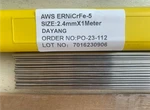


CR30 Hardfacing Flux-Cored Welding Wire
CR30 Chromium Carbide Hardfacing Flux-Cored Wire
CR30 is a high-chromium, high-carbon flux-cored wire specifically engineered to withstand severe abrasive wear conditions. The chemical composition of its weld deposit features a chromium (Cr) content exceeding 29% and a carbon (C) content exceeding 5%, enabling the formation of a dense, hypereutectic M₇C₃ chromium carbide microstructure. By virtue of this characteristic, CR30 demonstrates exceptional resistance to high-stress abrasive wear, erosion, and moderate corrosion.
Classified under the DIN EN 14700 standard as category T Fe 15-60-G, CR30 achieves a weld deposit hardness of 58–62 HRC. This places it among high-performance hardfacing materials, making it widely applicable for the repair and protection of various wear-prone components across the mineral processing, cement production, and power generation industries.
Key Features of CR30 Hardfacing Wire
- Exceptional Wear Resistance: A hypereutectic M₇C₃ carbide network provides superior resistance to high-stress abrasion and gouging wear.
- 58–62 HRC Hardfacing Layer: The multi-layer hardfacing deposit exhibits uniform and consistent hardness, requiring no post-weld heat treatment.
- High Volume Fraction of Chromium Carbides: A composition containing >29% chromium and >5% carbon creates an extremely high carbide density, thereby significantly extending component service life.
- Corrosion-Resistant Hardfacing:The high-chromium matrix effectively resists oxidation and moderate chemical corrosion.
- Multi-Process Compatibility: Suitable for various hardfacing processes, including Gas Metal Arc Welding (GMAW), Open Arc Welding, and Submerged Arc Welding (SAW).
- Cost-Effective Wear Protection: Extends equipment service life by 3 to 5 times compared to unprotected low-carbon steel surfaces.
CR30 Chemical Composition
| Element | Specification (%) | Typical Deposit (%) |
|---|---|---|
|
C |
5.0–6.5 |
6.42 |
|
Cr |
>29.0 |
30.76 |
|
Mn |
1.0–2.0 |
1.03 |
|
Si |
0.6–1.5 |
1.47 |
|
Fe |
Balance |
Balance |
Mechanical Properties
| Property | Value |
|---|---|
|
Deposit Hardness |
58–62 HRC |
|
Typical Measured Hardness |
59.5 HRC |
|
Carbide Microhardness |
~1,600–1,800 HV (M₇C₃) |
|
Maximum Service Temperature |
~600°C (1,112°F) |
|
Check Crack Pattern |
Normal - stress-relief cracking is inherent and does not affect wear performance |
Note: Hardfacing deposits from CR30 exhibit a characteristic check-crack (relief crack) pattern. These cracks are confined within each weld bead, relieve residual stress, and do not propagate into the base metal. This is standard behavior for hypereutectic chromium carbide overlays.
CR30 Product Specifications
| Property | Value |
|---|---|
|
Classification |
DIN EN 14700: T Fe 15-60-G |
|
Product Type |
Flux-cored wire (self-shielded or gas-shielded) |
|
Welding Processes |
GMAW (gas-shielded), Open Arc, SAW |
|
Available Diameters |
1.2 mm, 1.6 mm, 2.0 mm, 2.4 mm, 2.8 mm, 3.2 mm |
|
Recommended Layers |
2–3 layers, max. 10 mm total thickness |
|
Buffer Layer |
Recommended on crack-sensitive or previously hardfaced substrates |
Recommended Welding Parameters
| Diameter (mm) | Voltage (V) | Current (A) | Process |
|---|---|---|---|
|
1.2 |
18–24 |
160–240 |
Gas-shielded |
|
1.6 |
22–26 |
180–280 |
Gas-shielded / Open Arc |
|
2.0 |
22–26 |
220–320 |
Gas-shielded / Open Arc |
|
2.4 |
26–30 |
260–340 |
Open Arc / SAW |
|
2.8 |
28–30 |
320–420 |
Open Arc / SAW |
|
3.2 |
28–32 |
350–450 |
SAW |
- Shielding Gas (GMAW): 100% CO₂ or Ar + 20% CO₂, flow rate 18–25 L/min.
- Preheating: For low-carbon steel substrates, preheating is typically not required. For high-carbon or alloy steel base metals, preheating to 150–250°C is necessary to minimize the risk of underbead cracking.
Storage and Handling
- Please store CR30 spools in their original sealed packaging within a dry environment (relative humidity < 60%).
- Once opened, spools should be consumed within 72 hours or returned to their protective packaging.
- If the filament is suspected to have absorbed moisture, please re-dry it at a temperature of 120–150°C for 2 hours prior to use.
- Please handle spools with care to avoid kinking or deforming the filament, as this may lead to feeding failures.
FAQ
Q: What are the primary applications for CR30 hardfacing welding wire?
A: CR30 is used for hardfacing (surface overlaying) components subjected to severe abrasive wear. Common applications include crusher parts, wear plates, grinding rollers, chute liners, and mining equipment-essentially any situation requiring a surface layer with high hardness and strong wear resistance to extend service life.
Q: What level of hardness can CR30 achieve?
A: After depositing 2 to 3 layers, the hardfacing layer produced by CR30 can reach a hardness of 58–62 HRC (Rockwell Hardness, C-scale). This represents one of the highest hardness levels achievable by flux-cored hardfacing wires; its performance is comparable to high-quality imported welding consumables that comply with the DIN EN 14700 T Fe 15-60-G standard.
Q: Can CR30 serve as a substitute for Corodur 56 or similar European hardfacing wires?
A: Yes. CR30 also complies with the DIN EN 14700 T Fe 15-60-G standard; it forms the same hypereutectic M₇C₃ chromium carbide microstructure and meets the required hardness specifications of 58–62 HRC. It serves as a direct substitute for European chromium carbide hardfacing wires falling under the same standard category.
Q: Is CR30 suitable for applications involving high impact loads?
A: CR30 is optimized primarily for conditions involving abrasive wear, rather than impact loads. For applications involving heavy impact (such as hammer crushers processing large-sized feed materials), it is recommended to first deposit a buffer layer with good toughness; alternatively, a hardfacing consumable with lower hardness but superior impact resistance should be selected for the initial layer.
Q: Are cracks appearing on the surface of the CR30 hardfacing layer considered defects?
A: No, they are not. This network-like distribution of microcracks (also known as "stress-relief cracks") is a normal phenomenon inherent to all high-chromium, high-carbon hardfacing overlays, and constitutes one of their intended characteristics. The function of these cracks is to relieve the thermal stresses generated within the overlay; they do not compromise the overlay's wear resistance or its bond strength with the base metal.
Q: Which welding processes are suitable for CR30?
A: CR30 is compatible with a variety of welding processes, including Gas Metal Arc Welding (GMAW), Open Arc Welding (Self-Shielded), and Submerged Arc Welding (SAW). The selection of the wire diameter determines the optimal welding process: smaller diameters (1.2–2.0 mm) are suitable for GMAW, while larger diameters (2.4–3.2 mm) are suitable for Open Arc and Submerged Arc welding.
Q: Is it necessary to deposit a buffer layer before applying CR30?
A: If hardfacing is to be performed on high-carbon steel, manganese steel, or cast iron substrates-or if a secondary hardfacing pass is being applied over a previously hardfaced surface-it is recommended to first deposit a buffer layer. For low-carbon steel substrates (C < 0.25%), CR30 can be applied directly without the need for a buffer layer.
Hot Tags: cr30 hardfacing flux-cored welding wire, China, manufacturers, suppliers, factory, company, wholesale, discount, buy, low price, high quality, products
Previous
No InformationNext
E308LT-1You Might Also Like



Send Inquiry