




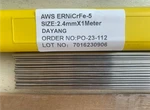


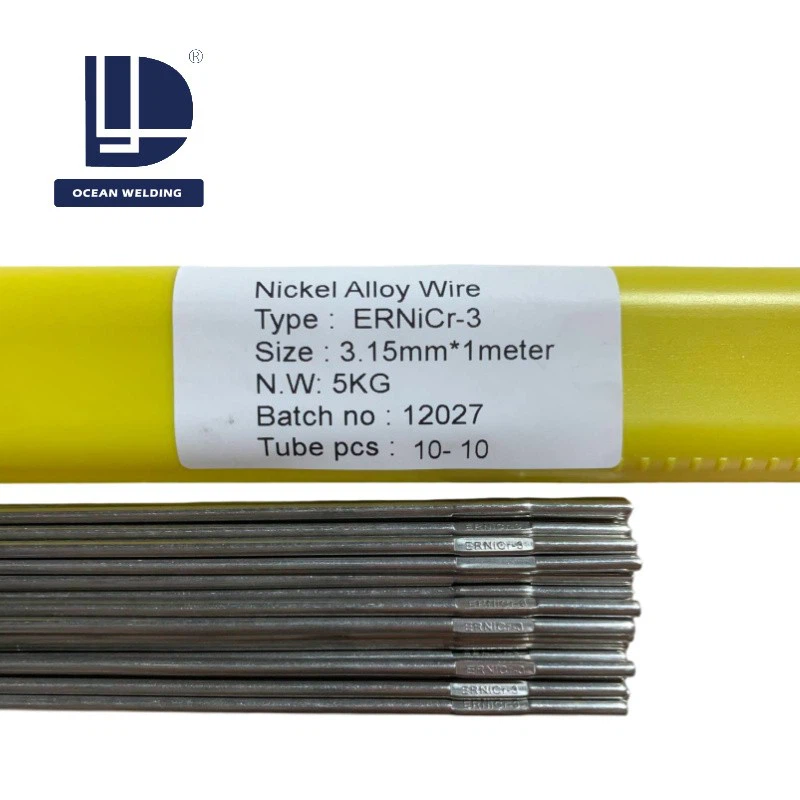
ERNiCr-3 Nickel Alloy Welding Wire
ERNiCr-3 is a nickel-chromium filler metal engineered for GTAW (TIG) and GMAW (MIG) welding of Inconel 600, Inconel 601, Incoloy 800, and dissimilar metal joints. With a minimum 67% nickel content and precisely controlled niobium additions, this wire delivers exceptional resistance to hot cracking, oxidation, and corrosive attack across a wide temperature range.


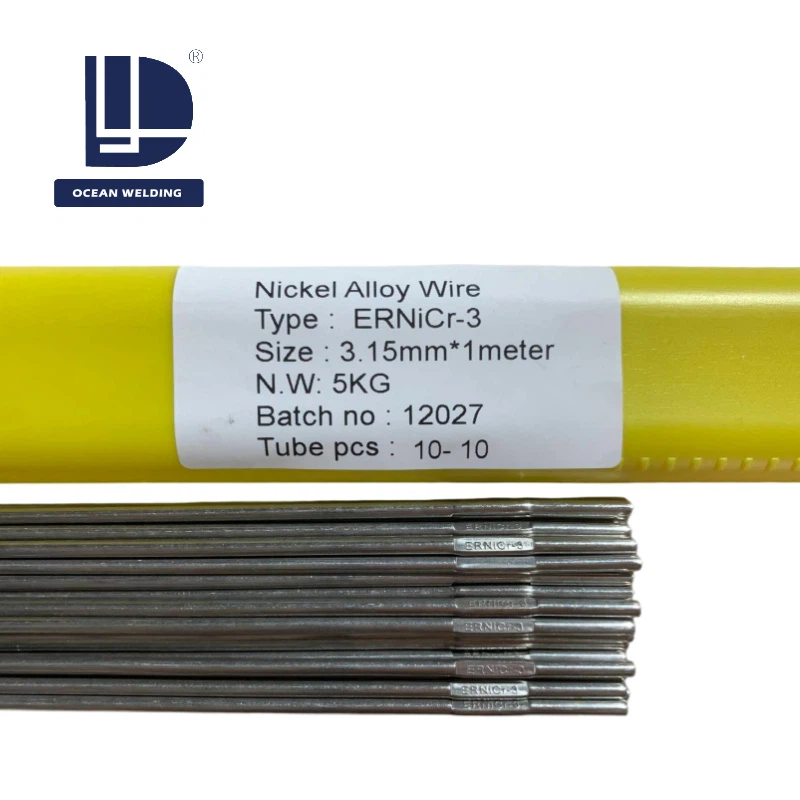
What Is ERNiCr-3 Welding Wire?
ERNiCr-3 (also known commercially as Inconel Filler Metal 82) is a solid bare wire classified under AWS A5.14. It is the industry standard filler metal for joining and overlaying nickel-chromium alloys in environments where high temperatures, thermal cycling, and chemical exposure demand the highest weld integrity.
The controlled addition of niobium and tantalum (2.0–3.0%) provides excellent resistance to solidification cracking, while the high chromium content (18–22%) ensures sustained oxidation resistance in service. ERNiCr-3 produces smooth, low-spatter welds with excellent tie-in and minimal post-weld cleanup - reducing fabrication time and rework costs.
Why Choose ERNiCr-3 Filler Wire
In harsh thermal and chemical environments, ERNiCr-3 outperforms general-purpose nickel alloy welding wires. This is precisely why engineers specify its use.
Hot-Crack Resistant
Controlled addition of Nb+Ta can suppress solidification cracking during multi-pass and root-pass welding, even in highly constrained joints.
High-Temperature Performance
The weld overlay retains its strength and resists oxidation at continuous operating temperatures of up to 1150 °C (2100 °F).
Broad Corrosion Resistance
In various process environments, it is capable of withstanding reducing and oxidizing acids, chloride stress corrosion cracking (SCC), sulfidation, and carburization.
Dissimilar Metal Joining
Nickel alloys can be joined with carbon steel, stainless steel (304/316/321), and other alloys, and in most specifications, post-weld heat treatment (PWHT) is not mandatory.
Excellent Weldability
The arc is stable and quiet, with minimal spatter. The weld bead profile ranges from flat to slightly convex, enabling the production of neat, high-quality welds that meet code requirements in all positions.
Full Code Compliance
Complies with AWS A5.14, ASME SFA-5.14, and EN ISO 18274 standards, and is suitable for marine applications.
ERNiCr-3 Chemical Composition
Compliant with AWS A5.14 / ASME SFA-5.14. Values represent specification limits; typical values fall within the middle of each range.
| Element | Ni | Cr | Nb+Ta | Fe | Mn | Ti | Si | C | Cu | S | P |
|---|---|---|---|---|---|---|---|---|---|---|---|
| Minimum | 67.0 | 18.0 | 2.0 | - | - | - | - | - | - | - | - |
| Maximum | Bal. | 22.0 | 3.0 | 5.0 | 3.0 | 0.75 | 0.50 | 0.10 | 0.50 | 0.015 | 0.03 |
| Typical | 72.0 | 20.0 | 2.5 | 1.0 | 2.8 | 0.35 | 0.10 | 0.04 | 0.05 | 0.003 | 0.008 |
Typical Mechanical Properties
| Property | Value (Imperial) | Value (Metric) | Standard |
|---|---|---|---|
| Ultimate Tensile Strength | 80 ksi | 550 MPa | AWS B4.0 |
| 0.2% Yield Strength | 55 ksi | 380 MPa | AWS B4.0 |
| Elongation (2″ gauge) | 35% | AWS B4.0 | |
| Reduction of Area | 45% | AWS B4.0 | |
| Hardness | ~85 HRB | - | |
| Charpy V-Notch (RT) | ≥ 80 J (59 ft-lbs) | ASTM E23 | |
Where ERNiCr-3 Wire Is Specified
ERNiCr-3 nickel alloy filler wire is trusted across heavy industries where weld failure carries significant safety and economic consequences.
-
Oil, Gas & Petrochemical
Reformer pigtails, furnace tubes, heat exchangers, and reactor internals operating under high-temperature sulfidation and carburization.
-
Power Generation
Superheater / reheater tubing, boiler headers, and steam piping in fossil-fuel, combined-cycle, and waste-to-energy plants.
-
Nuclear Energy
Primary circuit piping, steam generators, pressurizer nozzles, and structural attachments in PWR and BWR reactor systems.
-
Aerospace & Defense
Jet engine combustion liners, afterburner assemblies, exhaust ducting, and missile motor casings exposed to extreme thermal cycling.
-
Chemical Processing
Pressure vessels, columns, and piping systems handling nitric acid, caustic soda, and mixed acid environments.
-
Weld Overlay / Cladding
Corrosion-resistant Ni-Cr overlay on carbon and low-alloy steel substrates in refinery, pulp & paper, and marine equipment.
Recommended Welding Parameters for ERNiCr-3
Starting parameters for flat / horizontal position. Adjust for vertical-up, overhead, and root passes as needed.
| Process | Wire Dia. | Current (A) | Voltage (V) | Polarity | Shielding Gas | Gas Flow |
|---|---|---|---|---|---|---|
| GTAW | 1/16″ (1.6 mm) | 60 – 110 | 12 – 15 | DCEN | 100% Ar | 20–30 cfh |
| GTAW | 3/32″ (2.4 mm) | 100 – 160 | 12 – 16 | DCEN | 100% Ar | 20–30 cfh |
| GTAW | 1/8″ (3.2 mm) | 140 – 210 | 13 – 17 | DCEN | 100% Ar | 25–35 cfh |
| GMAW | 0.035″ (0.9 mm) | 120 – 200 | 22 – 28 | DCEP | Ar + 1–2% CO₂ | 35–45 cfh |
| GMAW | 0.045″ (1.14 mm) | 160 – 280 | 24 – 30 | DCEP | Ar + 1–2% CO₂ | 35–50 cfh |
Notes: Preheat not required for most nickel alloys. Maintain interpass temperature ≤ 150 °C (300 °F). Use argon back purge for root passes. Clean each pass with stainless steel brush before subsequent passes.
FAQ
Q: What is ERNiCr-3 welding wire used for?
A: ERNiCr-3 is used for GTAW and GMAW welding of nickel-chromium alloys including Inconel 600, Inconel 601, and Incoloy 800/800H. It is also the primary filler metal for dissimilar joints between nickel alloys and carbon or stainless steels in petrochemical, power generation, nuclear, and aerospace applications. Additionally, ERNiCr-3 is widely used for corrosion-resistant weld overlay on steel substrates.
Q: What is the difference between ERNiCr-3 and ERNiCrFe-7?
A: ERNiCr-3 (Filler Metal 82) has a maximum 5% iron and is optimized for Inconel 600-type alloys. ERNiCrFe-7 (Filler Metal 52) contains up to 10% iron and 28–31.5% chromium, designed specifically for Alloy 690 (N06690) applications where higher chromium is needed for additional SCC resistance. For Inconel 600 joints, ERNiCr-3 remains the standard choice.
Q: Does ERNiCr-3 require preheat or post-weld heat treatment?
A: Preheat is generally not required for nickel alloy base metals. Most ASME and AWS codes do not mandate PWHT for ERNiCr-3 welds. However, when joining dissimilar metals (e.g., Inconel 600 to 2.25Cr-1Mo steel), a stress relief at 620–720 °C may be specified by the fabrication code. Always verify with the governing standard for your application.
Q: What shielding gas is recommended for ERNiCr-3?
A: For GTAW (TIG): 100% argon for both shielding and back purge. For GMAW (MIG): argon with 1–2% CO₂ or argon/helium blends (75Ar/25He) for improved wetting on thicker sections. Avoid CO₂ levels above 5% as they can introduce porosity and reduce corrosion resistance of the deposit.
Q: What is the maximum operating temperature for ERNiCr-3 welds?
A: ERNiCr-3 weld deposits retain useful strength and oxidation resistance at sustained service temperatures up to 1150 °C (2100 °F). This makes it suitable for furnace components, radiant tubes, and other equipment in the upper temperature range of nickel-chromium alloy service.
Q: How does ERNiCr-3 compare to ENiCrFe-3 (covered electrode)?
A: ERNiCr-3 is the bare wire version (for TIG/MIG), while ENiCrFe-3 is the corresponding flux-coated electrode (SMAW). They produce deposits with similar chemical compositions. ERNiCr-3 offers cleaner welds with less slag, better for critical root passes, while ENiCrFe-3 is preferred for field welding where gas shielding is impractical.
Q: Can ERNiCr-3 pass NACE MR0175 / ISO 15156 requirements?
A: Yes. ERNiCr-3 weld deposits are listed as acceptable materials under NACE MR0175 / ISO 15156 for sour service applications, provided hardness limits (typically ≤ 35 HRC for nickel alloys) are met. This makes ERNiCr-3 suitable for welding equipment in oil and gas environments containing H₂S.
Hot Tags: ernicr-3 nickel alloy welding wire, China, manufacturers, suppliers, factory, company, wholesale, discount, buy, low price, high quality, products
You Might Also Like




Send Inquiry