




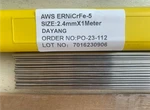

Nickel Alloy Filler Wire
Product Name:ERNiFeCr-2
Main ingredients: nickel (Ni), chromium (Cr), iron (Fe), molybdenum (Mo), niobium (Nb), titanium (Ti) and aluminum (Al), etc.
Product Overview
ERNiFeCr-2 is a nickel alloy filler wire, mainly used for welding nickel-based alloys and other high-performance alloy materials. This welding wire has excellent mechanical properties and corrosion resistance, and is widely used in aerospace, oil and gas, chemical and energy industries.
Product Advantages


Chemical composition
|
Item
|
C
|
Mn
|
P
|
S
|
Si
|
Ni
|
Cr |
Mo
|
Cu
|
Ti
|
B
|
AI
|
Fe
|
Nb+Ta |
|---|---|---|---|---|---|---|---|---|---|---|---|---|---|---|
|
AWS Standard
|
0.08max
|
0.35max | 0.015max | 0.015max | 0.35max | 50.0-55.0 | 17.0-21.0 |
2.8-3.3
|
0.3max
|
0.65-1.15
|
0.006max
|
0.2-0.8
|
- | 4.75-5.5 |
- The low carbon content can effectively reduce the tendency of intergranular corrosion, reduce the possibility of cracks during welding, and improve the toughness and crack resistance of the weld.
- Manganese plays a role in deoxidation and desulfurization during welding, which can reduce inclusions in the weld, improve the strength and toughness of the weld, and improve the mechanical properties of the weld.
- Silicon is an effective deoxidizer that can enhance the strength and hardness of the weld, improve the resistance to thermal cracking of the weld, and It is beneficial to improve the welding process performance of ERNiFeCr-2 nickel alloy filler wire.
- Chromium can significantly improve the corrosion resistance of the alloy, form a dense oxide film, and prevent the alloy from being corroded in various environments. At the same time, chromium can also improve the high-temperature strength and oxidation resistance of the alloy, so that the welded parts maintain good performance under high-temperature conditions.
- Sulfur is a harmful impurity and its content is controlled to be extremely low. Because sulfur can reduce the toughness and crack resistance of the weld and increase the sensitivity to thermal cracking, strict control of sulfur content helps to ensure the quality of the weld.
- Phosphorus is also a harmful impurity. Phosphorus can make the weld cold brittle, reduce impact toughness and plasticity. Strictly limiting the phosphorus content can avoid these problems and ensure the mechanical properties of the weld.
- Nickel is the main component of nickel-based alloys, which can improve the strength, toughness and corrosion resistance of the alloys. Especially in low temperature environments, it can maintain good mechanical properties and is suitable for welding of low temperature parts.
- As the matrix of the alloy, it carries other alloy elements to play a role and ensures the basic structure and performance of the alloy.
- An appropriate amount of copper can improve the corrosion resistance of the alloy in certain specific environments, such as having a certain effect on seawater corrosion resistance, but too high a content may affect the thermal crack sensitivity of the weld.
- Aluminum plays a role in deoxidation and grain refinement in the alloy, which can improve the strength and toughness of the alloy, improve the fatigue resistance of the alloy, and also help improve the oxidation resistance of the alloy.
- Molybdenum can enhance the corrosion resistance of the alloy, especially in resisting corrosion by reducing media. At the same time, molybdenum can also improve the high temperature strength and hardness of the alloy, so that the welded parts can still work normally under high temperature and high stress environment.
- Titanium is a strong deoxidizer and grain refiner element, which can effectively reduce the oxygen content in the weld, reduce pores and inclusions, improve the strength and toughness of the weld, and improve the alloy's resistance to intergranular corrosion.
- Niobium and tantalum can form stable carbides with carbon, effectively preventing intergranular corrosion, improving the high-temperature strength and creep resistance of the alloy, and ensuring the stability of welded components during long-term high-temperature service.
Such precise chemical composition ratio ensures that the filler wire can perform stably during the welding process, obtain high-quality welding joints, and have good corrosion resistance and mechanical properties.
Mechanical properties
|
Mechanical properties
|
Yield strength MPa
|
Tensile strength MPa
|
Elongation % |
|---|---|---|---|
|
AWS Standard
|
≥641 MPa
|
≥846 MPa
|
≥41% |
High tensile strength and appropriate elongation ensure that the welded components can maintain good structural integrity when subjected to various stresses and meet the use requirements of different working conditions.
ERNiFeCr-2 Welding parameters
| Diameter (mm) | Welding process | Voltage (V) | Current (A) | Shielding gas |
|---|---|---|---|---|
| 0.9 (0.035 in) | GMAW | 26 - 29 | 150 - 190 | 100% Argon |
| 1.2 (0.045 in) | GMAW | 28 - 32 | 180 - 220 | 100% Argon |
| 1.6 (1/16 in) | GMAW | 29 - 33 | 200 - 250 | 100% Argon |
| 1.6 (1/16 in) | GTAW | 14 - 18 | 90 - 130 | 100% Argon |
| 2.4 (3/32 in) | GTAW | 15 - 20 | 120 - 175 | 100% Argon |
| 3.2 (1/8 in) | GTAW | 15 - 20 | 150 - 220 | 100% Argon |
Reasonable welding parameters are the key to obtaining high-quality welds. When using filler wire, users can make fine adjustments according to actual conditions to achieve the best welding effect.
Applicable scope
This nickel alloy filler wire is mainly used to weld nickel-based alloy materials such as alloy 718, 706 and X-750. In the aerospace field, it is often used to manufacture key components of aircraft engines; in the energy field, it can be used to weld low-temperature liquid fuel rocket components to ensure the reliability and safety of these components in extreme environments.


Heat Treatment
| Heat Treatment Type | Purpose | Process Parameters | Applicable Scenarios |
|---|---|---|---|
| Solution Treatment | Improve the plasticity and toughness of the material, and enhance its corrosion resistance | Heating Temperature: 1489°C - 1775°C, Soaking Time: Depends on the thickness of the workpiece, Cooling Method: Water quenching or rapid air cooling | Suitable for most nickel-based alloy workpieces welded with ERNiFeCr-2 wire to achieve good comprehensive properties |
| Aging Treatment | Increase the strength and hardness of the material | Heating Temperature: 720-820°C, Soaking Time: 8 hours, Cooling Method: Air cooling | Used for workpieces with higher strength and hardness requirements, conducted after solution treatment |
how to order
| Type | ERNiFeCr-2 | ERNiFeCr-2 | ERNiFeCr-2 |
|---|---|---|---|
| Material | Filler Wire | Filler Wire | Filler Wire |
| Welding | MIG | TIG | SAW |
| Dimension: | 0.8–1.6 mm (spools) | 1.6–3.2 mm (spools) | 1.6–5.0 mm (coils) |
| Tolerance: | ±0.02 mm (diameter) | ±0.02 mm (diameter) | ±0.05 mm (diameter) |
| Processing: | Cold-drawn, stabilized, degreased | Cold-drawn, stabilized, degreased | Cold-drawn, stabilized, degreased |
| Packaging: | Vacuum-sealed spools (15–25 kg) | Vacuum-sealed spools (15–25 kg) | Bulk coils in moisture-proof drums (50–100 kg) |
| M.O.Q | 1 ton | 1 ton | 1 ton |
Hot Tags: nickel alloy filler wire, China, manufacturers, suppliers, factory, company, wholesale, discount, buy, low price, high quality, products
Previous
Ernicrmo-3 Filler WireYou Might Also Like


Send Inquiry