




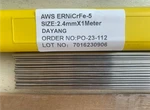

Key Notes E7024
Welds thin (≤5mm)/thick (≥8mm) plates, easy for beginners
Suitable for engineering machinery, steel structures, pressure vessels
Officially certified; store dry, dry if damp
I. Product Positioning & Core Advantages
The E7024 welding electrode is a universal industrial-grade welding material designed for industrial welding scenarios. With three core advantages-dual-power compatibility, suitability for both thin and thick plates, and easy parameter adjustment-it is widely used in engineering machinery, steel structures, pressure vessels, equipment manufacturing, and other fields. It can effectively meet the welding needs of plates of different thicknesses, balance weld strength and appearance quality, and reduce common welding defects such as porosity and burn-through.
Dual-Power Compatibility: Supports both direct current (DC) and alternating current (AC) welding machines, eliminating the need for frequent electrode replacement and adapting to most existing equipment in factories.
Full-Scenario Coverage: Through current adjustment, it can realize deep penetration welding for thick plates and precision welding for thin plates, covering the entire process of root passes, fill passes, and cover passes.
Cost-Effectiveness: Features stable flux coating and high deposition efficiency. With clear parameter guidelines, even novice operators can quickly get started, reducing welding rework costs.
II. Key Welding Parameters (Must-Read)
1. Current Selection: Precise Matching Based on Plate Thickness
The type and magnitude of current directly determine the penetration depth and weld bead appearance. Select the current mode (DC Electrode Positive/DCEP, DC Electrode Negative/DCEN, or AC) according to welding requirements. Specific parameters are as follows:
| Current Type | Core Features | Application Scenarios | Current Adjustment Recommendations |
|---|---|---|---|
| DC Electrode Positive (DCEP) | Deep penetration, high weld strength | Thick steel plates (≥8mm), root passes | Adjust based on plate thickness to ensure full penetration |
| DC Electrode Negative (DCEN) | Shallow penetration, smooth and flat weld bead | Thin steel plates (≤5mm), cover passes | Reduce current to avoid burn-through and improve appearance |
| Alternating Current (AC) | Requires AC welding machine | Batch welding scenarios with stable power grid | Increase current by 10%-15% compared to DC |
Note: When using an AC welding machine, check the stability of the power grid in advance. Excessive voltage fluctuations will cause unstable arcs and increase the risk of porosity.
2. Arc Voltage: Precise Regulation via Formula
Arc voltage must be strictly matched with current, as it directly affects weld bead formation. It can be quickly calculated using the following formula:Arc Voltage (V) = 20 + 0.04 × Welding Current (A)
Example: When the current is set to 200A, the voltage should be controlled at approximately 28V.
Fluctuation Range: A deviation of ±2V is allowed (e.g., for 200A, the voltage can be adjusted between 26V and 30V).
Risk Warning: Excessively high voltage may lead to wider weld beads and increased spatter; excessively low voltage may cause electrode sticking to the workpiece and insufficient penetration.
3. Welding Speed: Judgment Based on Molten Pool Shape
Excessively fast or slow welding speed will affect welding quality. Adjust the speed while observing the molten pool state:
Prohibited Practices: Excessively fast speed (insufficient molten pool protection → porosity); excessively slow speed (overly wide weld beads → burn-through).
Standard: Conduct test welding until the molten pool takes on a duck-egg shape without obvious sagging or flowing. This is the optimal speed (80-120mm/min is recommended for manual welding).
III. Operation Guide (Novice-Friendly)
Pre-Welding Preparation: Confirm the welding machine type (DC/AC) and select the current type based on plate thickness (refer to the "Current Selection Table").
Parameter Presetting: Calculate the initial voltage using the voltage formula. For example, a current of 180A corresponds to a voltage of 20 + 0.04×180 = 27.2V, so preset the voltage to 27V.
Test Welding Adjustment: Conduct a small-range test weld first. Observe the molten pool shape and weld bead appearance. If the molten pool is too small, increase the current; if the weld bead sags, reduce the speed.
Formal Welding: Maintain a stable arc and move uniformly along the welding line. Ensure the molten pool remains in a duck-egg shape and avoid pauses or rapid movements.
IV. Application Scenarios
Engineering Machinery: Welding of structural components for excavators, loaders, etc.
Steel Structures: Welding of thick plates for factory frames, bridge components, etc.
Pressure Vessels: Welding of sealed welds for low-pressure storage tanks.
Equipment Manufacturing: Precision welding of thin plates for machine tool bases, motor housings, etc.
Hot Tags: key notes e7024, China, manufacturers, suppliers, factory, company, wholesale, discount, buy, low price, high quality, products
Previous
Electrode Angle E7024You Might Also Like


Send Inquiry