




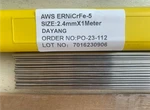

Core Welding E7024
Stable arc, uniform penetration; strict quality control for welding strength
Supports wholesale/retail; suitable for machinery, steel structure welding
In industrial scenarios such as machinery manufacturing, steel structure processing, and pressure vessel production, a welding electrode with stable performance and strong adaptability is crucial for ensuring welding quality and operational efficiency. As a commonly used product in this field, Core Welding E7024 has become a preferred welding material for many enterprises due to its strict quality control, flexible parameter adaptability, and cost-effectiveness. Currently, it is mass-supplied by professional Chinese manufacturers (e.g., Hangzhou Dayang Welding Equipment Co., Ltd.), covering various procurement needs such as wholesale and retail.
I. Core Welding Parameters of Core Welding E7024
To avoid welding defects like weld cracks and pores and ensure welding strength, base metals of different thicknesses need to be matched with corresponding electrode diameters and welding parameters. Catering to mainstream industrial needs, Core Welding E7024 offers three commonly used diameters: 3.2mm, 4.0mm, and 5.6mm. The specific parameter adaptations are shown in the table below, with all parameters designed based on the DC positive (DC+) mode, balancing practicality and safety:
| Electrode Diameter | DC Positive (DC+) Current Range | Welding Speed | Arc Voltage | Maximum Interpass Temperature | Applicable Base Metal Thickness |
|---|---|---|---|---|---|
| 3.2mm | 100-160 A | 10-15 cm/min | 22-24 V | ≤200°C | 6-10 mm |
| 4.0mm | 160-215 A | 12-18 cm/min | 24-26 V | ≤180°C | 8-15 mm |
| 5.6mm | 270-340 A | 8-12 cm/min | 26-28 V | ≤150°C | 12-20 mm |
It can be seen from the parameters that as the electrode diameter increases, the adapted current range and arc voltage increase accordingly to ensure sufficient penetration depth; while the maximum interpass temperature decreases gradually, which can effectively control the heat input and prevent the base metal from performance degradation due to overheating. This parameter design not only adapts to the welding needs of base metals from thin to medium-thick types but also provides adjustment space for different operational efficiency requirements.
II. Core Advantages of Core Welding E7024
Reliable Quality, Compliance with Industry StandardsThe production process of Core Welding E7024 strictly adheres to industrial welding material specifications. Products from some manufacturers have obtained authoritative certifications such as SGS. A complete quality control system has been established from raw material selection to finished product inspection, ensuring the uniformity of composition and arc stability of each batch of electrodes. After welding, the welds have an attractive appearance and meet the requirements for mechanical properties (such as tensile strength and impact toughness), which can satisfy the welding needs of most industrial structures.
Wide Adaptability, Reducing Operational ComplexityWhether it is a thin steel plate of 6mm or a medium-thick base metal of 20mm, welding can be completed by selecting the E7024 electrode of the corresponding diameter without frequent replacement of electrode types. At the same time, its welding parameter range is clear and easy for operators to master. Even in small-batch production scenarios, operators can quickly get started and ensure welding quality.
Cost-Effectiveness, Adapting to Diverse Procurement NeedsAs a product supplied by local Chinese manufacturers, Core Welding E7024 relies on a mature supply chain system to control production costs while ensuring high quality. It can provide customers with preferential policies such as wholesale discounts and low-price purchases. Whether it is bulk procurement by large enterprises (e.g., monthly orders from steel structure factories) or small-batch trials by small and medium-sized enterprises, suitable procurement solutions can be found to effectively reduce the material cost of welding operations.
III. Usage Recommendations for Core Welding E7024
To maximize the product performance, the following points should be noted during actual welding:
Parameter Matching: Strictly select the electrode diameter and corresponding parameters according to the thickness of the base metal. For example, when welding a base metal of 8-15mm, priority should be given to using a 4.0mm electrode to avoid base metal burn-through due to excessive current or poor fusion due to insufficient current.
Temperature Control: The interpass temperature must be strictly controlled within the upper limit specified in the parameter table (e.g., no more than 200°C for 3.2mm electrodes). It can be adjusted by means of intermittent welding and air cooling to prevent stress concentration in the weld due to high temperature.
Storage Conditions: Electrodes should be stored in a dry and well-ventilated environment to avoid moisture absorption, which may cause pores during welding and affect the weld quality.
IV. Procurement and Supply Support
Currently, Core Welding E7024 is produced and supplied by a number of professional manufacturers in China (such as Hangzhou Dayang Welding), which support services including "wholesale procurement with discounts", "customized packaging", and "return and exchange for quality issues". Customers can obtain the latest quotations and product inspection reports through the manufacturer's official website or by directly contacting the supplier. Whether pursuing low-cost procurement or focusing on high-quality assurance, suitable cooperation solutions can be found.
V. Frequently Asked Questions (FAQ) about Core Welding E7024
What is the difference between Core Welding E7024 and the commonly used E7018 electrode? Are their applicable scenarios different?The core differences between the two lie in their uses and welding requirements: E7024 is a "high deposition rate" electrode with stable arc and fast forming, which is more suitable for the welding of general industrial structures such as steel structures and mechanical components; E7018 is a "low-hydrogen type" electrode with stronger crack resistance, but it has higher requirements for welding processes (such as preheating temperature) and is more suitable for high-strength and high-risk scenarios such as pressure vessels and high-pressure pipelines. If extreme crack resistance is not required, E7024 is more advantageous in terms of cost-effectiveness and operational convenience.
Only "DC+ (DC positive)" is marked in the parameter table. Can AC (alternating current) power be used for welding?AC power can be used for short-term welding, but long-term use is not recommended. Under the DC+ mode, E7024 has higher arc concentration and more uniform penetration depth, which can reduce weld defects; if AC power is used, problems such as arc fluctuation and poor fusion may occur, and the risk of defects will increase especially when welding electrodes with a thickness of 5.6mm. It is recommended to prioritize matching with DC welding machines; if only AC can be used, the welding speed should be appropriately reduced and weld inspection should be strengthened.
Can the electrode be dried and reused after getting damp? How to operate it specifically?Electrodes that are slightly damp (no obvious rust or caking on the surface) can be dried and reused, while those that are severely damp are recommended to be scrapped. Drying parameters: Put the electrodes into a drying oven and dry them at a low temperature of 70-100℃ for 1-2 hours to avoid rapid drying at high temperatures leading to cracking of the coating; after drying, the electrodes should be placed in a heat preservation barrel (maintaining a temperature of 50-80℃) and taken as needed to prevent re-moistening.
Can Core Welding E7024 be used for welding stainless steel or high-strength steel?No. The composition and coating design of this electrode are only suitable for mild steel and low-alloy steel (such as Q235 and Q345 steel). If it is used for welding stainless steel, the corrosion resistance of the weld will decrease due to mismatched composition; when welding high-strength steel (tensile strength ≥690MPa), it cannot meet the mechanical requirements and is prone to weld cracking. Specialized electrodes should be selected according to the base metal material (e.g., E308L for stainless steel and E8018 for high-strength steel).
Can small-batch procurement apply for a trial? What is the minimum order quantity (MOQ) for wholesale?Most suppliers support small-batch trials (e.g., 1-2 boxes, 20-25kg per box), and the specific details can be negotiated with the manufacturer through the official website or phone; there is no unified standard for the MOQ of wholesale. Small and medium-sized manufacturers usually set the MOQ at 500kg, while large manufacturers (such as Hangzhou Dayang Welding) can adjust it according to customer needs. Generally, the larger the order quantity, the higher the discount.
In addition to SGS certification, do the products comply with other industry standards?In addition to SGS, Core Welding E7024 from mainstream manufacturers also complies with ISO 6848 (International Standard for Welding Electrodes) and GB/T 5117 (Chinese Standard for Carbon Steel Welding Electrodes). Some export products will also obtain certifications such as AWS A5.1 (Standard of the American Welding Society) according to the requirements of the target market. Customers can request a complete certification report from the supplier during procurement.
After welding, pores appear in the weld. What may be the reasons? How to avoid them?There are 3 common reasons: ① The electrode is damp (the coating absorbs water, leading to gas generation during welding); ② Improper welding parameters (e.g., insufficient current causes the molten pool to cool too quickly, and gas cannot escape in time); ③ The interpass temperature is too low (lower than the lower limit in the parameter table, leading to poor fusion and gas entrapment). Corresponding solutions: Strictly control the storage humidity, match the parameters according to the base metal thickness, and check the interpass temperature before welding (measure with a temperature detector to ensure it is not lower than the ambient temperature +50℃).
Can it be used for the welding of pressure vessels? What should be noted?It is only suitable for the welding of medium and low-pressure pressure vessels (design pressure ≤1.6MPa), and two prerequisites must be met: ① The base metal is mild steel/low-alloy steel (e.g., Q245R); ② Non-destructive testing (such as radiographic testing RT and ultrasonic testing UT) is performed after welding. It is not recommended for high-pressure pressure vessels (design pressure >10MPa); low-hydrogen electrodes (such as E7018) should be selected and more strict welding process specifications should be followed.
Hot Tags: core welding e7024, China, manufacturers, suppliers, factory, company, wholesale, discount, buy, low price, high quality, products
Previous
Key Notes E7024You Might Also Like




Send Inquiry