




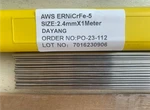

E7024 Rod
1. Core Application Scenario Positioning
The core advantages of E7024 electrode lie in its "ease of operation, moderate cost, and good formability", while it has weaknesses in crack resistance and low-temperature toughness. Therefore, its application scenarios are concentrated on mild steel structures that do not require extreme mechanical properties of welded joints (e.g., no requirements for low temperature, high pressure, or dynamic loads), and it is particularly suitable for on-site construction, batch welding, or scenarios operated by non-professional welders.
2. Specific Application Fields & Examples
1. Construction and Steel Structure Industry
Applicable Structures: Non-load-bearing or secondary load-bearing mild steel components, such as factory steel columns, steel beams (non-main load-bearing), steel platforms, guardrails, stair handrails, and temporarily built steel structure supports (e.g., construction scaffolding, material platforms).
Inapplicable Scenarios: Core load-bearing steel structures of high-rise buildings, main girders of long-span bridges, and steel structures in low-temperature environments (e.g., below -20°C) (due to insufficient low-temperature toughness).
2. General Machinery Manufacturing Industry
Applicable Components: Non-core stress-bearing parts of mechanical equipment, such as:
Casings, protective covers, brackets, and bases (mild steel material) of machine tools;
Casings and flanges (non-high-pressure sealed flanges) of general machinery (e.g., fans, water pumps);
End caps and brackets of reducers and gearboxes (parts without impact loads).
Inapplicable Scenarios: Core stress-bearing components such as mechanical spindles, gears, and bearing housings (which require electrodes with higher strength or toughness, e.g., E7018).
3. Automotive and Construction Machinery Field
Applicable Scope:
Auxiliary support parts of truck frames, carriage guardrails, toolboxes (mild steel material);
Chassis brackets, body casings, and agricultural implement connecting frames (non-stress core) of agricultural machinery (e.g., tractors, harvesters);
Cab frames and auxiliary pipeline brackets (non-hydraulic system or load-bearing structure) of construction machinery (e.g., loaders, excavators).
Inapplicable Scenarios: Main girders of automobile frames, boom arms (stress core) of construction machinery, and high-pressure hydraulic pipelines (requiring electrodes with stronger crack resistance).
4. Pipeline and Vessel Welding (Low-Pressure Scenarios)
Applicable Pipelines: Low-pressure fluid transmission pipelines, such as:
Low-pressure water and gas transmission pipelines for civil or industrial use (working pressure ≤ 1.6MPa, medium: non-corrosive fluids such as water and air);
Non-pressure-bearing or low-pressure storage tanks (e.g., water tanks, oil drums with small volume and no pressure requirements).
Inapplicable Scenarios: High-pressure oil and gas transmission pipelines (e.g., long-distance natural gas pipelines), pressure-bearing boilers, and pressure vessels (e.g., steam tanks, reaction kettles) - such scenarios require low-hydrogen electrodes (e.g., E7018) with strong crack resistance.
5. Light Industry and Civil Products Field
Applicable Products:
Household metal products: Anti-theft doors, anti-theft windows (mild steel material), clothes drying racks, metal furniture (e.g., wrought iron tables and chairs), and storage cabinet frames;
Small equipment: Casings of power tools (e.g., metal casings of electric drills and cutting machines), and hardware accessories (e.g., welding and fixing of bolts and nuts).
3. Application Limitations & Precautions
Material Limitations: Only applicable to mild steel (carbon content ≤ 0.25%) or low-alloy high-strength steel (yield strength ≤ 345MPa, e.g., non-critical parts of Q345 steel). It cannot be used for welding high-carbon steel, stainless steel, cast iron, or other materials.
Environmental Limitations:
Avoid welding in low-temperature (<0°C), high-humidity (relative humidity >80%), or strong-wind environments (prone to porosity and cracks). If welding in such environments is necessary, preheating (80-150°C) and windproof/moisture-proof measures must be taken in advance.
Not suitable for corrosive environments (e.g., chemical workshops, high-salt-spray coastal environments) - welds of acid-coated electrodes have poor corrosion resistance and need to be matched with anti-corrosion coatings (e.g., painting, galvanizing).
Structural Safety Limitations: It is prohibited to use E7024 for critical load-bearing structures, dynamic load structures, or low-temperature/high-pressure equipment (e.g., crane booms, low-temperature storage tanks, aerospace components). For such scenarios, low-hydrogen electrodes (e.g., E7018) or special-purpose electrodes should be selected.
Summary
E7024 (corresponding to J422) is a versatile, easy-to-operate mild steel electrode. Its core applications involve welding non-critical mild steel structures under non-extreme working conditions, covering industries such as construction, general machinery, low-pressure pipelines, and civil products. It is a commonly used electrode type in industrial production and on-site construction, prioritizing cost-effectiveness and low operation thresholds. In practical applications, it is necessary to strictly follow the requirements of design drawings, confirm the stress level and environmental conditions of the welded structure, and avoid using it in scenarios requiring high toughness and crack resistance.
Hot Tags: e7024 rod, China, manufacturers, suppliers, factory, company, wholesale, discount, buy, low price, high quality, products
Previous
Welding Precautions For E9015GNext
E316L SSYou Might Also Like


Send Inquiry