




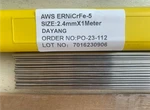

E9015-G
Chemical Composition of Deposited Metal (Typical Values, %) Mechanical Properties of Deposited Metal (Typical Values) Key Performance Comparison (Electrode vs. Welding Wire) Influence of Welding Process on Properties
Send Inquiry
Product Introduction
Chemical Composition of Deposited Metal (Typical Values, %)
| Element | C | Mn | Si | S | P | Ni | Cr | Mo | V | Cu |
|---|---|---|---|---|---|---|---|---|---|---|
| Range | ≤0.12 | 0.80-1.50 | ≤0.75 | ≤0.035 | ≤0.035 | 0.50-1.50 | ≤0.50 | 0.20-0.50 | ≤0.08 | ≤0.30 |
| Typical Value | 0.06-0.08 | 1.10-1.30 | 0.28-0.40 | ≤0.015 | ≤0.020 | 0.62-1.23 | 0.05-0.10 | 0.24-0.27 | ≤0.01 | ≤0.03 |
Mechanical Properties of Deposited Metal (Typical Values)
| Performance Indicator | Unit | Standard Requirement (AWS A5.5) | Typical Measured Value | Test Condition/Note |
|---|---|---|---|---|
| Tensile Strength | MPa | ≥620 | 620-680 | Room temperature, post-weld heat treatment at 620℃ for 1h |
| Yield Strength | MPa | ≥530 | 550-600 | Rp₀.₂ (0.2% proof strength), room temperature |
| Elongation (A₅) | % | ≥15 | 18-26 | Room temperature, 5× gauge length tension test |
| Impact Energy (-20℃) | J | ≥110 (Charpy V-notch) | 120-180 | 10mm×10mm specimen, transverse sampling |
Key Performance Comparison (Electrode vs. Welding Wire)
| Characteristic | AWS E9015-G (Electrode) | AWS ER90S-G (Welding Wire) |
|---|---|---|
| Process Type | Shielded Metal Arc Welding (SMAW), flux-coated | Gas Metal Arc Welding (MIG/MAG), requires CO₂/Ar mixed gas |
| Diffusible Hydrogen Content | ≤5 mL/100g (ultra-low hydrogen type) | ≤15 mL/100g (conventional) |
| Typical Tensile Strength | 620-680 MPa | 620-650 MPa |
| Applicable Scenarios | Critical structures such as pressure vessels, bridges, and penstocks of hydropower stations | Automated welding, general structural components |
| Operation Difficulty | Requires strict drying (400-430℃); skill required for all-position welding | Easy to operate, suitable for continuous welding of long welds |
Influence of Welding Process on Properties
| Process Parameter | Recommended Range | Influence on Properties |
|---|---|---|
| Current Polarity | Direct Current Electrode Negative (DCEN) | DC arc stability is better than AC, reducing hydrogen-induced cracking risk |
| Welding Current | φ3.2mm: 80-120A φ4.0mm: 130-180A |
Excessively high current leads to coarse grain size and decreased impact toughness |
| Interpass Temperature | ≤150℃ (recommended 90-130℃) | Overly high temperature may cause reheat cracking; overly low temperature may lead to cold cracking |
| Preheat Temperature | 50-150℃ (depending on base metal thickness) | Prevents cold cracking, especially for high-strength steels such as Q460 |
Hot Tags: e9015-g, China, manufacturers, suppliers, factory, company, wholesale, discount, buy, low price, high quality, products
Previous
E316L SS Welding RodNext
E7018 RodYou Might Also Like




Send Inquiry