






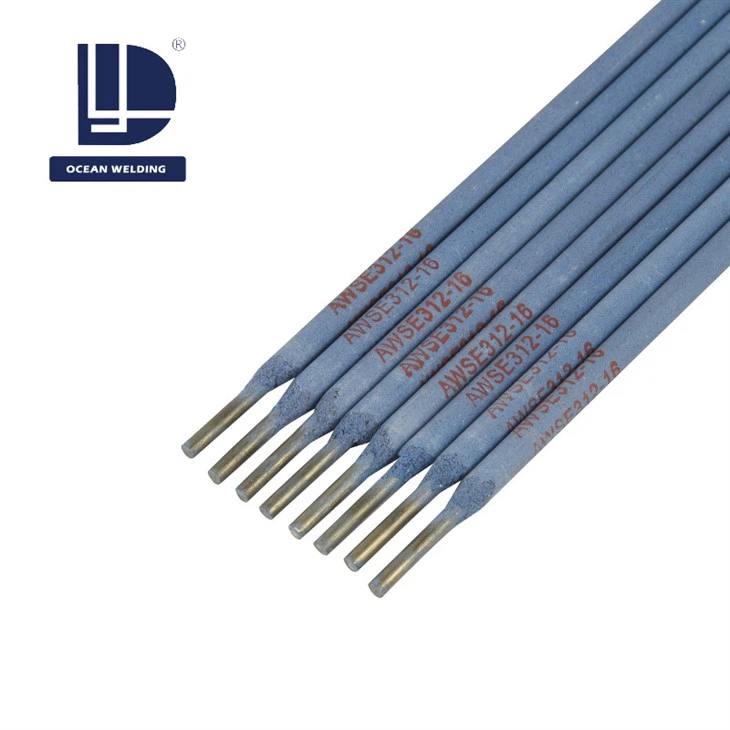
E312-16 Stainless Steel Welding Electrode
Place of Origin: Zhejiang, China
Model: E312-16
Material: Stainless Steel
Core Positioning: A mid-to-high-end duplex stainless steel welding electrode suitable for high-demand welding operations. It integrates crack resistance, process stability, and wide compatibility, with all indicators complying with international standards and passing authoritative certifications.
I. Core Product Parameters
The AWS E312-16 electrode ensures stability and reliability in various welding scenarios through precise parameter design. The specific parameters are as follows:
1. Basic Specifications
| Item | Details |
|---|---|
| Base Material | Pure stainless steel, ensuring the corrosion resistance and strength of welded joints, laying a material foundation for high-demand scenarios (e.g., chemical equipment, high-pressure vessels) |
| Executive Standard | Complies with international standard AWS A5.4 and corresponds to national standard GB E312-16. It has strong compatibility, can adapt to mainstream welding equipment at home and abroad, and meets compliance requirements of multiple industries |
| Size Specifications | Diameter: 2.0mm (for welding thin-walled parts such as precision instrument casings), 2.5mm (for welding small and medium-sized structural parts such as pipeline fittings), 3.2mm (for welding conventional industrial components such as mechanical brackets), 4.0mm (for welding thick-walled parts such as heavy equipment bases); Length: 300mm-500mm (uniform size, suitable for continuous welding of workpieces with different thicknesses) |
| Quality Certifications | Has passed ISO 9001-2008 Quality Management System Certification, CE Safety Certification, and SGS testing, and can be used in overseas markets such as the EU and Southeast Asia; OEM customization is supported to meet personalized procurement needs of industries such as automobile manufacturing and ship engineering |
2. Deposited Metal Properties

(1) Chemical Composition Ratio (mass fraction)
- Carbon ≤0.15%: Effectively reduces the risk of welding cracks, suitable for welding crack-prone materials such as high-carbon steel and tool steel
- Manganese 0.5%-2.5%: Improves the toughness of deposited metal, suitable for scenarios requiring resistance to vibration and impact (e.g., welding of engineering machinery joints)
- Chromium 28%-32%: Enhances corrosion resistance, suitable for harsh environments such as humid, acid, and alkali conditions (e.g., welding of chemical pipelines and marine equipment)
- Nickel 8.0%-10.5%: Optimizes the duplex structure and improves comprehensive performance, meeting the needs of high-temperature working conditions (e.g., welding of boiler and heating furnace components)
- Sulfur ≤0.03%, Phosphorus ≤0.04%: Strictly controls impurities to avoid welding defects, ensuring use in scenarios with high purity requirements such as food machinery and medical equipment
- Molybdenum and Copper ≤0.75% each: Balanced composition ensures stable performance, suitable for welding dissimilar steels (stainless steel and carbon steel)
(2) Mechanical Properties
- Tensile Strength ≥660MPa: Withstands high tension, and joints are not easy to break, suitable for load-bearing scenarios such as high-pressure pipelines and lifting equipment
- Elongation ≥22%: Has good plasticity and resistance to brittle fracture, suitable for welding in low-temperature environments (e.g., refrigeration equipment, polar operation machinery)
- Ferrite Content: 40%, significantly improving crack resistance, suitable for complex stress environments (e.g., welding of bridge steel structures and pressure vessels)
II. Welding Operation Guide
To give full play to the electrode's performance, standardized operating procedures must be followed. Precise control is required from pre-treatment to current setting to adapt to welding needs of different scenarios:
1. Pre-Welding Preparation
(1) Electrode Baking
- Requirement: Bake at 250°C for 1 hour before use
- Purpose: Remove moisture from the electrode coating to avoid welding porosity and ensure welding quality in sealed scenarios (e.g., storage tanks, sealed containers)
- Applicable Scenarios: A mandatory step before welding in humid environments (e.g., ship decks, underground pipelines)
(2) Current Selection (DC+ is recommended)
| Electrode Diameter | Current Range | Applicable Scenarios | Remarks |
|---|---|---|---|
| 2.5mm | 50-80A | Precision welding of thin-walled parts, such as stainless steel casings of electronic equipment and small instrument accessories | - |
| 3.2mm | 80-110A | Welding of conventional industrial components, such as mechanical transmission parts and pipeline connections | - |
| 4.0mm | 110-160A | Welding of thick-walled parts, such as heavy equipment bases and large steel structure supports | - |
| 5.0mm | 160-220A | Welding of extra-thick-walled and high-load components, such as large pressure vessels and bridge load-bearing parts | Supports alternating current (AC) welding, suitable for field operation scenarios without DC equipment (e.g., construction emergency repair, mining equipment maintenance) |
2. Applicable Welding Positions
- Flat Welding (H): Suitable for welding large-area flat components, such as equipment panels and steel structure platforms
- Horizontal Welding (OH): Suitable for scenarios such as horizontal butt welding of pipelines and welding of container side wall welds
- Overhead Welding (HF): Suitable for welding in confined spaces such as ceiling pipelines and equipment bottoms, e.g., maintenance of overhead pipelines in workshops
- Vertical Welding (F): Suitable for welding vertical pipelines and column structures, such as building steel structure columns and vertical sections of oil pipelines
- Vertical-Down Welding (VU): Suitable for rapid welding of long-distance pipelines, such as on-site construction of oil and gas transmission pipelines
- Versatility Advantage: No frequent electrode replacement is required, and it can meet the welding needs of multi-station and complex structures (e.g., special-shaped mechanical parts)
III. Core Application Scenarios
With excellent crack resistance and compatibility, it widely covers high-demand welding fields, especially scenarios with strict requirements on the strength and corrosion resistance of welded joints:
- Welding of High-Carbon Steel and Tool Steel: Such as the connection of die steel and cutting tool steel components (e.g., stamping die splicing, tool shank welding). It solves the problem of easy cracking during welding of these steels due to high carbon content, ensuring the stability and service life of joints.
- Welding of High-Temperature Steel and Armor Steel: Suitable for welding high-temperature working condition equipment (e.g., boiler furnaces, heating furnace tubes) and high-strength protective equipment (e.g., bulletproof steel plates, military mechanical parts). It can maintain stable performance in the temperature range of -40°C to 600°C, ensuring the safe operation of equipment.
- Welding of Dissimilar Steels: Such as the connection between stainless steel and carbon steel/low-alloy steel (e.g., welding of stainless steel inner liners and carbon steel outer shells in chemical equipment, welding of stainless steel corrosion-resistant sections and carbon steel main pipes in oil pipelines). It bridges the performance gap between materials and ensures the compatibility and corrosion resistance of joints.
- Welding of Special Steels: Covers the welding of Cr29Ni9 cast steel (e.g., repair of large valve castings), duplex stainless steel (e.g., components of seawater desalination equipment), and various "problematic steels" (e.g., renovation of waste steel components with uneven composition), filling the application gap of conventional electrodes in the welding of special materials.
- Industry-Specific Scenarios:
- Chemical Industry: Welding of acid-alkali storage tanks and reactor welds, with corrosion resistance suitable for strong chemical medium environments
- Marine Engineering: Welding of ship decks and offshore platform steel structures, with salt spray corrosion resistance suitable for high-humidity marine environments
- Food and Pharmaceutical Industry: Welding of stainless steel storage tanks and conveying pipelines, with low impurities and no harmful substance precipitation, meeting hygiene standards
- Engineering Machinery Industry: Welding of excavator bucket rods and crane booms, with high tensile strength suitable for heavy-duty operation needs
IV. Product Advantages and Service Guarantee
1. Core Advantages
- Process-Friendly, Suitable for Multi-Scenario Processing: Little spatter during welding (reducing the subsequent cleaning cost of precision components such as chemical equipment and food machinery); beautiful weld formation (meeting the appearance requirements of scenarios such as building curtain walls and display equipment); easy to cut and grind (suitable for post-trimming of special-shaped components, such as stainless steel welding of art installations), shortening the production cycle.
- Flexible Packaging, Suitable for Different Procurement Scenarios: Standard packaging (5kg/PVC box with shrink film; 4 boxes/carton = 20kg; 50 cartons/pallet = 1 ton) is suitable for bulk procurement (e.g., annual stockpiling of large factories); customized packaging (e.g., small-sized 1kg/box) is supported, suitable for small-batch procurement of small workshops and maintenance stores, adapting to different procurement volumes and storage needs.
2. Delivery and Services, Ensuring Scenario Implementation
- Delivery Cycle: In-stock products can be shipped within 8-25 days, suitable for emergency maintenance scenarios (e.g., sudden factory equipment failures, pipeline leakage repair); customized products will be delivered within 25 days after order confirmation, meeting the bulk production needs during industry peak seasons (e.g., shipbuilding peak season, infrastructure peak period).
- Trade Terms: Supports multiple terms such as CIF (e.g., door-to-door delivery for overseas projects), CFR (e.g., customer self-pickup of sea freight goods), FOB (e.g., customer-designated freight forwarder), and EXW (e.g., self-pickup from domestic factories), adapting to global procurement needs (e.g., procurement by Southeast Asian shipyards and European chemical enterprises).
- Risk Guarantee: Free samples are provided for trial. Customers can verify the performance according to actual application scenarios (e.g., welding tests of specific materials, working condition simulation welding) before formal procurement, reducing cooperation risks.
Contact and Procurement
Keywords: E312-16 electrode, stainless steel welding electrode, industrial welding materials
Service Support: Direct supply from the manufacturer, wholesale customization, quality assurance. Welding solution consultation for different application scenarios is available (e.g., recommending welding parameters according to customers' specific workpiece materials and working condition requirements).
Procurement Consultation: Contact the brand to obtain the latest quotation and samples, suitable for industrial manufacturing, precision welding in special fields, and other scenario needs. It supports small-batch trials and rapid response to large-volume orders.
Hot Tags: e312-16 stainless steel welding electrode, China, manufacturers, suppliers, factory, company, wholesale, discount, buy, low price, high quality, products
You Might Also Like




Send Inquiry