




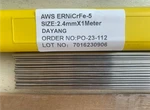


H600R (E2 UM-55)
Standard :DIN 8555 E6UM-60
Characteristic: HRC 60
Sizes:2.5mmx300mm,3.2mmx350mm,4.0mmx350mm,5.0mmx400mm
Products Description
A rutile coated, hard facing electrode featuring deposits of high toughness and excellent abrasion resistance to medium impact.
Positions: flat, horizontal and vertical-up.
Product characteristics

Optimized resistance to medium impact wear: wear rate under 50J/cm² impact load <0.15mm³/N·m (ASTM G65 standard, 12 times higher than low carbon steel)
Composite wear-resistant phase design: M7C3 carbide (accounting for >35%) + tough martensite matrix, achieving impact-abrasion composite working condition tolerance
Low-defect deposited metal: crack sensitivity index Pcm <0.25% (ISO/TR 15608), deposited layer is suitable for welding without preheating (workpiece thickness ≤30mm)
Long-term service guarantee: life of vulnerable parts of mining/cement equipment is increased by 3-5 times (actually measured hammer life of granite crushing working condition reaches 1900 hours)
Mechanical properties
| Item | Tensile Strength | Yield strength | Elongation | Hardness |
| Indicator | ≥750MPa | ≥500MPa | ≥10% | HRC55-60 |
Tensile strength ≥750MPa: Prevents tensile fracture of welded joints and ensures structural tensile safety.
Yield strength ≥500MPa: Resists high-load plastic deformation and maintains stable component shape and function.
Elongation ≥10%: Improves toughness, absorbs external deformation energy, and reduces the risk of brittle fracture.
Hardness HRC55-60: High wear resistance, resists friction and wear, and extends service life in high-loss environments.
Chemical composition (%)
| Item | C | Cr |
| Requirements | 3.0-5.0 | 20-30 |
| Example Value | 3.5-5.0 | 25-30 |


Application
| Mining tools: Suitable for high-impact parts such as rock drill bits and ripper teeth. After surfacing, they can be used directly, and the abrasive wear resistance is improved by more than 3 times. | ||||||||||
| Metal forming equipment: Repair stamping dies, guillotine blades and other shearing tools. Single-layer surfacing hardness HRC55 can extend the service life of the blade. | ||||||||||
| Forestry machinery parts: Strengthen chipper blades and peeling hammer anvils to resist wood fiber wear and reduce the average monthly maintenance frequency by 60%. | ||||||||||
| Recycling equipment: Used for scrap steel crusher blades and garbage sorting machine tooth plates to maintain HRC55-60 hardness stability in mixed media. |


Notes on use
Sudden porosity: Stop welding immediately and check the electrode drying (re-baking at 350℃×1h is required) and the ambient humidity.
Insufficient hardness: Check whether the heat input exceeds the standard or the interlayer temperature is too high (metallographic analysis of carbide distribution is required).
Interface cracks: Confirm whether the substrate is a prohibited material (such as austenitic stainless steel) or the preheating is insufficient.
Welding process
Welding parameter setting: electrode diameter 4.0mm: DC+polarity, current 140-180A, voltage 24-28V, welding speed 15-20cm/min (matching 1.0-1.4kJ/mm heat input).
Overlay operation: short arc welding (arc length ≤3mm), electrode inclination 70-80°, weld overlap 30%-50%; for multi-layer overlay, each layer crosses 90° direction, and the interlayer temperature is strictly controlled at 200-220℃ (overtemperature needs to be cooled to 150℃ for continued welding).
Post-weld treatment: asbestos felt wrapping and slow cooling to below 80℃, high-constraint workpieces are subjected to 350℃×2h stress relief annealing (not mandatory, selected according to substrate performance).
FAQ
Q: How to match electrode diameter and current?
A: The electrode diameter is usually Φ4.0mm, and the recommended current range is 140-180A (DC+). At this time, the heat input is controlled at 1.0-1.4kJ/mm. If welding thin-walled parts (thickness <20mm) or narrow welds, Φ3.2mm electrodes can be used and the current can be adjusted to 90-120A. Too low current (such as <140A) will result in a deposition efficiency of less than 80% and uneven carbide distribution.
Q: How to determine the preheating temperature?
A: The preheating temperature needs to be adjusted according to the thickness of the workpiece: the workpiece with a thickness of less than 50mm should be preheated at 150-200℃, and the workpiece with a thickness of 50mm or more should be preheated at 250-300℃. This setting can reduce the risk of hydrogen-induced cracking (hydrogen diffusion efficiency is increased by 3 times) and relieve the high restraint stress of thick parts (the peak residual stress is reduced from 500MPa to 300MPa).
Q: What could be the reason for insufficient hardness after cladding?
A: Common causes include excessive heat input (>1.4kJ/mm), resulting in insufficient carbide precipitation (volume fraction <30%), or excessive interlayer temperature (>220℃), resulting in carbide coarsening (size >3μm). In addition, if the substrate is high carbon steel (C>0.5%), the increased carbon content of the molten pool will form a brittle Fe3C phase, resulting in abnormal hardness.
How To Order
| TYPE: | H600R (E2 UM-55) | H600R (E2 UM-55) | H600R (E2 UM-55) |
| Material: | High carbon high chromium | High carbon high chromium | High carbon high chromium |
| Size : | Diameter:Φ3.2mm,Φ4.0mm | Diameter: Φ3.2mm,Φ4.0mm | Diameter:Φ3.2mm,Φ4.0mm |
| Length:350mm,etc | Length:350mm,etc | Length:350mm,etc | |
| Torelance: | (-0.04/-0.01)mm | (-0.04/-0.01)mm | (-0.04/-0.01)mm |
| Packing: | 1kg,2.5kg,5kg/inner box | 20kg/carton | 1000kg/pallet |
| M.O.Q: | 500.00kgs | 500.00kgs | 500.00kgs |
Hot Tags: h600r (e2 um-55), China, manufacturers, suppliers, factory, company, wholesale, discount, buy, low price, high quality, products
Previous
Surface ElectrodesNext
H600B (E6UM-60)You Might Also Like


Send Inquiry