




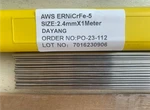

ER347 Ss Wire
347 stainless steel is an austenitic stainless steel containing niobium, which exhibits excellent resistance to intergranular corrosion and high-temperature stability. When welding this material, the following key precautions must be observed to ensure welding quality and performance:
Matching of Welding Consumables
Select welding consumables that match the composition of 347 stainless steel, such as ER347 welding wire (for gas metal arc welding) or E347 electrodes (for shielded metal arc welding). These consumables contain niobium, which can counteract the combination of carbon and chromium, thereby preventing intergranular corrosion.
Strict Control of Cleanliness
Before welding, thoroughly clean the groove and the surface within a range of at least 20mm on both sides of the groove. Remove impurities such as scale, oil, moisture, and paint (using stainless steel wire brushes, sandpaper, or specialized cleaning agents) to avoid porosity, inclusions, or cracks during welding.
Avoid contact between carbon steel tools and the area to be welded, as carbon steel contamination can cause weld rusting.
Keep the welding wire/electrodes dry to prevent moisture absorption.
Selection of Appropriate Welding Methods
Prioritize gas shielded welding (e.g., TIG tungsten inert gas welding, MIG metal inert gas welding), as it provides stable inert gas protection to minimize oxidation of the weld pool. For thick plates, submerged arc welding can be used in combination, but the purity of the flux must be ensured.
Control Welding Parameters to Avoid Overheating
Use lower welding current and faster welding speed to reduce heat input, preventing overheating of the base metal and weld (overheating of austenitic stainless steel leads to coarse grains, which degrades toughness and corrosion resistance).
Control the interpass temperature (generally not exceeding 150°C) to avoid excessive precipitation of niobium carbides due to repeated heating.
Maintain short-arc welding to reduce the scouring of the weld pool by the arc and the burnout of alloying elements.
Enhance Shielding Gas Protection
Pure argon (Ar) or argon-helium mixed gas (to increase arc temperature) is typically used as the shielding gas. The flow rate should be moderate (generally 8-15 L/min for TIG welding) to ensure complete coverage of the weld pool and high-temperature zones, preventing oxidation.
For the root pass, backside protection (e.g., backside argon purging) is required to avoid root oxidation, which can cause embrittlement or corrosion.
Prevent Hot Cracks
Austenitic stainless steel welds are prone to hot cracks due to low-melting eutectics (e.g., sulfur and phosphorus compounds). Attention should be paid to:
Control weld formation; avoid excessive stress concentration caused by overly small groove angles or improper gaps.
Reduce the sulfur and phosphorus content in the base metal and welding consumables.
Avoid rapid cooling during welding; use slow cooling measures if necessary.
Preheating and Post-Weld Heat Treatment
Preheating is generally not required (unless welding extremely thick workpieces or structures with high rigidity, in which case low-temperature preheating at 100-150°C can be adopted to prevent cold cracks).
Post-weld heat treatment is usually unnecessary, but for components subjected to high-temperature or corrosive conditions, stabilization heat treatment (e.g., holding at 850-900°C followed by air cooling) can be performed to promote the precipitation of niobium carbides and further improve intergranular corrosion resistance.
Post-Weld Treatment and Inspection
Promptly remove weld slag and spatter after welding. Perform pickling and passivation treatment (using specialized passivation solutions) on the weld and heat-affected zone to restore the surface passive film and enhance corrosion resistance.
Conduct visual inspection; if necessary, use non-destructive testing (NDT) methods such as radiographic testing (RT) and ultrasonic testing (UT) to ensure no internal defects.
Adhering to the above precautions can effectively ensure the mechanical properties and corrosion resistance of 347 stainless steel welded joints, meeting its application requirements in high-temperature and corrosive environments (e.g., petrochemical, pressure vessel, and power generation industries).
Hot Tags: er347 ss wire, China, manufacturers, suppliers, factory, company, wholesale, discount, buy, low price, high quality, products
You Might Also Like


Send Inquiry