






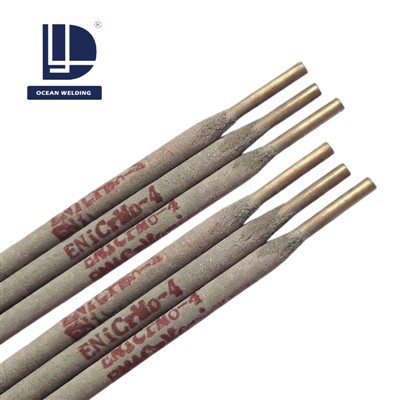
ENiFe-CI Nickel-Iron Cast Iron Welding Electrode
55% Ni-Fe, HB 190, machinable, cold-weld process.
For ductile iron, gray iron, engine block repair.
MTC.
AWS A5.15 ENiFe-CI Nickel-Iron Cast Iron Welding Electrode
Ocean Welding ENiFe-CI is a basic, graphite-coated nickel-iron cast iron welding electrode that complies with AWS A5.15 / SFA-5.15 (UNS W82002) standards. Its approximately 55% nickel-iron balanced chemical composition can form a fully austenitic weld metal, which can resist cracking in ductile iron, high-phosphorus cast iron and thick-section castings, while pure nickel ENi-CI welding electrodes may not be strong enough in these cases.
ENiFe-CI is the preferred single-electrode solution for applications such as repairing engine block cracks, ductile iron gearboxes, and machine tool beds; joining dissimilar materials (cast iron to steel); and restoring cast iron artworks. Supplied directly from the factory, it is available in diameters ranging from Ø 2.5 to 4.0 mm and comes with a factory inspection certificate. The deposited weld metal is machinable (hardness HB 190) and features a grey color that matches the base cast iron.
Comparison of Classifications and Standards
| Standard | Designation |
|---|---|
| AWS A5.15 / SFA-5.15 | ENiFe-CI |
| UNS | W82002 |
| ISO 1071 | E C NiFe-1 |
| GB/T 10044 (China) | EZNiFe-1 (industry code Z408 / Z408A) |
| DIN 8573 | E Ni-BG 55 |
| JIS Z3252 | DFCNiFe |
Product Image


Applications and Industries
| Segment | Component | Why ENiFe-CI |
|---|---|---|
| Automotive / Diesel | Cracked engine blocks, cylinder heads, exhaust manifolds | Cold-weld process avoids full engine bake |
| Machine tools | Machine bed restoration, lathe frame repair, planer beds | Machinable deposit (HB 190) |
| Ductile iron (QT500/QT600) | Gearbox housings, crankshafts, hubs, wind-turbine hubs | Superior crack resistance vs pure Ni ENi-CI |
| Pumps & valves | Pump casings, valve bodies, HT200/HT250 flanges | Colour-matched grey deposit |
| Casting defect repair | Sand holes, blowholes, shrinkage in fresh castings | Foundry-grade repair, low dilution |
| Cast iron to steel | Cast iron flange to carbon steel pipe, dissimilar joints | 55 %Ni buffers thermal expansion mismatch |
| Artistic / heritage | Antique cast iron, decorative castings | Grey deposit close to original colour |
| Heavy castings | Large motor housings, ship bearings, mining equipment | High strength + low residual stress |
Chemical Composition of All-Weld Metal (wt %)
| Element | AWS A5.15 ENiFe-CI spec | OW-ENiFe-CI typical | Washington Alloy Ni-55 typical[1] |
|---|---|---|---|
| C | ≤ 2.0 | 0.6 | 0.058 |
| Mn | ≤ 2.5 | 1.5 | 1.27 |
| Si | ≤ 4.0 | 0.8 | 0.66 |
| Ni (+ Co) | 45 – 60 | 55.0 | 55.03 |
| Fe | balance | balance | balance |
| Cu | ≤ 2.5 | 1.5 | 2.45 |
| Al | ≤ 1.0 | 0.3 | - |
| P | ≤ 0.03 | 0.020 | 0.024 |
| S | ≤ 0.03 | 0.015 | 0.024 |
ENiFe-CI vs ENi-CI vs ENiCu - Which Cast Iron Electrode Should You Choose?
This is the single most common question from cast iron repair buyers.
| Criterion | ENi-CI (pure nickel) | ENiFe-CI (this product) | ENiCu-A/B (nickel-copper) |
|---|---|---|---|
| AWS class | AWS A5.15 ENi-CI | AWS A5.15 ENiFe-CI | AWS A5.15 ENiCu-A/B |
| Core wire | > 92 % Ni | ~ 55 %Ni + 45 %Fe | ~ 65 %Ni + ~ 30 %Cu |
| Hardness HB | 130–170 (softest) | 160–220 (medium) | 140–180 |
| Tensile Rm | 300–400 MPa | 400–580 MPa | 300–380 MPa |
| Crack resistance on gray iron | Excellent | Excellent (equal) | Excellent |
| Crack resistance on ductile iron | Medium | Excellent (clearly superior) | Medium |
| Crack resistance on high-P (>0.2%P) iron | Fair | Excellent | Fair |
| Machinability of deposit | Best (softest) | Good | Good |
| Deposit colour | Slight silver sheen | Grey - close to cast iron | Slight reddish |
| Cost per kg | Highest (pure Ni) | Medium (30–50% less than pure Ni) | Medium-high (Cu volatile) |
Specifications, Packaging and Delivery
Standard diameters: Ø 2.5 · Ø 3.2 · Ø 4.0 mm
Standard lengths: 300 mm (Ø 2.5) · 350 mm (Ø 3.2 – 4.0)
Packaging:
- Primary: 5 kg vacuum-shrink PVC inner box with moisture indicator
- Secondary: 4 × 5 kg = 20 kg carton
- Palletised: 50 cartons × 20 kg = 1 000 kg / pallet
- 20' FCL: 20 – 22 MT
Optional: 2 kg small carton, hermetically-sealed tin can (humid tropical export), private-label OEM printing from 2 000 kg / SKU.
Delivery:
- MOQ: 500 kg per diameter
- Lead time: 8 – 25 days after order confirmation
- Trade terms: EXW · FOB · CFR · CIF (Shanghai / Ningbo / Yiwu)
- Payment: T/T 30 % deposit + balance against copy of B/L; L/C at sight negotiable
FAQ
Q: What are the applications of ENiFe-CI electrodes?
A: ENiFe-CI is suitable for Shielded Metal Arc Welding (SMAW) of gray cast iron, ductile iron, and dissimilar joints between cast iron and steel. Typical applications include repairing cracks in engine blocks, ductile iron gearbox housings, and machine tool beds, as well as repairing pump casings and casting defects.
Q: Is ENiFe-CI superior to ENi-CI for cast iron welding?
A: ENiFe-CI offers better crack resistance than pure-nickel ENi-CI when welding ductile iron (QT500/QT600), high-phosphorus cast iron (P > 0.2%), and thick or large castings. However, for thin-walled gray iron castings requiring excellent machinability, the softer weld deposit produced by ENi-CI may be more suitable. Additionally, ENiFe-CI is 30%–50% less expensive than ENi-CI.
Q: Is preheating required when welding with ENiFe-CI?
A: It is not mandatory. ENiFe-CI utilizes a "cold welding" process and can be welded at room temperature or with slight preheating (≤ 200°C). For thick or large workpieces, preheating to 100–200°C helps reduce thermal shock.
Q: What is the hardness of the ENiFe-CI weld deposit?
A: The typical post-weld hardness is HB 190 (range: HB 160–220). Brinell hardness (HB) is used rather than Rockwell hardness (HRC) because the weld is designed to ensure machinability with standard high-speed steel (HSS) tools, rather than for wear resistance.
Hot Tags: enife-ci nickel-iron cast iron welding electrode, China, manufacturers, suppliers, factory, company, wholesale, discount, buy, low price, high quality, products
Previous
No InformationYou Might Also Like



Send Inquiry