




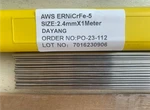
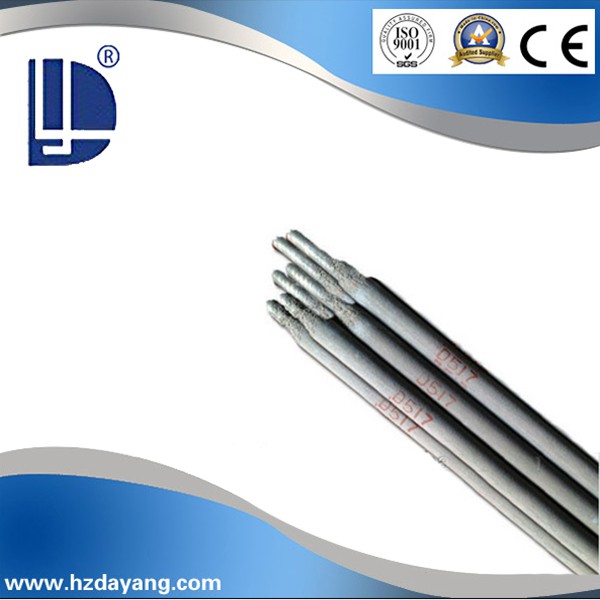
Surfacing rod
Origin: Hangzhou, Zhejiang, China
Brand: Ocean Welding
Model Number: EDCr-B-15(D517)
Size: 2.5mm 3.2mm 4.0mm
-
Product Overview
EDCr-B-15 (D517) wear-resistant welding rod is a high-chromium valve cladding welding rod with low-hydrogen sodium coating, which adopts DC reverse connection process. This product is carefully developed by Ocean Welding. The cladding metal is 2Cr13 martensitic high-chromium steel, which has unique air quenching characteristics and can obtain uniform hardness distribution without complex heat treatment process. Compared with traditional welding rods, EDCr-B-15 cladding layer has higher hardness (HRC ≥ 50) and better wear resistance, which is particularly suitable for cladding and repair of parts subjected to high wear conditions.
The research and development background of this product stems from the urgent demand for high-wear-resistant materials in the industrial field. In industries such as mining, cement, and electricity, wear of equipment parts is the main factor leading to reduced production efficiency and increased maintenance costs. EDCr-B-15 wear-resistant welding rod optimizes the alloy composition design, controls the chromium content between 10.0~16.0%, and the carbon content ≤0.25%, achieving a perfect balance between hardness and toughness, and solving the technical problem of traditional welding rods that are difficult to balance wear resistance and crack resistance.
Compared with similar products on the market, EDCr-B-15 has the following significant advantages:
1. Higher wear resistance: The hardness of the cladding layer can reach HRC50-55, which is about 25% higher than that of ordinary D507 electrodes
2. Excellent heat resistance: The softening temperature is as high as 500℃, suitable for high temperature working conditions
3. Excellent crack resistance: The low hydrogen sodium type coating is used to reduce hydrogen-induced cracks during welding
4. Wide applicability: It can be clad on a variety of substrates such as carbon steel, low alloy steel, and cast steel
EDCr-B-15 wear-resistant electrodes have been widely used in the repair of key equipment wear parts in the power, cement, mining, steel and other industries, such as valve sealing surfaces, mixer blades, screw conveyor blades, crusher hammers, etc., which can increase the service life of equipment by 6-8 times on average, significantly reducing maintenance costs for users and improving production efficiency. -
Technical Parameters
Basic parameters
Parameters Values Model EDCr-B-15 (D517) Brand Ocean Welding Coating Type Low hydrogen sodium type Specifications and Sizes 2.5mm,3.2mm,4.0mm Overlay Hardness ≥50 HRC (air cooling after welding) Softening Temperature 500℃
Chemical composition (%)
| Ingredients | Content range | Function |
|---|---|---|
| C | ≤0.25 | Ensure hardness and wear resistance |
| Cr | 10.0~16.0 | Form chromium carbide to improve wear resistance |
| Mn | ≤1.00 | Improve welding performance and toughness |
| Si | ≤1.00 | Deoxidize and improve weld quality |
| S | ≤0.035 | Control harmful elements and reduce thermal cracks |
| P | ≤0.040 | Control harmful elements and improve crack resistance |
| Other | ≤5.00 | Ensure alloy system stability |
Mechanical properties
| Item | Content |
|---|---|
| Tensile strength σb | ≥650 MPa |
| Yield strength σs | ≥450 MPa |
| Elongation δ5 | ≥15 % |
| Impact toughness αk | ≥25 J/cm² |
| Hardness of weld overlay | 50-55 HRC |
| Wear resistance (relative value) | 1.8 |
Recommended welding parameters
| Welding rod diameter (mm) | Welding current (A) | Arc voltage (V) | Welding speed (cm/min) | Preheating temperature (℃) | Baking temperature (℃) | Baking time (h) |
|---|---|---|---|---|---|---|
| 2.5 | 70-100 | 22-26 | 15-20 | ≥300 | 300-350 | 1 |
| 3.2 | 80-120 | 24-28 | 18-25 | ≥300 | 300-350 | 1 |
| 4.0 | 120-160 | 26-30 | 20-30 | ≥300 | 300-350 | 1 |
| 5.0 | 170-210 | 28-32 | 25-35 | ≥300 | 300-350 | 1 |
Product Features
High wear resistance
The high wear resistance of EDCr-B-15 wear-resistant welding rod comes from its unique alloy composition design and microstructure. The surfacing metal is 2Cr13 martensitic high-chromium steel, which can be self-quenched to form a martensitic structure under air cooling conditions, and at the same time, hard carbide phases such as Cr7C3 are precipitated. These carbides are evenly distributed on the martensitic matrix, forming a strong wear-resistant skeleton.
Wear-resistant mechanism:
• The martensitic matrix provides good strength and toughness
• Dispersed Cr7C3 carbides (hardness can reach HV1800-2200) as wear-resistant phases
• Forming about 10-15% of residual austenite to improve impact resistance
Actual applications show that the wear resistance of EDCr-B-15 surfacing layer under abrasive wear conditions is 6-8 times that of ordinary low-carbon steel and 2-3 times that of high-manganese steel. It is particularly suitable for parts that are subject to abrasive wear such as sand and ore.
Excellent heat resistance
EDCr-B-15 cladding layer has excellent high temperature stability and can maintain high hardness and wear resistance at working temperature below 500℃. Its heat resistance is mainly due to:
1. Reasonable ratio of alloy elements: the addition of chromium not only improves wear resistance, but also enhances oxidation resistance; the appropriate amount of silicon improves high temperature stability.
2. Stable microstructure: The cladding layer is mainly composed of martensite and a small amount of residual austenite. This structure is not easy to undergo phase transformation and grain growth at high temperature.
3. High temperature oxidation resistance: Under high temperature environment, a dense Cr2O3 oxide film will be formed on the surface of the cladding layer, which effectively prevents further penetration of oxygen and protects the matrix from oxidation corrosion.
These characteristics make EDCr-B-15 particularly suitable for high temperature wear conditions such as coal mills in power plants and cement kilns.
Unique air quenching characteristics
EDCr-B-15 cladding layer has unique air quenching characteristics, which is one of its significant features that distinguishes it from other wear-resistant welding rods. The so-called air quenching characteristic means that the cladding metal can obtain martensitic structure by cooling in the air without the need for additional quenching treatment.
Air quenching mechanism:
• High chromium content expands the austenite zone and improves hardenability
• Alloying elements reduce the martensitic transformation temperature (Ms point)
• Rapid cooling during welding promotes martensitic transformation
Advantages brought by air quenching characteristics:
1. Simplified process: Eliminates complex heat treatment procedures and reduces production costs
2. Reduced deformation: Avoids deformation and cracking of workpieces caused by heat treatment
3. Uniform hardness: Uniform hardness distribution under air cooling conditions, no obvious soft spots
4. Flexible adjustment: Hardness can be adjusted through different heat treatment processes (750-800℃ annealing softening, 950-1000℃ re-hardening)
Excellent welding process performance
Although EDCr-B-15 is a high-hardness wear-resistant electrode, its welding process performance is still very excellent:
1. Good arc stability: Using low-hydrogen sodium type coating, the arc burns stably and spatters are small
2. Easy slag removal: The slag formed after the coating is melted is well separated from the weld metal and easy to remove
3. Beautiful shape: the weld surface is flat, the corrugation is uniform, and the shape is good
4. All-position welding: Although it is mainly recommended for flat welding position, it can also be used for vertical welding and horizontal welding after appropriate adjustment of the process
In addition, EDCr-B-15 welding rod has strong adaptability to the parent material and can be used for surfacing welding of various base materials such as carbon steel, low alloy steel, cast steel, etc., providing users with a wide range of application possibilities.
Application fields
Power industry
In the power industry, EDCr-B-15 wear-resistant welding rods are mainly used for wear repair of the following key equipment:
Coal mill parts
- Application parts: grinding rollers, grinding discs, and striking plates
- Wear characteristics: abrasive wear + impact wear
- Surfacing process:
Preheating temperature: 350-400℃
Surfacing layers: 2-3 layers
Welding current: 120-160A (φ4.0mm)
- Application case: A thermal power plant used EDCr-B-15 to surfacing repair the grinding roller of the 300MW unit coal mill, and the service life was extended from the original 3000 hours to 9000 hours, saving about 450,000 yuan in annual replacement costs.
Fan blades
- Application parts: induced draft fan, forced draft fan blades
- Wear characteristics: dust wear + erosion wear
- Surfacing process:
Adopting the 8-shaped strip method
Surfacing thickness: 3-5mm
Slow cooling after welding
- Application effect: The service life of the blades is extended by 2-3 times, and the number of shutdowns for maintenance is reduced
Cement industry
During the cement production process, equipment wear is very serious. The application of EDCr-B-15 in the cement industry mainly includes:
Vertical mill system
• Application parts: grinding roller, grinding disc, air guide cone
• Wear characteristics: high stress abrasive wear
• Overlay solution:
Transition layer: D507 welding rod (1 layer)
Working layer: EDCr-B-15 (2-3 layers)
Total thickness: 8-12mm
• Application case: Overlay welding of vertical mill rollers of a cement group's 5000t/d production line, using EDCr-B-15 welding rods, the service life after overlay is 8000 hours, 2.5 times higher than the original roller surface.
Crusher parts
• Application parts: jaw plate, liner, hammer head
• Wear characteristics: impact wear + abrasive wear
• Key points of surfacing:
• Preheating temperature: 400℃
• Low hydrogen welding process
• Multi-layer and multi-pass welding, control of interlayer temperature
• Application effect: The service life of the crusher hammer head is extended by 3 times
Mining industry
The working conditions of mining equipment are harsh, and the requirements for wear-resistant materials are extremely high. The main applications of EDCr-B-15 in the mining industry are:
Mining equipment
• Application parts: excavator bucket teeth, buckets
• Wear characteristics: strong impact wear + abrasive wear
• Surfacing process:
Bucket tooth edge surfacing thickness: 8-10mm
DC reverse connection, short arc welding
Heat preservation and slow cooling after welding
• Application case: An iron mine repaired the bucket teeth of an excavator by surfacing welding. Using EDCr-B-15 welding rods, the service life of a single tooth was extended from the original 15 days to 60 days, and the replacement frequency was reduced by 75%.
Conveying equipment
• Application parts: middle trough of scraper, blades of screw conveyor
• Wear characteristics: abrasive wear + adhesive wear
• Surfacing solution:
Middle trough: grid surfacing
Blade: edge reinforcement surfacing
Welding current: 140-180A
• Application effect: The service life of conveying equipment is extended by 2-3 times, and the maintenance workload is reduced
Welding Guide
Preparation before welding
Preparation of welding rods
Welding rod drying: Before use, it must be baked at 300-350℃ for 1 hour. After drying, it should be stored in an insulation tube at 80-100℃ and can be taken out at any time
Selection of welding rod diameter: Select the appropriate diameter according to the thickness of the cladding and the thickness of the parent material. Generally, 3.2mm and 4.0mm are recommended
Storage of welding rods: They should be stored in a dry and ventilated warehouse to prevent moisture. The shelf life is generally 1 year
Workpiece preparation
Surface cleaning: Thoroughly remove oil, rust, oxide scale and other impurities on the surface to be welded. Angle grinder can be used to grind until the metallic luster is exposed
Preheating treatment:
Low carbon steel: 300-350℃
Medium carbon steel: 350-400℃
High alloy steel: 400-450℃
Preheating range: At least 50mm area on both sides of the weld
Preheating method: Flame heating, electric heating, etc. can be used. It is recommended to use an infrared thermometer to monitor the temperature
Welding equipment preparation
Power supply selection: Use a DC arc welding machine with reverse polarity (the electrode is connected to the positive pole)
Current adjustment: Adjust the appropriate welding current according to the electrode diameter and welding position
Ground wire connection: Ensure that the ground wire is in good contact with the workpiece to avoid arc burns
Welding operation
Basic operation techniques
Arc striking: Use the scratch method or direct strike method to strike the arc, and maintain short arc welding after arc striking
Arc length: Generally 0.5-1.0 times the electrode diameter, about 2-4mm
Welding speed: Maintain a uniform welding speed, generally 15-30cm/min
Electrode angle: The angle with the workpiece surface is about 70-80 degrees to ensure appropriate penetration depth and width
Post-weld treatment
Slow cooling treatment
• Insulation and slow cooling: Immediately cover with insulation cotton or asbestos cloth after welding, and slowly cool to room temperature
• Furnace cooling treatment: For important workpieces, 200-300℃ furnace cooling can be used, and the furnace is cooled to below 100℃
• Avoid rapid cooling: It is strictly forbidden to cool directly with water after welding to prevent cracks
Packaging & Delivery
|
Packaging Details: |
5kgs/color box,20kgs/carton,1ton/pallet |
|
Delivery Detail: |
20-25days |
| Shipping:by sea: | CIF CNF FOB |
Hot Tags: welding electrode,surfacing electrode, edcr-b-15 wear resistant surfacing electrode, China, manufacturers, suppliers, factory, company, wholesale, discount, buy, low price, high quality, products
You Might Also Like




Send Inquiry