




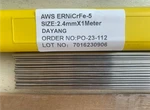

ERNiCrMo3 Nickel Alloy Welding Wire
I. Core Product Features: Excellent Both in Strength and Corrosion Resistance
The core competitiveness of ERNiCrMo3 nickel alloy welding wire lies in its dual breakthroughs in mechanical properties and corrosion resistance, perfectly adapting to welding requirements under harsh working conditions.
1. High Strength Across a Wide Temperature Range for More Stable Welded Joints
The deposited metal of the welding wire maintains high strength within a wide temperature range. Whether it is structural stability in low-temperature environments or load-bearing capacity under medium-to-high temperature working conditions, it can meet the welding needs of key components. This feature makes it outstanding in the welding of equipment that needs to bear loads for a long time, such as chemical reaction kettles and high-pressure vessels. It can effectively ensure the structural integrity of welded joints and extend the service life of equipment.
2. Strong Corrosion Resistance to Cope with Complex Erosive Environments
In response to common localized corrosion problems in industry, ERNiCrMo3 welding wire demonstrates excellent resistance:
Pitting Corrosion Resistance: It can effectively resist pitting corrosion caused by corrosive media such as chloride ions, preventing equipment leakage or structural damage due to localized corrosion.
Crevice Corrosion Resistance: In welded parts with crevices, such as flange connections and bolted joints, it can prevent crevice corrosion caused by the accumulation of corrosive media in the crevices, ensuring the sealing performance and structural safety of the equipment.
For this reason, the welding wire can work stably in highly corrosive environments such as seawater and chloride solutions, making it an ideal choice for welding marine engineering equipment.
II. Key Product Information: Specifications, Composition, and Packaging
1. Basic Specification Parameters
| Category | Details |
|---|---|
| Model | ERNiCrMo3 (MgNi625) |
| Type | Nickel Alloy Gas-Shielded Welding Wire |
| Diameter (DIA) | 1.2mm (conventional specification, customizable on demand) |
| Weight Specification | 12.5kg/spool, 15kg/spool |
| Delivery Cycle | Approximately 25 days after order confirmation |
| Minimum Order Quantity (MOQ) | 1000kg for standard specifications; customized specifications need to be evaluated based on process complexity, please consult the account manager for details |
2. Precise Chemical Composition to Ensure Stable Performance
The chemical composition of the deposited metal is scientifically formulated, and the content of each element is strictly controlled, providing solid support for the performance of the welding wire. The following is the specific element content (unit: %):
| Element | Content Range | Typical Value |
|---|---|---|
| Carbon (C) | ≤0.1 | 0.0275 |
| Manganese (Mn) | ≤0.5 | 0.248 |
| Silicon (Si) | ≤0.5 | 0.195 |
| Phosphorus (P) | ≤0.015 | 0.003 |
| Sulfur (S) | ≤0.020 | 0.0024 |
| Nickel (Ni) | ≥58.0 | 63.7 |
| Chromium (Cr) | 20-23 | 22.7 |
| Copper (Cu) | ≤0.50 | 0.0157 |
| Molybdenum (Mo) | 8-10 | 8.577 |
| Aluminum (Al) | ≤0.40 | 0.28 |
| Titanium (Ti) | ≤0.40 | 0.298 |
| Iron (Fe) | ≤1.0 | 0.419 |
| Niobium + Tantalum (Nb+Ta) | 3-4.2 | 3.3149 |
| Others | - | 0.2195 |
It can be seen from the composition table that nickel, as the base element, ensures the corrosion resistance and toughness of the alloy; chromium and molybdenum further enhance the corrosion resistance; niobium and tantalum improve the high-temperature strength and stability of the welding wire. All elements work together to ensure the excellent performance of the welding wire under different working conditions.
III. Application Scenarios: Covering Precision Welding Needs in Multiple Industries
With its unique performance, ERNiCrMo3 nickel alloy welding wire has become a core welding material in many high-demand industries. The specific application scenarios are as follows:
1. Welding of Nickel-Chromium-Molybdenum Alloy Structures
It is suitable for the welding of pure nickel-chromium-molybdenum alloy components, such as nickel alloy reaction tanks in the chemical industry and alloy oil pipelines in the petroleum industry. After welding, the joints can maintain the same performance as the base material, ensuring the corrosion resistance and strength of the overall structure and meeting the needs of equipment that operates in corrosive media for a long time.
2. Dissimilar Welding Between Steel and Nickel-Chromium-Molybdenum Alloy
In scenarios where ordinary steel needs to be connected to nickel-chromium-molybdenum alloy (such as the welding of stainless steel storage tanks and nickel alloy interfaces), this welding wire can effectively alleviate the performance difference between the two materials, reduce welding stress, avoid corrosion or cracking caused by dissimilar material welding, and ensure the reliability of the connection part.
3. Surfacing of Nickel-Chromium-Molybdenum Alloy on Surfaces
For workpieces that need to improve surface corrosion resistance and strength, surface strengthening can be achieved by surfacing ERNiCrMo3 welding wire. For example, surfacing a layer of nickel-chromium-molybdenum alloy on the surface of ordinary steel parts makes them have corrosion resistance comparable to that of pure alloys while reducing costs. It is widely used in marine platform brackets, nuclear power equipment components, etc.
4. Welding of Marine Engineering Equipment
Due to the excellent corrosion resistance of the welding wire to seawater and chloride solutions, it is widely used in the welding of marine engineering equipment, such as underwater parts of ship hulls, pipeline systems of offshore drilling platforms, and seawater desalination equipment. It can effectively resist long-term seawater erosion and extend the marine service life of the equipment.
IV. Operation Points and Precautions
To ensure welding quality and give full play to the performance advantages of ERNiCrMo3 nickel alloy welding wire, the following specifications must be followed during operation:
1. Preparation Before Welding: Thoroughly Clean the Welding Area
Before welding, surface impurities (such as oil stains, rust, moisture, oxide scale, etc.) in the welding area must be thoroughly removed. These impurities will not only affect the stability of the arc but also cause defects such as pores and slag inclusion in the weld, reducing the strength and corrosion resistance of the joint. It is recommended to use mechanical grinding, chemical cleaning, and other methods to ensure the welding area is clean and dry.
2. Welding Process Control: Optimize Parameters to Reduce Defects
Control Wire Energy: During welding, a small wire energy (i.e., low welding current and voltage) should be used to avoid coarse grain size in the weld due to excessive heat input, which affects the toughness and corrosion resistance of the joint.
Reduce Interpass Temperature: It is recommended to use a lower interpass temperature (usually controlled below 150℃, which needs to be adjusted according to the thickness of the base material) to reduce the damage of the welding thermal cycle to the weld and heat-affected zone and prevent hot cracks.
3. Precautions for Special Working Conditions
When used in highly corrosive environments such as marine and chemical industries, the weld should be subject to visual inspection and non-destructive testing (such as penetration testing and radiographic testing) after welding to ensure no surface defects and internal cracks. At the same time, passivation treatment can be carried out on the weld according to requirements to further improve its corrosion resistance.
V. Procurement and Services: Flexibly Adapting to Different Needs
As a professional supplier of nickel alloy welding wires, we provide flexible procurement plans and comprehensive service support:
Specification Customization: In addition to the conventional 1.2mm diameter specification, welding wires of different diameters can be customized according to customer needs to meet the requirements of special welding equipment or working conditions.
Bulk Procurement Discounts: Wholesale procurement is supported, and discounts are available for large quantities. For specific prices, please consult the account manager to obtain high-quality products with high cost-effectiveness.
Professional Technical Support: Provide one-on-one technical guidance for problems encountered by customers during the welding process, help optimize the welding process, and solve practical operation problems.
Whether it is marine engineering pursuing high corrosion resistance or high-end manufacturing requiring high-strength welding, ERNiCrMo3 nickel alloy welding wire can provide reliable guarantees for various precision welding needs with its excellent performance and stable quality, becoming the preferred material in the industrial welding field. To learn more about product details or consult procurement, you can obtain professional services through official channels to facilitate the smooth progress of your production and projects.
Hot Tags: ernicrmo3 nickel alloy welding wire, China, manufacturers, suppliers, factory, company, wholesale, discount, buy, low price, high quality, products
Previous
Ni55 AlloyYou Might Also Like


Send Inquiry