




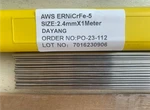
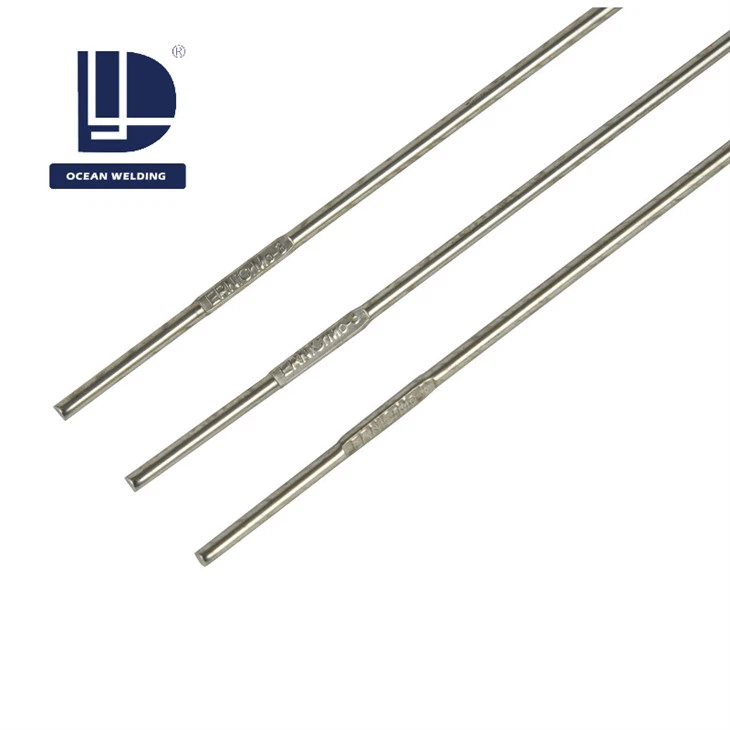

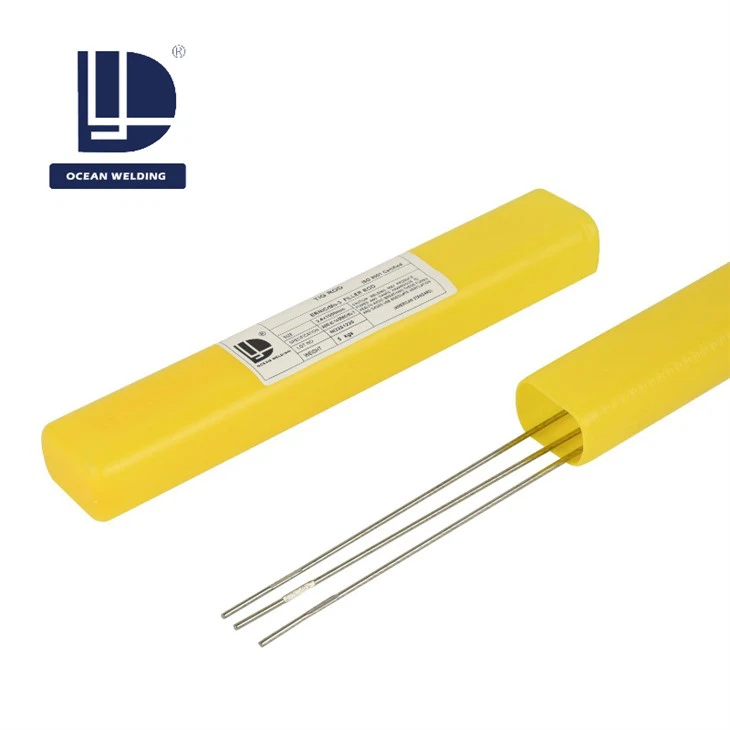

ERNiCrMo-3 GTAW/TIG Welding
Origin:China
Brand:OCEAN WELDING
Payment Term:30% TT prepayment,70% TT before Delivery
Equipment Configuration and Process Flow Diagram
GTAW/TIG welding (Gas Tungsten Arc Welding) serves as the most common welding method for ERNiCrMo-3 nickel-based alloy filler wire, where equipment configuration directly determines weld quality. The core system includes a direct current electrode negative (DCEN) power source, high-purity argon shielding system (purity ≥99.99%), and water-cooled torch. In typical configurations, the power source must support precise current adjustment (60-180A) with pulse capability for heat input control; the shielding gas system requires dual-path control for primary (flow rate 15-25 L/min) and backside shielding (8-12 L/min) to prevent root oxidation.

The image above illustrates the electro-gas-water coordinated control logic of GTAW welding: the power supply provides a stable current through a transformer and pulse generator, argon gas enters the welding torch through a flow valve to create a protective atmosphere, and a cooling water circulation system ensures that the welding torch does not overheat under high current. This configuration is particularly suitable for precision welding of nickel-based alloys (such as Inconel 625 (UNS N06625)), effectively preventing hot cracking and oxidation defects.
Core Welding Parameter Table and Setup Examples
GTAW welding parameters for ERNiCrMo-3 filler wire must be adjusted based on diameter. Below is the optimized parameter table for 1.6-3.2mm filler wires:
|
Wire Diameter (mm) |
Current Range (A) |
Travel Speed (cm/min) |
Gas Flow Rate (L/min) |
Maximum Heat Input (kJ/cm) |
|---|---|---|---|---|
|
1.6 |
60-90 |
50-80 |
15-20 |
≤12 |
|
2.0 |
80-110 |
60-90 |
15-20 |
≤13 |
|
2.4 |
100-140 |
70-100 |
18-22 |
≤14 |
|
3.2 |
130-180 |
80-110 |
20-25 |
≤15 |
Parameter Setup Key Points:
- Current Type: Direct Current Electrode Negative (DCEN); AC mode can be used for thin plates (<2mm) to reduce tungsten electrode wear;
- Gas Selection: Pure Ar for conventional welding; Ar+25-50%He mixture can increase penetration (suitable for thick plates);
- Heat Input Control: Achieved through "low current + high speed" combination. For example, when welding with 3.2mm wire, recommended parameters are 150A current, 90cm/min travel speed, and heat input controlled below 14kJ/cm.

The left table in the image shows the temperature-time curve, while the right side displays an actual welding parameter interface screenshot. Special attention must be paid to maintaining interpass temperature ≤150°C during welding, which can be achieved through forced air cooling or segmented welding to prevent grain coarsening in the heat-affected zone.
Operational Techniques and Quality Control
Key Operational Points
- Narrow Weave Technique: Weave width ≤3 times the wire diameter (e.g., maximum 7.2mm weave for 2.4mm wire) to prevent excessive weld pool oxidation;
- Multi-layer Multi-pass Welding: Each layer thickness ≤3mm; interpass oxidation scale must be cleaned with stainless steel wire brushes to ensure good fusion;
- Crater Filling: Use current decay function (gradually reducing from 180A to 60A) or backstepping method to fill craters and prevent crater cracking.
Weld Quality Inspection and Microstructural Analysis
Quality inspection of nickel-based alloy welds requires combining macroscopic appearance and microscopic structure. Macroscopic inspection focuses on weld reinforcement (recommended 0-2mm), undercut (≤0.5mm), and surface porosity; microscopic inspection evaluates grain boundary morphology and precipitates through metallographic analysis.

The images above show weld microstructures under different welding frequencies (50μm scale bar):
0Hz (DC): Grain growth oriented along fusion line with distinct columnar grains;
2Hz Pulse: Grain refinement with uniform distribution of precipitates (e.g., NbC);
20Hz Pulse: Densest structure with heat-affected zone width reduced from 120μm (0Hz) to 65μm, significantly improving corrosion resistance.
Common Defect Solutions
|
Defect Type |
Causes |
Solutions |
|---|---|---|
|
Porosity |
Insufficient gas purity, inadequate surface cleaning |
Use 99.999% high-purity Ar, clean base metal with acetone before welding |
|
Hot Cracking |
Excessive heat input (>15kJ/cm), high sulfur/phosphorus impurities |
Reduce welding current by 10-15%, use low-impurity filler wire (S/P ≤0.01%) |
|
Lack of Fusion |
Inadequate groove angle (<60°), excessive travel speed |
Adjust groove to 60-70°, reduce speed by 10-20cm/min |
|
Intergranular Corrosion |
Interpass temperature >150°C, carbide precipitation |
Control interpass temperature with forced cooling, avoid post-weld heat treatment |


Process Optimization and Industry Applications
The GTAW process for ERNiCrMo-3 filler wire finds extensive applications in high-end fields such as chemical pressure vessels and nuclear power piping. In one project, welding Inconel 625 thick-walled piping using φ2.4mm wire with 120A current and 80cm/min travel speed resulted in first-pass qualification rate increasing from 78% to 96% after optimization, with weld impact toughness reaching 85J at -196°C, meeting ASME BPVC VIII-1 requirements.
Core Optimization Directions:
- Digital Control: Use waveform-monitoring welding power sources (e.g., Fronius TPS 4000) to record current and voltage curves in real-time;
- Gas Purity Management: Equip gas drying units (dew point ≤-40°C) to reduce moisture-induced porosity;
- Personnel Training: Train welders in heat input control through simulation systems (e.g., RoboDK).
Conclusion
Successful application of GTAW/TIG welding processes must center on "precise parameters + strict control": ensuring stable output from DCEN power sources and high-purity argon systems on the equipment side, focusing on heat input (≤15kJ/cm) and weave width (≤3d) control on the operation side, and verifying process effectiveness through microstructural analysis on the inspection side. For ERNiCrMo-3 nickel-based alloys, only by integrating parameter optimization and quality control throughout the entire welding process can welds achieve high strength, high corrosion resistance, and long service life under extreme operating conditions.
Hot Tags: ernicrmo-3 gtaw/tig welding, China, manufacturers, suppliers, factory, company, wholesale, discount, buy, low price, high quality, products
You Might Also Like




Send Inquiry