




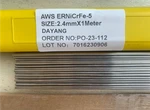


ENiCu-B Cast Iron Welding Electrode
Nickel copper alloy for cast iron repair
Stable arc, machinable weld, all positions
Products Description
ENiCu-B is a nickel copper welding electrode manufactured to AWS A5.15 ENiCu-B specification, designed for welding and repair of cast iron and for joining cast iron to steel or nickel-copper alloys (Monel type). The nickel-copper weld deposit provides excellent machinability, good color match on gray cast iron, and reliable resistance to cracking in constrained repair joints.


Key Features
- AWS A5.15 ENiCu-B classification - full standard compliance for cast iron welding electrodes and rods
- Nickel-copper (Ni-Cu) weld deposit - soft, ductile, and easily machinable after welding
- Excellent for cast iron repair welding - gray iron, ductile iron, malleable iron, and dissimilar joints
- Also suitable for Monel welding - joining Monel alloys and Monel-to-steel dissimilar welds
- All-position capability - flat, horizontal, vertical, and overhead
- Stable arc, minimal spatter, easy slag removal - smooth bead appearance and high radiographic quality
Technical Specifications
Classification
- AWS A5.15 : ENiCu-B
- ASME SFA-5.15 : ENiCu-B
Typical Weld Metal Chemistry (%)
| C | Mn | Fe | Si | Cu | Ni+Co | Al | Ti | S | P |
|---|---|---|---|---|---|---|---|---|---|
| ≤2.0 | ≤2.5 | 3.0–6.0 | ≤1.5 | 35–45 | 50–60 | ≤1.0 | ≤1.0 | ≤0.025 | ≤0.03 |
Typical Mechanical Properties (As-welded, cast iron)
- Tensile strength of weld deposit: ≥ 345 MPa
- Weld metal hardness: 140–200 HB (machinable)
Available Diameters & Packaging
- Diameters: 2.5 mm / 3.2 mm / 4.0 mm / 5.0 mm
- Length: 300 mm / 350 mm
- Packaging: 5 kg vacuum-sealed inner box, 20 kg outer carton


Recommended Welding Parameters
| Diameter (mm) | Current (A) | Polarity |
|---|---|---|
| 2.5 | 60–90 | DCEP (DC+) or AC |
| 3.2 | 90–130 | DCEP (DC+) or AC |
| 4.0 | 120–160 | DCEP (DC+) or AC |
| 5.0 | 150–200 | DCEP (DC+) or AC |
Typical Applications
- Cast iron repair welding: broken machinery housings, engine blocks, pump bodies, gearbox casings
- Cast iron joining: gray iron, ductile iron, malleable iron
- Dissimilar welding: cast iron to steel, cast iron to nickel-copper alloys
- Monel welding: Monel-to-Monel and Monel-to-steel joints
- Buttering & buildup: repair layers on cast iron before further welding
- Surfacing: machinable overlays where soft, corrosion-resistant deposits are required
Compatible Base Materials
- Gray cast iron (ASTM A48 / EN-GJL series)
- Ductile / nodular cast iron (ASTM A536 / EN-GJS series)
- Malleable cast iron (ASTM A47)
- Monel 400 (UNS N04400) and other nickel-copper alloys
- Dissimilar: cast iron ↔ carbon steel / low alloy steel
Operating Instructions
- Preparation: Remove all oil, paint, rust, and graphite smear from the joint. For cast iron, grind out defects until sound metal is exposed
- Electrode drying: Redry at 120–150 °C for 1 hour if exposed to humidity
- Technique: Short arc, stringer beads, peening after each bead to relieve stress
- Heat control: Keep interpass temperature low (≤ 150 °C) to prevent HAZ cracking in cast iron
- Cool slowly: For cast iron repair, allow slow cooling under insulation to minimize residual stress
Why Dayang ENiCu-B
Dayang Welding manufactures ENiCu-B under a certified quality system with batch-level traceability, full AWS A5.15 test reports, and consistent chemistry batch after batch. Our production line is dedicated to nickel and nickel-alloy electrodes, ensuring low contamination and stable performance for critical cast iron repair and Monel welding applications worldwide.
FAQ
Q1: What is ENiCu-B welding electrode used for?
A: ENiCu-B is an AWS A5.15 nickel-copper welding electrode used mainly for cast iron repair welding, including gray iron, ductile iron, and malleable iron, as well as dissimilar joints between cast iron and steel. It is also suitable for welding Monel and other nickel-copper alloys.
Q2: What AWS standard does ENiCu-B belong to?
A: ENiCu-B is classified under AWS A5.15, the specification for welding electrodes and rods for cast iron. It falls in the nickel-copper family alongside ENi-CI, ENiFe-CI, and ENiCu-A.
Q3: What is the difference between ENiCu-A and ENiCu-B?
A: Both are nickel-copper electrodes under AWS A5.15. ENiCu-B contains a higher iron content and higher copper range than ENiCu-A, giving it slightly different weld metal properties and cost profile. ENiCu-B is often preferred where a more economical nickel-copper deposit is acceptable.
Q4: Can ENiCu-B weld cast iron to steel?
A: Yes. ENiCu-B is one of the recommended electrodes for dissimilar welding of cast iron to carbon steel or low alloy steel, thanks to its ductile, crack-resistant weld deposit.
Q5: Is ENiCu-B machinable after welding?
A: Yes. ENiCu-B weld metal is soft and easily machinable (typically 140–200 HB), making it ideal for cast iron repairs where the welded area must be machined afterward.
Q6: What polarity should I use with ENiCu-B?
A: ENiCu-B is normally used with DCEP (Direct Current Electrode Positive), and it can also operate on AC depending on the welding machine and application.
Q7: Does ENiCu-B need preheating for cast iron welding?
A: For small repairs, ENiCu-B can often be used with little or no preheat (cold welding technique with short stringer beads and peening). For large or heavily constrained cast iron parts, preheat 150–300 °C and slow cooling are recommended.
Q8: How should ENiCu-B electrodes be stored?
A: Store in dry conditions (relative humidity < 60 %). If moisture exposure is suspected, redry at 120–150 °C for 1 hour before use.
Hot Tags: enicu-b cast iron welding electrode, China, manufacturers, suppliers, factory, company, wholesale, discount, buy, low price, high quality, products
You Might Also Like



Send Inquiry