




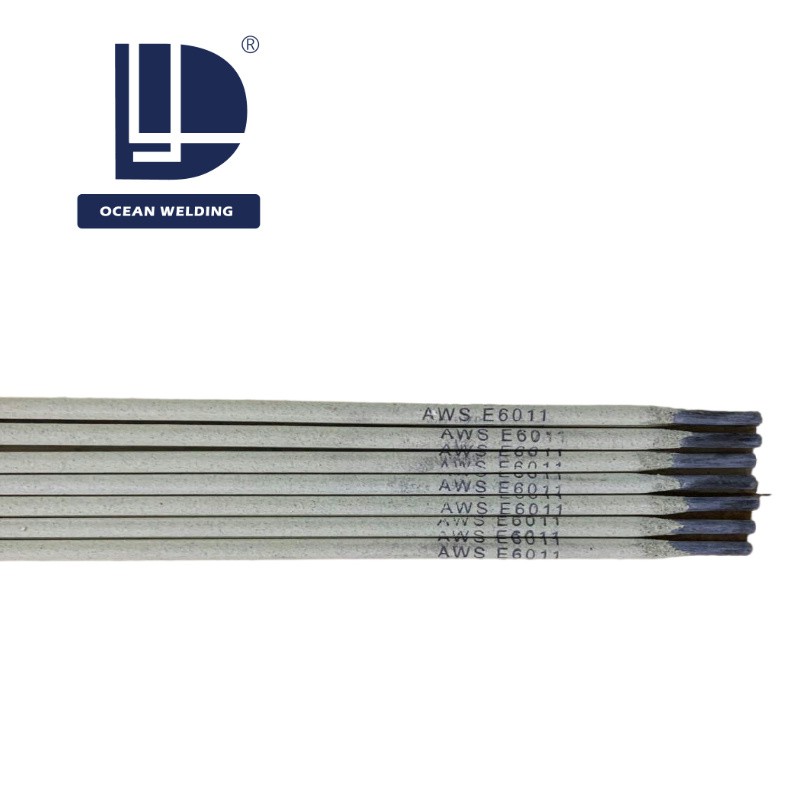


E6011 Rods
Payment Term:30% TT prepayment,70% TT before Delivery
Packing:5kg/Inner box,20Kg/Carton,1000kgs/Pallet
Production Time:Within 25days after recerving prepayment
Products video
[Product Positioning] AWS A5.1 certified, highly adaptable cellulose electrode, designed for challenging welding applications.
[Core Advantages]
1.Deep Penetration: Powerful arc, perfectly suited for root passes.
2.All-Position Welding: Stable and flexible operation in flat, horizontal, vertical, and overhead positions.
3.Withstands Harsh Conditions: Excellent tolerance for rusty and oily base materials.
4.Easy Slag Removal: Clean welds, saving cleaning time.
5.Easy to Operate: Easy arc ignition, stable arc, simplifying the welding process. [Main Applications] Pipelines, steel structures, agricultural equipment, outdoor and field repairs.
Chemical Composition (%) & Mechanical Properties
| Item | Standard Requirement | Typical Measured Value |
|---|---|---|
| Chemical Composition (%) | ||
| C | ≤0.20 | 0.0475 |
| Mn | 0.30–0.60 | 0.79 |
| Si | ≤1.00 | 0.098 |
| S | ≤0.035 | – |
| P | ≤0.040 | – |
| Mechanical Properties | ||
| Tensile Strength Rm (MPa) | ≥430 | 475 |
| Yield Strength ReL (MPa) | ≥330 | 400 |
| Elongation A (%) | ≥20 | 26 |
| Impact Energy KV2 (–30 °C, J) | ≥27 | 80 |
Notes
- The "Standard Requirement" values are the minimum requirements specified in AWS A5.1 / GB/T 5117 for E6011 (E4311) deposited metal.
- "Typical Measured Value" comes from actual product test reports, showing that actual performance often exceeds the standard lower limits.
- Elements S and P are restricted as impurities to ensure weld toughness.
- These data can be used for welding procedure qualification and material selection.
AWS E6011 Amperage Settings
| Diameter | Flat / Horizontal | Vertical / Overhead |
|---|---|---|
|
3/32" (2.5 mm) |
50–80 A |
40–70 A |
|
1/8" (3.2 mm) |
80–125 A |
75–110 A |
|
5/32" (4.0 mm) |
110–165 A |
100–140 A |
|
3/16" (4.8 mm) |
150–210 A |
Flat / Horizontal only |
AWS E6011 Polarity Guide
| Polarity | Arc Behavior | Best For |
|---|---|---|
|
DCEP (DC Electrode Positive) |
Maximum penetration, most stable arc, best bead control |
All-position work; preferred when DC is available |
|
AC (Alternating Current) |
Slightly softer arc, reduced arc blow on magnetized parts |
Transformer welders, field machines without DC output |
Applications for AWS E6011

Structural Steel & Construction
Beams, columns, trusses, and building frames
Bridge members and structural connections
Steel erection, fit-up, and tacking
Rebar tack welding

Pipeline Welding
Root passes on cross-country carbon steel pipelines (vertical-down / stovepipe)
Small-bore process piping
Pipeline tie-ins, hot taps, and sleeve repairs
In-service welding on pressurized lines (qualified procedures

Shipbuilding & Marine
Hull plating tack welds and fit-up
Bulkhead and deck plate connections
General ship steel fabrication
Marine equipment field repai
AWS E6011 vs E6010
This is the most frequently asked comparison for cellulose electrodes:
| AWS E6011 | AWS E6010 | |
|---|---|---|
|
Flux Coating |
Cellulose potassium |
Cellulose sodium |
|
Polarity |
AC + DCEP |
DCEP only |
|
AC Performance |
Excellent | designed for AC |
Unstable:not usable on AC |
|
Arc Character |
Deep penetration, slightly softer |
Very deep, aggressive dig |
|
Spatter |
Moderate |
Moderate to heavy |
|
Vertical-Down |
Capable |
Industry standard (API 1104) |
|
Power Source Flexibility |
Any transformer, inverter, engine |
DC-capable machines only |
|
Pipeline Root Pass |
Yes |
Yes | preferred by pipeline codes |
|
Field Repair |
Preferred | works on any machine |
Limited to DC machines |
- When to Choose AWS E6011: When your power source supports only Alternating Current (AC); when you require the flexibility to utilize any type of welding machine available on-site; and when the specific job requirements do not strictly mandate the use of E6010.
- When to Choose E6010: For pipe root pass welding procedures governed by the API 1104 standard-specifically when maximum penetration is required and the "deepest penetrating" arc characteristics must be achieved using Direct Current Reverse Polarity (DCEP); and during welder qualification tests, if the testing regulations explicitly specify that E6010 electrodes must be used.
- Practical Considerations: AWS E6011 delivers approximately 90% of the performance capabilities of E6010, with the key advantage being its additional compatibility with Alternating Current (AC) welding. Consequently, for general structural welding, equipment maintenance, and field operations, AWS E6011 often proves to be the more practical and sensible choice.
AWS E6011 vs E7018
These two electrodes are complementary, rather than competing.
| AWS E6011 | AWS E7018 | |
|---|---|---|
|
Flux Type |
Cellulose potassium |
Low-hydrogen iron powder |
|
Tensile Class |
60 ksi (420 MPa) |
70 ksi (480 MPa) |
|
Penetration |
Deep, digging |
Medium, smooth |
|
Hydrogen Level |
High (~25–30 mL/100g) |
Low (≤8 mL H₂/100g) |
|
Slag |
Light, fast-freeze |
Heavy, self-peeling |
|
Surface Tolerance |
Excellent | welds through contaminants |
Requires clean, dry surfaces |
|
Storage |
Room temperature - no rod oven |
Requires rod oven (120–150°C) |
|
Vertical-Down |
Yes |
No | V-up only |
|
Best For |
Root passes, field repair, dirty steel |
Fill/cap passes, code work, hydrogen control |
In carbon steel welding operations, the combination of E6011 for the root pass and E7018 for the fill and cap passes constitutes a standard industry practice.
The root pass is executed using AWS E6011 electrodes; leveraging their superior penetration, bridging capabilities, and resistance to impurities, this ensures proper root fusion and overall weld integrity. Subsequently, low-hydrogen E7018 electrodes are employed to complete the fill and cap passes, thereby meeting requirements for high tensile strength and resistance to hydrogen-induced cracking, while also achieving excellent weld bead formation. This electrode combination is widely utilized across sectors such as steel structures, pressure vessels, and general machinery manufacturing, representing a mature process that effectively balances quality, efficiency, and reliability.
AWS E6011 vs E6013
| AWS E6011 | AWS E6013 | |
|---|---|---|
|
Flux Type |
Cellulose potassium |
Rutile potassium |
|
Arc Force |
Deep, forceful, digging |
Soft, gentle, shallow |
|
Penetration |
Deep |
Light |
|
Spatter |
Moderate |
Very low |
|
Ease of Use |
Intermediate skill |
Beginner-friendly |
|
Gap Bridging |
Excellent |
Poor |
|
Surface Tolerance |
Welds through contaminants |
Requires cleaner surface |
|
Typical Use |
Structural, pipeline, heavy repair |
Sheet metal, light fabrication, cosmetic |
Choose AWS E6011 when penetration, gap-bridging, and contaminant tolerance matter. Choose E6013 when you need a soft arc on thin material with minimal spatter and low operator skill.
why choose Us?
As an enterprise with a history spanning over 20 years, Lin'an Dayang Welding Materials has established a significant reputation and credibility within the industry-thanks to its consistent product quality and extensive presence in overseas markets-and demonstrates particularly strong competitiveness in the field of specialized welding electrodes.


FAQ
Q1: What type of welding electrode is E6011?
A1: E6011 is a low-carbon steel welding electrode with a cellulose potassium-type coating. It is suitable for AC or DC positive polarity (DCEP) power supplies and can be used for all-position welding.
Q2: In what applications is E6011 mainly used?
A2: It is commonly used in general manufacturing, structural engineering, pipe welding (especially thin-walled pipes), galvanized steel, shipbuilding, bridges, and railway vehicles. It also has good adaptability to surfaces with rust, oil, or slight contamination.
Q3: What are the recommended welding current and polarity?
A3: E6011 can be used with AC or DC positive polarity (DCEP). Example of commonly used current ranges: 3.2mm diameter: approximately 75–125A; 4.0mm diameter: approximately 110–165A. The actual current needs to be adjusted according to the welding position and plate thickness.
Q4: What are the differences between E6011, E6010, E6013, and E7018?
A4:
E6010 is only for DC positive polarity, producing a stronger arc and deeper penetration; E6011 is AC compatible, producing a softer arc.
E6013 has a titanium-calcium coating, resulting in a more stable arc and less spatter, suitable for thin plates, but its penetration is not as strong as E6011.
E7018 is a low-hydrogen electrode with higher strength (70ksi) and better crack resistance, but requires strict moisture protection and is generally not used on dirty surfaces.
Q5: How should E6011 be stored and protected from moisture?
A5: Cellulose coatings require a certain moisture content (approximately 3-7%) for proper operation, therefore drying is not recommended. Unused electrodes should be kept in their original packaging and stored in a dry, well-ventilated indoor environment, avoiding high temperatures or high humidity.
Hot Tags: e6011 rods, China, manufacturers, suppliers, factory, company, wholesale, discount, buy, low price, high quality, products
Previous
No InformationYou Might Also Like


Send Inquiry