




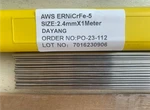

Low Alloy Steel Welding Electrodes
Delivery Detail: with 20-25 days after your order
Type: Low Alloy Steel Welding Electrodes
Item:AWS E9015-G
Delivery:Normally ready goods within 8 to 25 days.
Term: CIF CFR FOB EXW
Product Overview
AWS E9015-G low alloy steel welding rod is a low hydrogen sodium type welding material developed by Hangzhou Lin'an Dayang Welding Material Co., Ltd. for 620MPa grade low alloy high strength steel. It adopts nickel-molybdenum composite alloy system (Ni 1.2-1.5%, Mo 0.2-0.4%), combined with ultra-low hydrogen coating (diffusible hydrogen ≤5mL/100g), to achieve excellent impact toughness of 92J under -40℃ environment. The product complies with AWS A5.5 and ISO 18275 standards, and has passed ISO 9001 quality management system certification. It is particularly suitable for key fields such as cryogenic pressure vessels, hydropower projects and bridge steel structures.
Core advantages: The German SpectroMaxx spectrometer monitors the ingredients throughout the entire process, and three quality inspections (raw materials/process/finished products) ensure that the X-ray flaw detection pass rate of each batch is ≥99.5%, and the low-temperature toughness index exceeds the standard requirement by 70%.
Technical parameters and performance
Key mechanical properties
| Item | Standard requirements | Typical values |
|---|---|---|
| Tensile strength | ≥620 MPa | 650 MPa |
| Yield strength | ≥500 MPa | 550 MPa |
| Elongation | ≥18% | 25% |
| Impact energy (-40℃, V type) | ≥54 J | 92 J |
| Diffusible hydrogen content | ≤5 mL/100g | 3.5 mL/100g |
Chemical composition of deposited metal (%)
| C | Mn | Si | S | P | Ni | Mo | Cr |
|---|---|---|---|---|---|---|---|
| ≤0.12 | 1.2-1.8 | ≤0.80 | ≤0.035 | ≤0.035 | 1.2-1.5 | 0.2-0.4 | ≤0.2 |
Specifications
• Diameter: 2.5mm / 3.2mm / 4.0mm
• Length: 300mm (2.5mm) / 350mm (3.2mm/4.0mm)
• Packaging: 5kg vacuum box × 4 boxes/box (20kg), 1 ton/pallet (50 boxes)
• Shelf life: 12 months (original packaging, unopened, storage humidity ≤60%)
Application Areas
1. Welding of key structures in hydropower projects
Typical applications: penstocks, gates, steel structures of powerhouses
Applicable steel materials: Q460, Q500, 14MnMoVB
Technical challenges:
• Risk of cold cracking in thick steel plate welding (carbon equivalent CE=0.77%)
• Impact toughness requirements under low temperature conditions (-20℃)
Solutions:
• Preheating 200-250℃, interlayer temperature maintained ≥200℃
• Adopt narrow pass welding technology, thickness of each layer ≤4mm
• Hydrogen removal treatment at 250℃×2 hours after welding
2. Supercritical power plant boiler pipelines
Typical applications: high-temperature superheater and reheater pipelines (working temperature ≤ 540℃)
Applicable steel: P92 (9Cr-1Mo-V-Nb), 12Cr1MoVG
Technical challenges:
• High-temperature creep performance (100,000 hours life requirement)
• Microstructure matching of dissimilar steel welded joints
Solutions:
• Strictly control welding current at 130-170A (4.0mm welding rod)
• Tempering treatment at 750-760℃ after welding, and keep warm for 2 hours
• Combined process of ER90S-G welding wire for base coating + E9015-G welding rod for filling and capping
Standard compliance: ASME BPVC Section I, DL/T 869-2012 3. Marine engineering structures
Typical applications: offshore platform jackets, submarine pipelines
Applicable steel materials: WEL-TEN62, ASTM A517 Grade Q
Technical challenges:
• Reliability of welding joints in seawater corrosion environment
• Process stability of all-position welding
Solutions:
• The welding rod is baked at 400℃×1 hour and stored in a 150℃ insulation cylinder
• DC reverse connection, short arc operation, swing amplitude ≤3 times the welding rod diameter
• CCS, ABS certification (witness test can be provided)
Customer value: In a Southeast Asian offshore project, replacing imported welding rods reduced costs by 35% and increased welding efficiency by 20%.
Welding process guidance
Recommended welding parameters
| Electrode diameter | Welding current (DC+) | Arc voltage | Welding speed | Preheat temperature | Interpass temperature |
|---|---|---|---|---|---|
| 2.5mm | 60-90A | 22-24V | 140-160mm/min | 200-250℃ | ≥200℃ |
| 3.2mm | 80-120A | 24-26V | 120-140mm/min | 250-300℃ | ≥200℃ |
| 4.0mm | 130-170A | 26-28V | 100-120mm/min | 250-300℃ | ≥200℃ |
Operation points
- Electrode treatment: bake at 350-400℃ for 1 hour, store in 100-150℃ heat preservation tube, use within 4 hours after taking out
- Workpiece cleaning: thoroughly remove rust, oil stains, moisture, groove surface roughness Ra≤25μm
- Welding skills: use short arc welding, lateral swing amplitude ≤3 times the electrode diameter, multi-layer welding each layer thickness ≤4mm
- Post-heat treatment: for structures with thickness >25mm or high restraint, 620℃×1 hour tempering treatment is recommended
FAQ
Q: The core difference with E8015-G/E10015-G?
A: Strength 620MPa, using Ni-Mo composite alloy (Ni 1.2-1.5% + Mo 0.2-0.4%), -40℃ impact energy 92J, cost-effectiveness is better than E10015-G (cost 30% lower), suitable for welding heat-resistant steel below 540℃.
Q: What are the functions of nickel and molybdenum elements?
A: Ni improves low-temperature toughness (-40℃ impact energy 92J); Mo enhances high-temperature stability (540℃ creep resistance); synergistic effect achieves strength and toughness balance (yield 550MPa + elongation 25%).
Q: How to deal with welding rods after opening?
A: ①Humidity>60% exposure ≤4 hours; ②Re-baking 350℃×1h (limited to 2 times); ③Exceeded only for non-pressure fillet welds, 100% magnetic particle inspection is required.
Hot Tags: welding electrode, low alloy steel electrode,low alloy steel aws aws e9015-g welding electrodes, manufacturers, suppliers, factory, company, wholesale, discount, buy, low price, high quality
You Might Also Like


Send Inquiry