




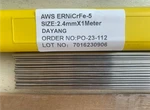


Tungsten Welding Rod
Standard: AWS A5.12
Applicable to: AC or DC welding
Brand: OCEAN welding
Product detailes of Tungsten Welding Rod

Properties & Characteristics: Tungsten welding electrodes feature in fast arc igntion, low arc maintaining current, high current carrying capability, low rate of burnt area, excellent electric conductivity and welding performance. Feature of 2% thoriated WT20 Tungsten WT20 • Low electronic function • Good conductivity • Good electron emission ability • Good mechanical cutting performance • High elastic modulus, Low vapour pressure • High recrystallization temperature
|
Packaging
1. Inner packing: 10pcs/plastic box attached labels, 20 plastic boxes/ plain carton
2. Out packing: 6 plain cartons/big carton, big carton dimensions
3.Outer packaging size: 18cm x 27cm x 45cm
4. Customers' special requirements can be satisfied
Features
- Excellent welding performance: It has low electron work function, easy arc starting, stable arc, can effectively reduce welding pollution, ensure welding quality, and obtain good weld formation and mechanical properties
- High current carrying capacity: It can withstand overload current, and its current carrying capacity is about 20% stronger than that of pure tungsten electrodes. It can operate well even under overload current and can meet various high-demand welding tasks.
- Excellent physical properties: high recrystallization temperature, stable performance under high temperature environment; good electrical conductivity, thermal conductivity and mechanical cutting performance; high elastic modulus, low vapor pressure, density of about 18.15, high hardness and strength.
- Real materials are more durable: Made of high-quality raw materials, strictly control the production process to ensure the durability of the electrode, reduce the replacement frequency, and reduce the cost of use.

chemical composition
| Ingredient | Content Range | Description |
| W | bal | Matrix metal, which imparts a high melting point, high hardness, and good electrical conductivity to the material. |
| ThO₂ | 1.7% - 2.2% | Main additives, which reduce the work function of electrons, improve arc stability and welding performance. |
| Other | ≤0.2% | Includes trace elements such as iron (Fe), silicon (Si), aluminum (Al), etc., which need to be controlled within standard ranges to ensure performance. |
Mechanical properties
| Performance | WT20 (Thorium Tungsten) |
| Hardness (HV) | 240 - 300 |
| Tensile strength (MPa) | ≥500 |
| Coefficient of Thermal Expansion | 4.5×10⁻⁶/℃ |
Application Areas
I) Industrial welding field
1. TIG welding
Applicable scenarios: high-quality welding of metals such as stainless steel, high-temperature alloys (such as Inconel), titanium alloys, copper alloys, etc., especially suitable for scenarios that require precise control of heat input.
Advantages:
High current carrying capacity (20% higher than pure tungsten electrodes), supports high current welding of thick plates (such as stainless steel plates above 5mm);
Electrode shape is stable at high temperature, arc concentration is high, weld formation is beautiful and spatter-free.
Typical applications: pressure vessel manufacturing, aviation engine component welding, medical equipment (such as stainless steel surgical instruments).
2. Plasma welding
Applicable scenarios: high energy density welding, used for welding thicker materials (such as steel plates above 10mm) or occasions requiring deep penetration.
Advantages:
Strong creep resistance, not easy to soften at ultra-high temperature (above 10000℃) of plasma arc, low electrode loss;
Can withstand higher current (above 300A), welding efficiency is higher than ordinary TIG welding.
Typical applications: nuclear power equipment pipeline welding, ship deck thick plate splicing.
II.) Aerospace and high-end manufacturing
1. Aerospace material welding
Applicable scenarios: welding of aerospace materials such as titanium alloys (such as Ti-6Al-4V) and nickel-based alloys (such as Inconel 718), which requires high weld strength and few impurities.
Advantages:
Good high-temperature strength retention (tensile strength of about 300 MPa at 1000°C), meeting the mechanical requirements of aerospace components in extreme environments;
Electrode material purity is high (tungsten content ≥ 97.9%), and impurities are not easily introduced during welding to avoid weld embrittlement.
Typical applications: rocket engine nozzle welding, satellite structural parts connection.
2. Precision parts processing
Applicable scenarios: repair and manufacturing of precision parts such as aircraft engine blades and turbine disks, which require guaranteed welding accuracy and surface quality.
Advantages:
High hardness (240 - 300 HV), slow wear of electrode tip, and accurate welding trajectory can be maintained for a long time;
Low thermal expansion coefficient (4.5×10⁻⁶/℃), reducing dimensional deviation of precision parts caused by thermal deformation.
III.) Electronics and semiconductor industry
1. Microelectronic device welding
Applicable scenarios: precision welding in integrated circuit lead bonding and semiconductor packaging, requiring small heat-affected zone and high solder joint reliability.
Advantages:
Can be processed into fine diameter electrodes (such as 0.5mm), and cooperate with micro-beam plasma welding to achieve micron-level solder joints;
Excellent electrical conductivity, stable current conduction during welding, avoiding damage to devices due to instantaneous high temperature.
Typical applications: chip pin welding, sensor packaging.
2. High-power electronic components
Applicable scenarios: welding of heat dissipation substrates of components such as IGBT modules and power diodes, which requires both electrical conductivity and thermal conductivity.
Advantages:
High thermal conductivity (130 - 170 W/(m・K)), good heat dissipation path after welding, avoiding overheating of components;
Electrodes do not react chemically with copper, silver and other solders at high temperatures, ensuring long-term reliability of solder joints.
IV.) Energy and heavy industry
1. Nuclear power and thermal power equipment
Applicable scenarios: Welding of nuclear power plant pressure vessels and steam pipelines (such as stainless steel 316L), requiring welds to be corrosion-resistant and resistant to high temperature and high pressure.
Advantages:
Corrosion resistance matches the base metal, and the weld can withstand high temperature and high pressure water corrosion after welding;
Long life characteristics reduce the frequency of equipment downtime maintenance, suitable for the high reliability requirements of the nuclear power industry.
Typical applications: nuclear reactor pressure shell welding, thermal power boiler pipeline connection.
2. Oil and gas pipelines
Applicable scenarios: On-site welding of high-pressure oil pipelines (such as X70 and X80 pipeline steels) needs to adapt to the field environment and large-diameter welding requirements.
Advantages:
Can withstand mechanical vibrations during field welding, and the electrode is not easy to break;
High current welding capacity supports efficient completion of circumferential seam welding of thick-walled pipes (above 12mm).
Hot Tags: Tungsten Welding Rod, China, manufacturers, suppliers, factory, company, wholesale, discount, buy, low price, high quality, products
Previous
TIG Welding WT20You Might Also Like


Send Inquiry