




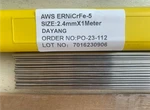

Technical Data Sheet Of ER4047
1. Core Chemical Composition (AWS A5.10 Standard) 2. Typical Mechanical Properties (As-Welded Condition) 3. Performance Comparison with ER4043 Welding Wire 4. Application Scenarios & Performance Matching 5. Standard Certification & Technical Specifications 6. Key Precautions 7. Reference...
Send Inquiry
Product Introduction
1. Core Chemical Composition (AWS A5.10 Standard)
| Element | Content Range (%) | Function Analysis |
|---|---|---|
| Si | 11.0-13.0 | Eutectic composition improves fluidity, suppresses hot cracking, and exhibits gray-black color after anodization. |
| Fe | ≤0.8 | Controls impurity content to prevent the precipitation of brittle phases. |
| Cu | ≤0.3 | Limits copper content to avoid intergranular corrosion (caution required when welding aluminum alloys with Cu content >2%). |
| Al | Remainder | Base metal that provides lightweight properties and corrosion resistance. |
2. Typical Mechanical Properties (As-Welded Condition)
| Performance Indicator | Value Range (Typical Value) | Test Conditions & Application Scenarios |
|---|---|---|
| Tensile Strength | 240-310 MPa (270 MPa) | Suitable for general structural parts in as-welded condition; can reach 310 MPa when welding 6061-T6 base metal. |
| Yield Strength | 180-276 MPa (200 MPa) | Low plasticity in as-welded condition; may decrease after heat treatment (e.g., drops to 234 MPa after welding 2014-T6 base metal). |
| Elongation | 8-12% (Typical: 10%) | Superior to ER4043 (≈7%) in as-welded condition, but decreases significantly after heat treatment (e.g., drops to 3.3% after welding 6082 aluminum alloy). |
| Shear Strength | 200-250 MPa | Outstanding fillet weld performance, 15-20% higher than ER4043, suitable for shear-resistant scenarios such as automotive radiators. |
| Hardness (HV) | 80-100 | Microhardness of the weld zone; compatibility with the base metal must be verified by metallographic analysis. |
3. Performance Comparison with ER4043 Welding Wire
| Comparison Dimension | ER4047 | ER4043 |
|---|---|---|
| Silicon Content | 11-13% (Eutectic composition) | 4.5-6.0% (Hypoeutectic composition) |
| Melting Point | 577-582℃ (50℃ lower) | 621-638℃ |
| Hot Cracking Resistance | Significantly superior to ER4043 (reduction of over 30%) | Moderate, suitable for general welding |
| Weld Color | Gray-black after anodization | Silver-white after anodization |
| Typical Tensile Strength | 270 MPa (as-welded) | 220 MPa (as-welded) |
| Elongation | 10% (as-welded) | 12% (as-welded) |
| Application Scenarios | Thin-walled parts, high-temperature environments, crack-susceptible aluminum alloys (e.g., 6061) | General welding, preferred for applications with high appearance requirements |
4. Application Scenarios & Performance Matching
| Application Field | Key Performance Requirements | Actual Test Data or Advantages |
|---|---|---|
| Automotive Manufacturing | Hot cracking resistance, shear strength | Shear strength of engine block welds >200 MPa; hot cracking rate of radiator welds <5%. |
| Architectural Decoration | Consistency of anodized color, corrosion resistance | Gray-black color after anodization matches 6063 base metal; no obvious surface corrosion in salt spray test (1000 hours). |
| High-Temperature Environments | Long-term high-temperature strength retention | Tensile strength retention rate >85% at 150℃, superior to ER5356 (≈75%). |
| Thin-Walled Part Welding | Low melting point, high fluidity | Weld pool fluidity increased by 30%; welding speed up to 1.5 m/min (1.2 m/min for ER4043). |
5. Standard Certification & Technical Specifications
| Standard Category | Core Requirements | Certification Basis |
|---|---|---|
| Chemical Composition | Si: 11-13%, Fe ≤0.8%, Cu ≤0.3% | AWS A5.10, ISO 18273 |
| Wire Dimensions | Diameter tolerance ±0.02 mm, packaging form (e.g., 150 kg drum) | AMS 4185, ISO 544 (Class H9) |
| Weld Quality | Radiographic inspection complies with ISO 18273; porosity ≤ Grade 2 | ISO 18273, EN 13479 |
| Mechanical Properties | Tensile strength ≥240 MPa (as-welded), elongation ≥8% | AWS A5.10, GB/T 2651 |
6. Key Precautions
| Risk Type | Impact Mechanism | Countermeasures |
|---|---|---|
| Base Metal Dilution | High-magnesium base metals (e.g., 5052) melting into the weld form Mg₂Si brittle phases, reducing strength by 10-15%. | Control welding speed ≤1.2 m/min; preheat to 100-150℃ before welding. |
| Porosity Defects | Unremoved oxide film causes hydrogen porosity, reducing weld strength by over 20%. | Clean with a wire brush + acetone; control interpass temperature ≤100℃ during welding. |
| Insufficient Corrosion Resistance | Corrosion resistance in salt spray environments is slightly lower than ER5356; anodization can triple corrosion life. | Anodization (film thickness ≥15μm) or acrylic paint coating is recommended. |
| High-Temperature Embrittlement | Long-term exposure to high temperatures (>200℃) causes silicon particle coarsening, reducing strength by 15%. | Prefer use in environments ≤150℃; match with thermal insulation design for high-temperature applications. |
7. Reference Welding Process Parameters
| Welding Method | Wire Diameter (mm) | Current Range (A) | Voltage (V) | Shielding Gas | Typical Application Scenarios |
|---|---|---|---|---|---|
| MIG Welding | 1.2 | 150-250 | 18-26 | 100% Ar | Automotive components, thin-walled parts of building frames |
| TIG Welding | 2.4 | 120-200 | 16-22 | 100% Ar | Pressure vessels, precision instrument repair |
| Pulsed MIG Welding | 1.6 | 180-300 | 20-28 | Ar + 30% He | Thick plate welding (>6 mm), weld penetration increased by 20% |
| Flame Brazing | 1.6 | - | - | None | Air conditioning pipelines, copper-aluminum connections of radiators |
Hot Tags: technical data sheet of er4047, China, manufacturers, suppliers, factory, company, wholesale, discount, buy, low price, high quality, products
You Might Also Like


Send Inquiry