


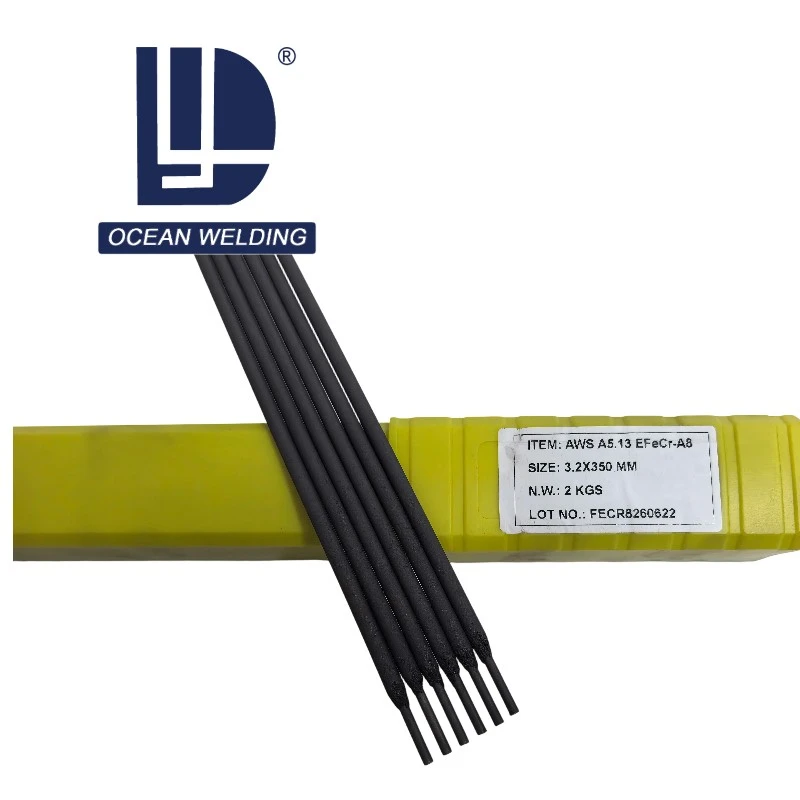
EFeCr-A8 is the Chinese trade code for a high-chromium iron-carbon (Fe-Cr-C) hardfacing electrode used for wear-surfacing of mining, cement and agricultural equipment. It is chemically equivalent to AWS A5.13 EFeCr-A1 and GB/T 984 EDZCr-C-15, delivering as-welded hardness of HRC 58–62.
Is EFeCr-A8 an AWS-recognized classification?
The short answer is no. AWS A5.13:2021 (*Specification for Surfacing Electrodes for Shielded Metal Arc Welding*) recognizes only the EFeCr-A1 and EFeCr-A1A classifications within the iron-chromium (Fe-Cr) surfacing electrode category. The suffix "-A8" is a commercial code or SKU number used by Chinese welding consumable manufacturers to identify a specific proprietary formulation within the broader Fe-Cr-C product family.
To ensure compliance with international standards, EFeCr-A8 should always be cross-referenced against the following classifications:
| Standard system | Equivalent designation |
|---|---|
| AWS A5.13 | EFeCr-A1 (Fe-Cr-C high-chromium cast iron) |
| GB/T 984 (China) | EDZCr-C-15 (industry code D667) |
| ISO 14700 | T Fe15 (high-chromium hardfacing) |
| DIN 8555 | E10-UM-60-GR (60 HRC hardfacing) |
| JIS Z3251 | DFCrA-500 |
What is EFeCr-A8 Made Of?
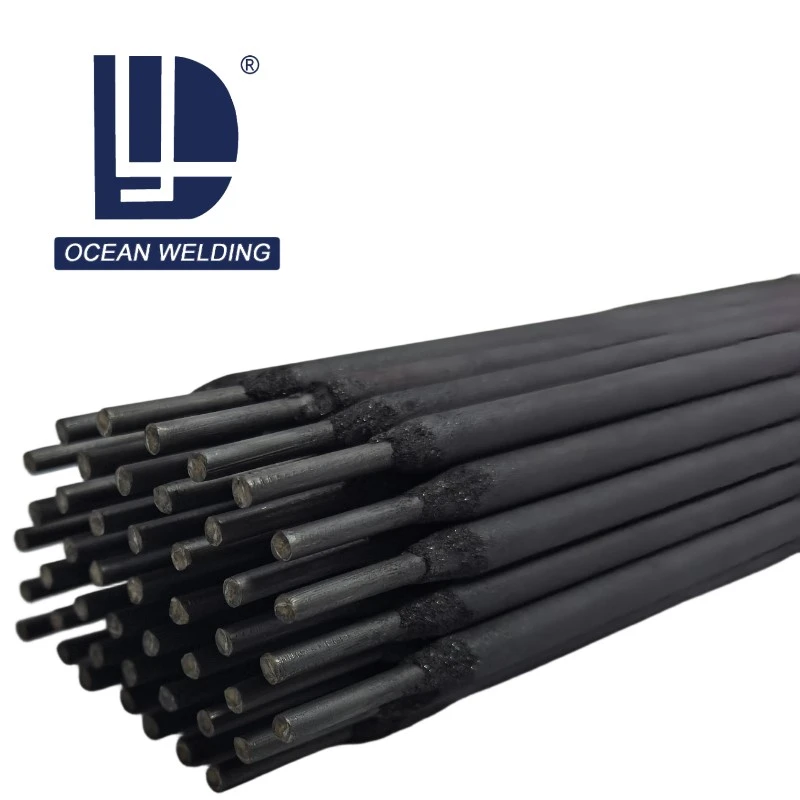
EFeCr-A8 is a flux-coated stick electrode (SMAW consumable) with an iron-based core wire and a low-hydrogen basic coating. When welded, the electrode deposits a high-chromium cast-iron overlay with the following typical chemistry:
| Element | Range (wt %) | Typical value |
|---|---|---|
| C | 2.50 – 5.00 | 3.40 |
| Cr | 25.00 – 32.00 | 28.85 |
| Ni | 3.00 – 5.00 | 3.80 |
| Mn | ≤ 8.00 | 3.50 |
| Si | 1.00 – 4.80 | 1.67 |
| Mo / Nb / V | 0 – 1.5 (optional improved grade) | on request |
| Fe | balance | balance |
This combination of high chromium (25%–32%) and high carbon (2.5%–5%) is not accidental; the proportions are precisely set to maintain a Cr/C ratio of approximately 6–10. This promotes the formation of primary M7C3 hexagonal chromium carbides-occupying about 30%–45% of the deposit volume-embedded within an austenite-martensite iron matrix during solidification. It is precisely these hard, wear-resistant carbides that impart a final hardness of HRC 58–62 to the material.
How Hard is the EFeCr-A8 Deposit?
| Measurement condition | Typical hardness |
|---|---|
| As-welded, third layer (undiluted) | HRC 58 – 62 |
| Single layer (with base-metal dilution) | HRC 48 – 52 |
| Best-case high-carbon variants | up to HRC 65 |
| After service temperature > 500 °C | Drops sharply - not for high-temperature applications |
Because the first layer of a hardfacing deposit is always diluted by the base metal (typically 30–50 % dilution), hardness measurements should only be taken on the third layer or deeper. This is a critical acceptance criterion that many first-time buyers overlook.
What is EFeCr-A8 Used For?
EFeCr-A8 covers the "middle ground" of the hardfacing market, making it suitable for components operating at temperatures below 500°C that are subjected to severe abrasion and light-to-moderate impact. Typical applications include:
| Industry | Component | Wear mechanism |
|---|---|---|
| Mining & crushing | Jaw / cone crusher liners, hammers, cheek plates | Severe abrasion + moderate impact |
| Cement | Vertical mill rollers, roller-press tyres, concrete-pump pipe | Abrasion + fatigue |
| Earth-moving | Excavator bucket teeth (with EFeMn-A buttering), bulldozer cutting edges | Impact + abrasion |
| Agriculture | Plow shares, rotary tiller blades, mulcher hammers | Soil / sand abrasion |
| Sintering | Feeder blades, blast-furnace bell rings, ball-mill liners | High-temp abrasion (< 500 °C) |
| Slurry handling | Slurry pump impellers, agitator blades, screw conveyors | Abrasion + corrosion |
| Petrochemical | Centrifugal cracker pump sleeves, valve internals | Abrasion + corrosion + cavitation |
How Do You Weld with EFeCr-A8?
Six parameters separate a successful hardfacing overlay from a spalled disaster:
- Polarity: DC electrode positive (DCEP / DC+) only. Basic-coated electrodes will not run stably on AC.
- Preheat: 500 – 600 °C on carbon and low-alloy steel base metal. Insufficient preheat causes transverse cracking.
- Interpass temperature: 300 – 500 °C. Do not let the part cool below 300 °C during welding.
- Amperage (Ø 3.2 mm: 90–130 A; Ø 4.0 mm: 120–170 A; Ø 5.0 mm: 140–210 A)[3].
- Layer limit: maximum 2–3 layers, total deposit ≤ 10 mm. More layers add stress-relief cracks without adding hardness.
- Post-weld cooling: slow cool by burying in vermiculite, lime or slag box. Never water-quench.
For excavator bucket teeth or crusher hammers made of austenitic manganese steel (Hardfield steel), it is essential to first perform a transition layer surfacing (root pass) using EFeMn-A welding rods, followed by surface surfacing using EFeCr-A8 welding rods. This composite structure of "hard surface layer + tough surface layer" balances wear resistance and impact resistance.


