


I. Characteristics of Self-Shielded Flux-Cored Welding Wire
In 1958, the United States and the former Soviet Union simultaneously developed a flux-cored welding wire that did not require external gas protection, which is the current self-shielded flux-cored welding wire. Over the following 50 years, self-shielded flux-cored welding wire has seen significant development due to its unique advantages. In the United States, self-shielded flux-cored welding wire accounts for 30% of the total flux-cored welding wire market.
Currently, self-shielded flux-cored welding wire is widely used in pipeline construction, marine engineering, outdoor large steel structure manufacturing, high-rise steel structure buildings, surface cladding, etc.
Self-shielded flux-cored welding wire protects the molten droplets and weld pool through the gas and slag generated by the slag-forming agent and gas-forming agent in the flux core under the high temperature of the electric arc. Self-shielded flux-cored wire arc welding has the following advantages:
1. No external shielding gas source is required; the welding torch has a simple structure, is lightweight, and easy to operate.
2. Excellent wind and porosity resistance. During welding, the welding wire itself generates a protective atmosphere through a metallurgical reaction, allowing welding in winds up to level 4. As long as the wind speed does not exceed 8 m/s, no protective measures are necessary, making it particularly suitable for field operations.
3. High arc penetration, with a jet-like transition of molten droplets and minimal spatter.
4. Excellent all-position vertical down welding operation performance and good operational characteristics.
5. Good slag removal performance.
6. The deposited metal can achieve high low-temperature toughness even under various harsh conditions such as low temperatures and strong winds.
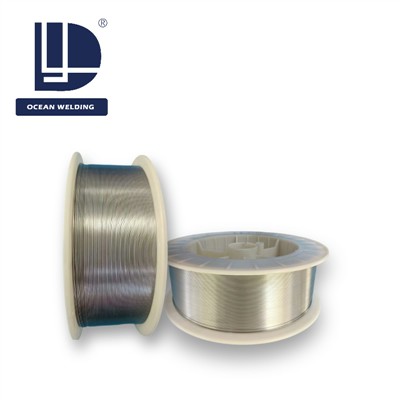
II. Requirements for the Use of Self-Shielded Flux-Cored Wire
1. Welding Power Supply
Use a dedicated DC power supply and inverter power supply.
2. Use DC positive polarity (DC-): Connect the workpiece to the positive terminal of the power supply and the welding torch to the negative terminal.
Reversed polarity connection easily leads to excessive spatter, shallow penetration, and welding failure.
3. When welding downwards, the welding wire angle should generally be maintained at 80°–90° to avoid molten slag and iron dripping down when close to a vertical position, which can affect the smooth progress of welding operations and easily cause defects such as slag inclusions and porosity.
4. The extension length of self-shielded flux-cored welding wire should generally be controlled at 6–10 times the wire diameter. Excessive extension length will cause the wire to melt too quickly, reducing arc power.
5. The surface to be welded should be uniform and smooth, free from rust, slag, grease, and other harmful substances that affect weld quality.
6. The welding ground wire should be as close as possible to the welding area, and its conductivity should be confirmed to be good (check for oxidation of the ground wire, secure connection, and absence of rust at the contact point between the ground wire and the base metal). Poor conductivity will cause arc instability.
7. The quality of welding parameter adjustment directly affects weld quality.
Insufficient current can easily lead to incomplete penetration and slag inclusions.
Insufficient current can easily cause burn-through, increased spatter, and, during downward welding, cause molten slag and metal to flow downwards, making welding impossible and increasing the likelihood of porosity.
Insufficient voltage can easily cause an unstable arc, failure to open the set wire and molten pool, and slag inclusions.
Insufficient voltage can easily cause the arc to be too far from the molten pool, allowing air to be entrained and resulting in porosity.


