


ONE. Preparation before welding
1. According to the strength grade of the structural steel to be welded, select the same strength grade grade and suitable electrode diameter for various joint forms.
2. When the construction environment temperature is lower than 0℃, or the carbon equivalent of the steel is greater than 0.41% and the structural rigidity is too large, and the components are thick, pre-welding measures should be adopted. The preheating temperature is 80℃~100℃, and the preheating range 5 times the thickness of the plate, but not less than 100mm.
3. When the thickness of the workpiece is greater than 6 mm for butt welding, in order to ensure the penetration strength, a V-shaped or X-shaped groove is cut at the butt edge of the plate, the groove angle α is 60°, the blunt edge p=0~1 mm, and the assembly Gap b = 0~1 mm, as shown in Figure 1. When the plate thickness difference is greater than or equal to 4 mm, the butt edge of the thicker plate shall be beveled, as shown in Figure 2.
4. Welding rod baking: Acid-coated electrodes should be baked at 150°C × 2 for 2 hours before welding; alkaline-coated electrodes must be baked at 300-350°C × 2 before welding, and kept for 2 hours before use.
5. The cleaning of the joint before welding requires that the burrs, oil stains, water, rust and other dirt and oxide scales that affect the quality of the weld within 30 mm of the groove or both sides of the weld must be removed.
6. If the margin at both ends of the plate seam is less than 50 mm, arc striking and arc extinguishing plates should be added at both ends before welding, and the size should not be less than 50 × 50 mm.
TWO. Selection of welding materials
1. First of all, consider the matching of the strength grade of the base metal with the grade of the electrode and the use characteristics of the electrode with different coating types.
2. Considering the working conditions of the object, if it is subjected to dynamic load, high stress or complex shape, and the rigidity is large, the low hydrogen type electrode with crack resistance and impact toughness should be selected.
3. Under the premise of meeting the performance and operating performance, iron powder electrodes with large specifications and high efficiency should be appropriately selected to improve welding production efficiency.
THREE. Welding Specifications
1. The diameter of the electrode should be selected according to the thickness of the plate, and the welding current should be determined, as shown in the table.
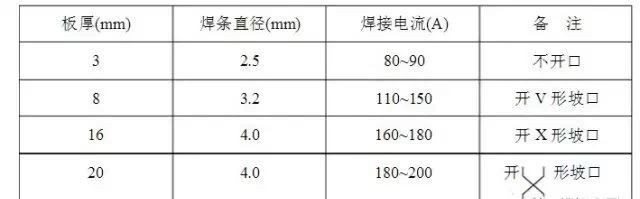
The current is for flat welding position welding, and the welding current should be reduced by 10-15% during vertical, horizontal and overhead welding; φ3.2 mm electrode should be selected for the bottom layer of 16 mm thick welding, and the welding current of fillet welding should be slightly larger than that of butt welding.
2. In order to penetrate the butt weld, the diameter of the electrode for the bottom welding should be smaller than that of the welding of other layers.
3. For the welding of thick parts, the temperature between layers should be strictly controlled, and the welding seam of each layer should not be too wide, and multiple multi-layer welding should be considered.
4. The front side of the butt weld is welded thick, the back side uses carbon gouging groove, and the back cover is welded.
FOUR. Welding procedure
1. Welded plate seam: There are vertical and horizontal cross welds, the end seams should be welded first and then the edge seams should be welded.
2. When the welding seam is long, the central symmetrical welding method or the gradual de-welding method should be used.
3. When the butt weld and the fillet weld exist at the same time in the structure: the butt weld of the plate should be welded first, then the butt weld of the welding object frame, and finally the fillet weld of the welding object frame and the plate.
4. All symmetrical objects: welding should be started from the center to the head and tail direction, and the welding should be carried out symmetrically in the left and right directions.
5. When the flat and vertical fillet welds exist on the component at the same time: the vertical fillet welding should be welded first, then the flat fillet welding should be welded, and the short welds should be welded first and then the long welds should be welded.
6. All hoisting "horses" use low-hydrogen welding rods. After welding, slag must be smashed in time. Carefully check the size requirements of the welding feet and the surrounding welding seam corners.
7. If the welding seam quality of the parts is not good, the parts should be reworked and qualified, and should not be left in the overall installation and welding.
FIVE. Operation points
1. When welding important structures, low-hydrogen electrodes must be dried at 300-350°C for 2 hours, and used for no more than 4 hours at a time, and should be placed in a heat preservation cylinder. Other electrodes should also be stored in the electrode box for safekeeping.
2. Debug the welding current and select the polarity according to the diameter and type of the electrode, welding position, etc.
3. Under the premise of ensuring that the joint does not burst, the root bead should be as thin as possible.
4. During multi-layer welding, the coating and spatter of the upper welding seam should be cleaned before the next layer welding starts, and the thickness of each layer of the multi-layer welding should not exceed 3-4mm.
5. When the workpiece has preheating requirements before welding, multi-layer multi-pass welding should be completed continuously as much as possible to ensure that the temperature between layers is not lower than the minimum preheating temperature.
6. The arc-starting joints of multi-layer welding should be staggered by 30-40mm, and arc-starting and arc-extinguishing are not allowed within 50mm of the intersection of the "T" and "-" seams.
7. The low hydrogen type electrode should be welded by short arc welding, and the reverse polarity connection method of the DC power supply should be selected.
SIX. Weld quality requirements
1. The butt welds of important structures shall undergo a certain number of internal inspections of X-ray or ultrasonic welds according to various design technical requirements, and shall be evaluated according to the design level.
2. External weld inspection: All structural welds are inspected, and the external quality requirements of the welds:
①Weld straightness: The straightness of any part within ≤100mm should be ≤2mm.
②The welding seam transition is smooth: the transition angle of <90° cannot be abruptly changed.
③Weld height difference: when the length is 25mm, the height difference should be ≤1.5mm.
④Tolerance of K value of fillet weld: when the thickness of the component is ≤1.5mm, 0.9K0≤K≤K0+1;
When the thickness of the component is ≤4mm, 0.9K0≤K≤K0+2 (K0 is the design foot size)
⑤Weld undercut: when the plate thickness is ≤6mm, d≤0.3mm, local d≤0.5mm;
When the plate thickness is >6mm, d≤0.3mm, local d≤0.5mm (d is the undercut depth)
⑥ The weld is not allowed to be lower than the surface of the workpiece and cracks, and the lack of fusion is the existence of defects.
⑦ The concave depth at the intersection of the stacking surface of the multi-pass weld shall be ≤1mm.
⑧ All welding defects are allowed to be repaired, and they should be polished and smoothed after repairing.
⑨ When the structural material of the component is cast steel, it must be annealed at 550℃ after welding to relieve stress.
3. Welded components allow pyrotechnic correction.


