


The role of protective gas
In laser welding, shielding gas will affect the weld formation, weld quality, weld penetration and penetration width. In most cases, blowing shielding gas will have a positive effect on the weld, but it may also bring adverse effect.
Positive effects
1) Correctly blowing shielding gas will effectively protect the weld pool from reducing or even avoiding oxidation;
2) Correctly blowing in the shielding gas can effectively reduce the spatter generated during the welding process;
3) The correct blowing of the protective gas can promote the uniform spreading of the weld pool when it solidifies, so that the weld is formed uniformly and beautifully;
4) Correctly blowing in the protective gas can effectively reduce the shielding effect of the metal vapor plume or plasma cloud on the laser, and increase the effective utilization of the laser;
5) Properly blowing shielding gas can effectively reduce weld pores.
As long as the gas type, gas flow rate and blowing method are selected correctly, the ideal effect can be obtained.

However, improper use of shielding gas can also have adverse effects on welding.
The adverse effects are as follows:
1) Improper blowing of shielding gas may lead to poor welds:
2) Selecting the wrong type of gas may cause cracks in the weld and may also reduce the mechanical properties of the weld;
3) Choosing the wrong gas blowing flow rate may lead to more serious oxidation of the weld (whether the flow rate is too large or too small), or it may also cause the weld pool metal to be seriously disturbed by external forces, causing the weld to collapse or form unevenly;
4) Choosing the wrong gas blowing method will cause the weld to have no protective effect or even no protective effect or have a negative impact on the weld formation;
5) Blowing into the shielding gas will have a certain effect on the penetration depth of the weld, especially when welding thin plates, it will reduce the penetration depth of the weld.
Type of protective gas
Commonly used laser welding shielding gases are mainly N2, Ar, He, and their physical and chemical properties are different, so the effect on the weld is also different.
1 Nitrogen N2
The ionization energy of N2 is moderate, higher than that of Ar, and lower than that of He. Under the action of laser, the ionization degree is average, which can better reduce the formation of plasma cloud, thereby increasing the effective utilization of laser. Nitrogen can chemically react with aluminum alloy and carbon steel at a certain temperature to produce nitrides, which will increase the brittleness of the weld. WeChat public account: Welder, the toughness will decrease, which will have a greater adverse effect on the mechanical properties of the weld joint. , so it is not recommended to use nitrogen to protect aluminum alloy and carbon steel welds.
The nitride produced by the chemical reaction between nitrogen and stainless steel can improve the strength of the weld joint, which will help improve the mechanical properties of the weld, so nitrogen can be used as a protective gas when welding stainless steel.
2 Argon Argon
The ionization energy of Ar is relatively low, and the degree of ionization under the action of the laser is relatively high, which is not conducive to controlling the formation of plasma clouds, and will have a certain impact on the effective utilization of the laser. However, the activity of Ar is very low, and it is difficult to chemically react with common metals. reaction, and the cost of Ar is not high. In addition, the density of Ar is large, which is conducive to sinking to the top of the weld pool, which can better protect the weld pool, so it can be used as a conventional shielding gas.
3 Helium He
He has the highest ionization energy, and the ionization degree is very low under the action of the laser, which can well control the formation of the plasma cloud. The laser can act on the metal very well. It chemically reacts with metals and is a good weld shielding gas, but the cost of He is too high. Generally, this gas is not used in mass-produced products. He is generally used for scientific research or products with very high added value.
Shielding gas blowing method
At present, there are two main ways to blow the protective gas: one is to blow the protective gas on the paraxial side, as shown in Figure 1; the other is the coaxial protective gas, as shown in Figure 2.

Figure 1
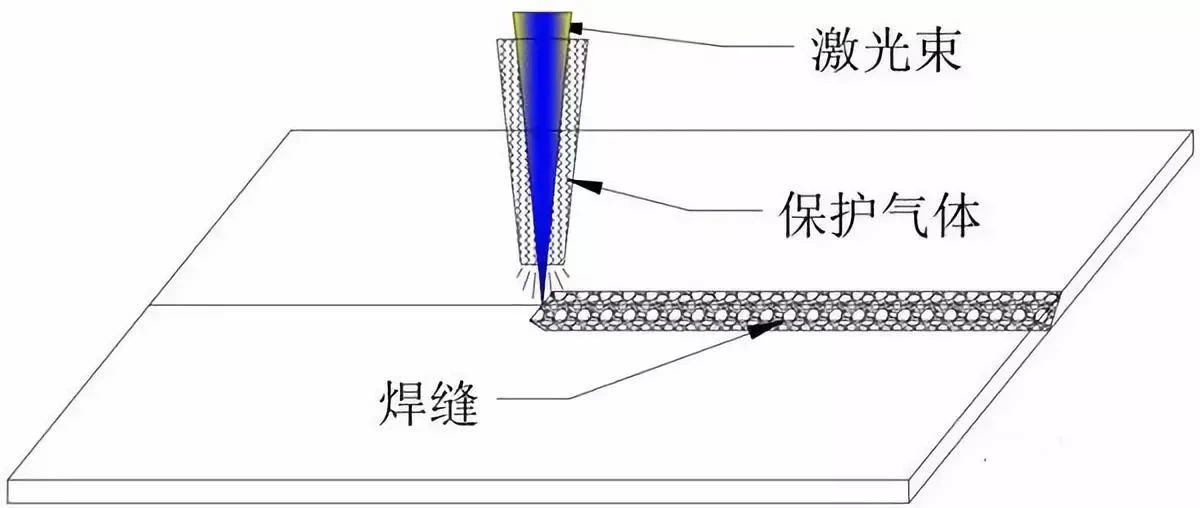
Figure 2
How to choose the two blowing methods is a comprehensive consideration. Generally, it is recommended to use the side blowing protective gas method.
Selection principle of protective gas blowing method
First of all, it needs to be clear that the so-called "oxidation" of the weld is only a common name. In theory, it means that the weld is chemically reacted with harmful components in the air, resulting in the deterioration of the quality of the weld. It is common that the weld metal is at a certain temperature. Reacts chemically with oxygen, nitrogen, hydrogen, etc. in the air.
Preventing the weld from being "oxidized" is to reduce or prevent such harmful components from coming into contact with the weld metal at high temperatures, not just the molten pool metal, but from the time the weld metal is melted until the The pool metal solidifies and its temperature drops below a certain temperature over the course of the period.
Example
For example, titanium alloy welding can quickly absorb hydrogen when the temperature is above 300 °C, oxygen can be quickly absorbed when the temperature is above 450 °C, and nitrogen can be quickly absorbed when it is above 600 °C, so the titanium alloy weld is solidified and the temperature is reduced to 300 °C The following stages need to be effectively protected, otherwise they will be "oxidized".
It is not difficult to understand from the above description that the blown shielding gas not only needs to protect the weld pool in a timely manner, but also needs to protect the area that has just solidified that has been welded. Therefore, the side shaft side shown in Figure 1 is generally used. Blow the shielding gas, because the protection range of this method is wider than that of the coaxial protection method in Figure 2, especially the area where the weld has just solidified has better protection.
For engineering applications, not all products can use the side shaft side blowing shielding gas. For some specific products, only coaxial shielding gas can be used, which needs to be carried out from the product structure and joint form. Targeted selection.
Selection of specific protective gas blowing methods
1 Straight weld
As shown in Figure 3, the shape of the welding seam of the product is a straight line, and the joint form is a butt joint, a lap joint, an internal corner corner seam joint or a lap welded joint. It is better to blow protective gas on the shaft side.
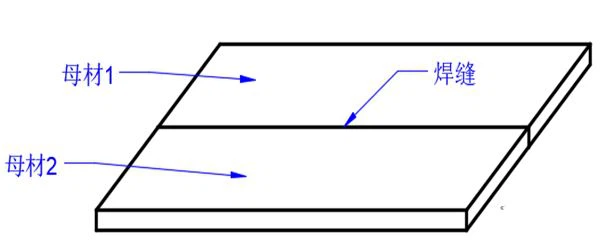

Figure3
2 Plane closed graphic welds
As shown in Figure 4, the shape of the welding seam of the product is a closed shape such as a plane circle, a plane polygon, and a plane multi-segment line. It is better to use the coaxial shielding gas method shown in Figure 2.


Figure 4 Plane closed figure shape weld
The selection of shielding gas directly affects the quality, efficiency and cost of welding production. However, due to the diversity of welding materials, the selection of welding gas is also relatively complicated in the actual welding process. It is necessary to comprehensively consider welding materials, welding methods, and welding positions. As well as the required welding effect, only through the welding test can a more suitable welding gas be selected to achieve better welding results.


