


1. The Selection Of Copper
Copper pipe is an important raw material for refrigeration equipment, mainly used for making heat exchangers and connecting pipes and fittings. Refrigeration pipe fittings are mostly made of copper (purple) pipes, and the commonly used types of solder are copper-phosphorus solder, silver-copper solder, copper-zinc solder, etc. When welding, according to the characteristics of the pipe material, the correct choice of solder and skilled operation to ensure the quality of the welding.
Copper to copper soldering: Phosphor copper solder or phosphor copper solder with low silver content, such as 2% or 5% silver-based solder, can be used. This solder is relatively inexpensive, has a good solution, uses a caulking and wetting process, and does not require flux.

Welding of copper and iron: Phosphor copper solder or brass bar solder can be used, but the corresponding flux, such as borax, boric acid or a mixed flux of boric acid, can also be used.
2. Welding Operation
Use sandpaper to remove grease, oxides, smudges and dust from the surface of the copper pipe inserted into the joint part. The copper pipe is inserted into the welded part. Pipeline welding requires that the length of the neutral flame is generally 20-30cm. When the gas output is greater than the oxygen output, a carbonized flame that is not suitable for welding will be generated. Use a welding torch to heat the copper pipe interface.
Then heat the welded pipe evenly until the welding port is dark red, put in the welding rod and make the molten welding rod wrap around the welding port for more than 0.8cm to remove the welding rod, and stop heating when the brazing filler metal is completely melted.

After a few minutes between the end of soldering, wipe the connection part with a damp cloth. This can not only stabilize the welded part, but also remove the slag on the welding surface to prevent corrosion. Normal welds after welding should be free of pores, cracks and lack of fusion.

3. Analysis Of Common Defects In Welding
1). Weld Bulb
Welding characteristics: The solder flows out of the brazing seam and forms an accumulation.

Formation reason:
A. The thermal efficiency of welding is too large;
B. The amount of solder applied is too much or the application method is improper;
C. The welds are not on the same level during welding;
Precaution:
A. Swing the welding torch back and forth during heating to prevent local overheating;
B. To add solder, slide along the weld from the back of the heating position;
C. The welding parts are positioned stably.
2). Undercut
Features: The edge of the weld was burned into a rotten shape by the flame, but it was not completely burned through, and the pipe wall itself was burned.
Formation reason:
A. The thermal efficiency of welding is too large
B. The heating method is wrong.

Precaution:
A. Use flame as neutral welding.
B. The flame swings the welding torch back and forth to avoid concentrated heating.
3). Overburning or corrosion
Features: The oxide on the surface of the joint naturally falls off in large chunks after welding. After the joint is wiped clean, there are black pits inlaid on the surface of the joint.

Formation reason:
A. The thermal efficiency of welding is too high (the temperature is too high);
B. The welding time is too long.
C. Use oxidizing flame welding.
D. Repeated welding (repair welding)
Precaution:
A. Neutral flame welding;
B. Do not repeat welding.
4). Trachoma
Characteristics: The weld has impurities, resulting in deep holes in the weld surface.
Formation reason:
A. The solder or base metal itself has oil stains, impurities or oxide film.
B. The temperature of the weld is too high, causing the phosphorus in the solder to volatilize.
C. The heating speed is too fast.

Precaution:
A. Ensure the cleanliness of solder and base metal;
B. The welding efficiency is appropriate, so that the gas that dissolves the high temperature molten pool can be effectively discharged when the weld solidifies
5). Stomata
Features: Insufficient heating time, the gas in the liquid seam metal fails to fully escape, and holes are formed on the surface or inside.
Formation reason:
A. The fiber material or base material itself is oily or oxidized;
B. The welding speed is too fast, and the gas in the welding is effectively discharged;
C. The flame is a reducing flame, producing reducing hydrogen holes;

Precaution:
A. Ensure the cleanliness of the base material fiber;
B. Select neutral flame welding with moderate speed.
6). Burn through
Features: The weldment is burnt and penetrated near the seam
Formation reason:
A. Unskilled operation, not swinging the welding torch;
B. Improper flame adjustment and uneven temperature control;

Precaution:
A. Swing the welding torch back and forth during welding to prevent overheating;
B. Select neutral flame connection.
7). Cracks
Features: cracks in brazed joints include base metal cracks and brazing cracks. The mechanical properties of the base metal and the brazing seam decrease, and cracks occur under the action of residual stress.
Formation reason:
A. The phosphorus content of the solder is too high, and the toughness of the material is weakened;
B. The copper cold shrinkage rate is obvious, and the residual thermal stress causes cracks;

Precaution:
A. Use electrodes with better connection performance;
B. Tempering treatment eliminates residual stress.
8). Weld leakage
Features: The weld is incomplete, some positions are not completely fused into the whole weld, and there is a leak channel in the weld.
A. Formation reason:he heat input of flame brazing welding is too small;
B. The temperature is not uniform when the solder is applied;
C. There are impurities such as oxide skin and oil stains on the surface of the weld.
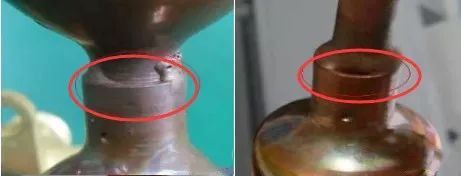
Precaution:
A. Uniform heating;
B. Heat the workpiece with flame and add it when the workpiece is dark red.
9). Preventive measures
Welding:
A. During the process of brazing and heating, the welding torch swings back and forth at the part that needs to be heated, and no fixed-point heating is allowed;
B. When adding solder, solder must be added from the back of the flame heating direction;
C. When welding, the nozzle should not be too close to the workpiece, otherwise it will be easy to temper;
D. When brazing red copper, generally preheat the insertion tube first to make the tube fit tightly, and then centrally heat the outer piping.
Welding completed:
The ratio of thermal expansion and contraction between the mating workpieces is different. During the welding process, internal stress is generated between the mating workpieces. After welding, tempering is required to eliminate the internal stress between the welding workpieces.
Tempering operation method:
After the workpiece is welded, when the temperature drops to 200℃~300℃, temper the welding edge within 30mm. When tempering, use the external flame to quickly sweep the welding torch back and forth at the joint, and do not heat at a fixed point. Each workpiece continues ( 3-5) seconds or so


