


Blockade and control aggravate port congestion! The shipping company announced to jump to port and adjust the sailing schedule! Summaries of stop sailing and port hopping
The port of Shanghai has been congested since early March. However, since the 28th, the whole city of Shanghai will conduct large-scale screening in batches, and it is expected that the congestion of the world's busiest container port will increase.
Shanghai International Port Group said in a statement that it will maintain 24-hour operations except in extreme weather. While the port of Shanghai will remain open throughout the lockdown, transportation to and from the airport and container terminal will be severely restricted given that roads, bridges and tunnels between the Pudong and Puxi areas have been blocked for at least a week.
Linerlytica analyst Tan Hua Joo said the lockdown could exacerbate port congestion. "Exports will be restricted as factory productivity is affected while ports remain open. Port operations are expected to increase due to manpower shortages, based on what was observed during the Shenzhen lockdown."
It is understood that the US electric car maker Tesla has stopped production at its Shanghai factory during the lockdown. Taiwan's "United Daily News" said that due to the lockdown measures, Taiwanese electronics factories in Kunshan, Jiangsu Province, are also facing delays in shipping products to Shanghai for export. However, April 3-5 is the three-day Qingming Festival holiday, which coincides with the end of the lockdown period in Shanghai, complicating the situation.

The worsening port congestion last week affected more than 14% of total container ship capacity for the first time, with further increases expected due to the lockdown in Shanghai, according to Linerlytica.
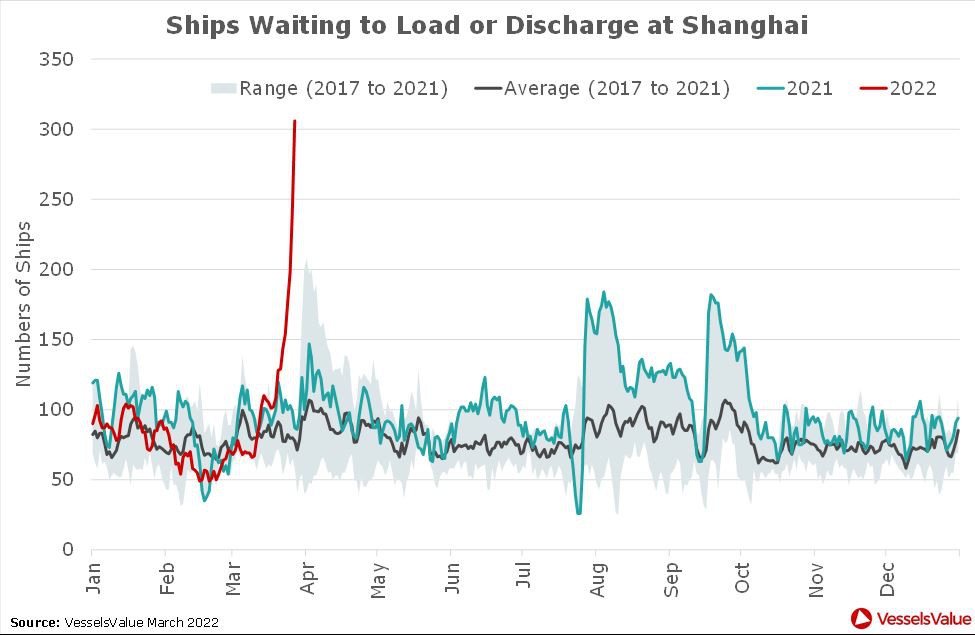
The number of ships waiting to be loaded or unloaded in Shanghai has increased nearly fivefold in the past two and a half weeks, according to VesselsValue.

As shown in the chart above, congestion in Shanghai typically worsens at this time of year. However, the recent increase was much higher than last year and normal seasonal levels. By ship type, the surge in congestion was driven by dry bulk carriers, followed by oil tankers, as shown in the chart below. On the contrary, the number of container ships in queue decreased by 6 compared to March 9.
It is unclear what impact the lockdown in Shanghai will have on the port's fleet, whether it will exacerbate or clear the backlog. However, supply chain managers and analysts around the world need to start planning for knock-on effects.
Thomas Gronen, head of Greater China at Fibs Logistics, said it was "almost impossible" for cargo to enter Shanghai Pudong Airport (PVG), Yangshan and Waigaoqiao container ports and any surrounding warehouses. "For sea freight shipments in the next 9 days, we recommend customers to choose Ningbo Port, especially for LCL shipments that need to pass through CFS."
On March 28th and 29th, the shipping company ONE announced that the AX1 route CAUTIN 2215E and the AX2 route SEASPAN BRAVO 2213E will cancel the call to Shanghai. At the same time, many routes have adjusted their sailing schedules, opening late and closing late.
According to the latest data released by Drewry on the 25th, in the next 4 weeks (weeks 13-16), the world's three major shipping alliances have successively cancelled 36 voyages. 7 voyages; the fewest Ocean Alliance cancelled 6 voyages.

Of a total of 576 scheduled sailings on major routes such as the transpacific, transatlantic, Asia-Nordic and Asia-Mediterranean, 48 sailings were cancelled between weeks 13 and 16, a cancellation rate of 8%. During this period, 75% of blank sailings will occur on the trans-Pacific eastbound trade lanes, primarily the West Coast.

Drewry said congestion at Nordic ports was rising again - exacerbated by the buildup of Russian cargo with nowhere to go, causing ocean carriers to adjust their schedules. These sudden disruptions have caused considerable confusion and delays for shippers, BCOs and forwarders in Europe.


